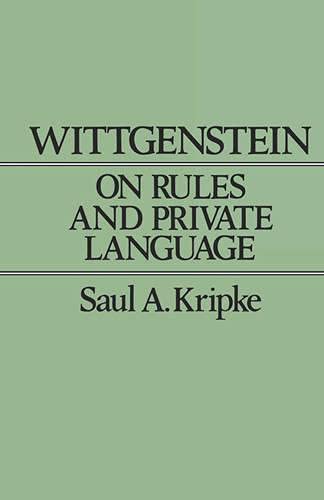
Ebook Info
- Published: 1982
- Number of pages: 160 pages
- Format: PDF
- File Size: 8.28 MB
- Authors: Saul A. Kripke
Description
In this book Saul Kripke brings his powerful philosophic intelligence to bear on Wittgenstein’s analysis of the notion of following a rule.
User’s Reviews
Editorial Reviews: Review “Kripke’s interpretation, and his arguments, deserve―and will repay―extremely careful attention.”―Philosophical Books“Saul Kripke has thought uncommonly hard about the central argument of Wittgenstein’s Philosophical Investigations and produced an uncommonly clear and vivid account of that argument…set out with all the clarity, incisiveness and economy that one expects of its author.”―Times Literary Supplement About the Author Saul A. Kripke is Distinguished Professor of Philosophy at The Graduate Center, City University of New York.
Reviews from Amazon users which were colected at the time this book was published on the website:
⭐A great addition to the modern philosophical literature. Clear exposition of W’s paradox about rule following, epistemology, psychology. If you’re thinking about buying this, you probably already know this is heady, but subtle stuff and difficult to assimilate to a comfort level at which you can actually “use” the concepts without getting really tripped up. I’ve probably read five or six other commentaries or exegeses of the Philosophical Investigations, each of which added a little. In light of the difficulty of the material I especially liked Kripke’s occasional comments to the effect that he’s not sure he’s got it quite right, or that he’s repeating himself in a little different way just because he’s not totally sure he understands it, which is probably what most normal people experience with this amazing branch of philosophy. A little modesty goes a long way. I would suggest some companion pieces for the non-genius level reader that aim at similar points, namely, Ryle’s Concept of MInd and Strawson’s Individuals and especially the essay Persons. Oddly enough, since the work borders on psychology, another great approach to these matters is Schafer’s “A New Language for Psychoanalysis” in which the metapsychological problems with “ordinary” concepts like “self” and the like are raked over until they are clear. None of this is advanced philosophy but it’s well beyond most psychology. I don’t know ANYTHING about Kripke otherwise, but this is real nice little book.
⭐Originally published in 1982, Saul Kripke’s Rules and Private Language has become a classic in contemporary analytic philosophy and probably the most notable (if contentious) analysis of Wittgenstein’s later work.As noted by Kripke himself, the work is more an elaboration of Kripke’s thoughts in reaction to the Philosophical Investigations, than a truly dedicated attempt to uncover Wittgenstein’s perspective. In large part as a result of this bold approach, Kripke comments have become both extremely well known and controversial. Readers unfamiliar (or rusty) with Kripke may find the pertinent chapters in Scott Soames’ excellent Philosophical Analysis in the Twentieth Century, Volume 2: The Age of Meaning helpful in preparing for this text.Overall, I recommend this book to readers of analytic philosophy – it is a relatively quick and enjoyable read. Familiarity with the Philosophical Investigations, however, is likely a prerequisite to understanding and appreciating this text.
⭐Great classic
⭐Intro/Background:Kripke opens up this work with something important to say: This book is the culmination of his first reading of Wittgenstein’s P.I. and how “it struck to me”. Therefore, Kripke doesn’t hold any of these views anymore.Summary:In this book he acts like an attorney in a court room defending a possible interpretation of the “Wittgensteinian paradox”. The paradox, briefly summed up, is the question of whether a past rule determines future usage in a new (set of) problem(s). Another sub-problem is whether the result of a function was the intention of the person who commands/uses the function.The first essay deals with answering the constant questioning by a sceptic that Kripke thinks up. The essay goes down all sorts of various and different pathways. (Kripke takes and examines the “dispositional theory” of intention for example.)Kripke ends somewhere in the second essay with claiming something like: A private language or privately followed rule (in a new way) cannot be followed individually because it has to be agreed upon in the community. Some of Kripke’s argument against private language resides in ressurectioning David Hume’s argument against a private causation.The argument against individual intention contra another’s intention rest on the resonance with the community again. If one person follows one rule, and another person follows some other rule, and if the answers differ, then the correct answer to problem will be the one that is agreed upon. (Kripke doesn’t take up the argument against people that are following different rules but arrive at the same answer.)That completes the first two essays. The postscript is interesting but tackles a different issue: The certainty of other minds being like ours. Again, Kripke examines the ‘other minds’ problem from Kripke’s perceived view of Wittgenstein. The postscript is very short and doesn’t come to any earth-shattering conclusions but is nevertheless a great thought exercise.Conclusion/Personal Reaction:Loved the book. It is a very unfavorable reading of Wittgenstein’s “Philosophical Investigations”, but in some ways it is the best book on that work. It is incredibly thoughtful and raises important concerns for epistemology and the philosophy of mind.I advise you to have the Wittgenstein’s “P.I.” next to you because often Kripke cites propositions that he doesn’t quote.Simply put, a must for any fan of Kripke’s meager alotment of written work and a must for any fan of Wittgenstein.
⭐Like all of Kripke’s work, this book makes a wildly original contribution to the subject, and like all of his work, it is pure pleasure to read. Kripke’s writing is the perfect mixture of lucidity and profundity. In the book, Kripke interprets the central theme of Wittgenstein’s work as an examination of what it means to follow a rule, and Kripke explores this train of thought and examines the consequences. This leads to a new form of skepticism, of which Wittgenstein’s private language argument is a consequence.Although Kripke’s interpretation seems to have fallen out of favor in many circles, this book is still a classic. Regardless of whether you agree with Kripke’s conclusions, this book will make you think deeply.
⭐Kripke’s genius is in re-integrating the infamous private language argument into Wittgenstein’s broader concerns with rule following in language and mathematics. Whether or not Kripke’s interpretation of the rule following paradox (or his proposed Humean ‘skeptical solution’) is one that Wittgenstein would have endorsed is not a question I found troubling me much; the work stands on its own merits irrespective of the answer.
⭐Excellent product and service thank you
⭐数あるウィトゲンシュタインの「研究書」のなかでも、「明らかな誤り」と決めつけられている珍しい本。そもそも、ウィトゲンシュタインの『哲学探求』全体を貫く一般的な問題なるもの(本書によれば、それは「規則」の問題)を想定すること自体、あまりウィトゲンシュタインの精神に即しているとはいえないでしょう。そんな事情もあって、本書はウィトゲンシュタイン研究とは独立にその価値を問われるべきものである、といった評価が一般的になっています。 しかし、この本を『探求』に照らしてみて、どこが間違っているのかを自分なりに検討してみるだけでも、かなりの勉強になることは明らかです。それに、「規則に従う」という問題に『探求』を理解する糸口を見出すこと自体は、それほど害のあることではないと思います(それが『探求』のすべてだ!と主張しないかぎりは)。 本書の議論がよく整理された、明晰なものであることは誰も疑わないでしょう。しかも、大した予備知識もなく理解できることも考えれば、本書は『探求』への格好の「入門書」とすらいえるのではないでしょうか。この「入門書」は明白な間違いかも知れませんが、どこがどう間違っているのかということを「自分で考えてみる」という作業もまた、『探求』の読者には有益だと思います。「自分で考える」ことをわれわれに要求すること、この点にこそ、本書の『探求』への入門書としての価値があるのではないでしょうか。
⭐
Keywords
Free Download Wittgenstein on Rules and Private Language: An Elementary Exposition in PDF format
Wittgenstein on Rules and Private Language: An Elementary Exposition PDF Free Download
Download Wittgenstein on Rules and Private Language: An Elementary Exposition 1982 PDF Free
Wittgenstein on Rules and Private Language: An Elementary Exposition 1982 PDF Free Download
Download Wittgenstein on Rules and Private Language: An Elementary Exposition PDF
Free Download Ebook Wittgenstein on Rules and Private Language: An Elementary Exposition