Ebook Info
- Published: 2011
- Number of pages: 403 pages
- Format: PDF
- File Size: 2.02 MB
- Authors: Saul A. Kripke
Description
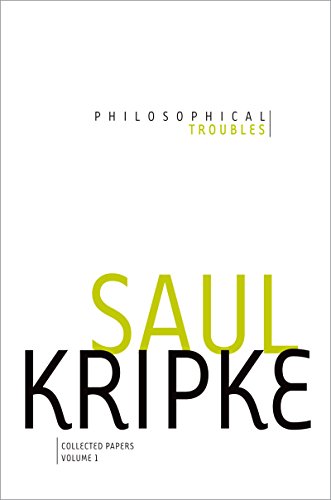
This important new book is the first of a series of volumes collecting the essential articles by the eminent and highly influential philosopher Saul A. Kripke. It presents a mixture of published and unpublished articles from various stages of Kripke’s storied career.Included here are seminal and much discussed pieces such as “Identity and Necessity”, “Outline of a Theory of Truth”, “Speaker’s Reference and Semantic Reference”, and “A Puzzle About Belief.” More recent published articles include “Russell’s Notion of Scope” and “Frege’s Theory of Sense and Reference” among others. Several articles are published here for the first time, including both older works (“Two Paradoxes of Knowledge”, “Vacuous Names and Fictional Entities”, “Nozick on Knowledge”) as well as newer (“The First Person” and “Unrestricted Exportation”). “A Puzzle on Time and Thought” was written expressly for this volume.Publication of this volume — which ranges over epistemology, linguistics, pragmatics, philosophy of language, history of analytic philosophy, theory of truth, and metaphysics — represents a major event in contemporary analytic philosophy. It will be of great interest to the many who are interested in the work of one its greatest living figures.
User’s Reviews
Reviews from Amazon users which were colected at the time this book was published on the website:
⭐I’m a Continental philosophy author, but for my 10th (and likely final) book I dedicate the first half to a survey of leading Analytic thinkers. Though I still fail toes how their approach yields much to our insight into language, I have come to respect their seriousness and rigor. “Naming and Necessity” provides a better introduction to Kripke’s thought. This collection of papers is more technical, and addresses issues within the history of Analytic philosophy.
⭐If you are interested in reading “Outline of a theory of truth”, please be warned that the Kindle version of this chapter is terrible. It is riddled with horrendous typos and terrible typesetting of the mathematical symbols. On the plus side, the lousy typesetting can keep you guessing and provide additional entertainment.
⭐This is the real deal from a top notch thinker. Does it matter if I disagree with particular positions? – just following his thoughts is a pleasure & an education. I’m so glad this collection has finally been published.
⭐In a review of
⭐, I pointed out that I read the book through interlibrary loan and so my review does not have the much sought after “amazon verified purchase”. Nonetheless, I thought a more in-depth review for a book of such importance was in order.Simply put, nearly every paper in this collection either changed the field with which it was concerned (philosophy of language, truth, etc.) in dramatic ways or provides a wildly important contribution to the topic (for those papers that are new). In the book, it is noted that Kripke’s papers tend to revolve around puzzles and paradoxes. Namely, two seemingly contradictory truths and how to resolve them. I suppose one could say that all of philosophy is an attempt to straighten out paradoxes. Since this book is merely a collection of various essays, a brief overview of each one will be provided and then some summary thoughts will conclude the review.”Identity and Necessity” is a precursor of sorts for Kripke’s famous book Naming and Necessity. Thus, this article is essentially Naming and Necessity in brief and so it will either re-stimulate one’s thinking on the matter or allow one to see how Kripke has changed his views over the years. Both are probably important in pursuing when reading this essay.The second chapter is entitled “On Two Paradoxes of Knowledge”. Here Kripke discusses the infamous surprise exam (or, surprise execution) paradox and how he thinks it falters. This is one of the more technical essays in the piece, but even an interested layman (as I am) can follow it with a bit of work.Third, Kripke’s “Vacuous Names and Fictional Entities” is another essay which acts as a book in brief. Namely, this essay discusses some of the material in Kripke’s Reference and Existence. Again, the treatment in this essay is obviously less all encompassing than his book on the topic, but it is still a stimulating read and worth perusing, if nothing else.Kripke’s “Outline of a Theory of Truth” is by far the most difficult essay in this book in my mind. For about three-quarters of the book, even a non-philosopher can follow the discussion quite well. However, at a certain point one hits a wall wherein Kripke starts talking about the matter of a truth on a complex level not because he wants to show off or because he is a poor communicator, but because truth is such a complex matter! However, the parts that one can read and understand are really interesting and very stimulating. A prime interest of Kripke in this essay is the well known liar paradox.”Speaker’s Reference and Semantic Reference” was hugely important when it was first published and it remains important to this day. To those up to date on reading philosophy of language, undoubtedly this essay has either been read or been influential in something they have read. However, to those who are trying to play catch up or are picking up what they can, this essay remains extremely influential in giving prime examples of where speaker’s reference and semantic reference converge and depart.The sixth chapter was thoroughly enjoyable because, while the essay discusses some hugely important topics, I found that it read much like a mystery novel of sorts. There are all of these clues lying around and it seems like the answer is just on the tip of one’s tongue, but as more and more is unveiled, the culprit becomes more and more mysterious. However, Kripke is much too intelligent to write a bland run-of-the-mill mystery novel and so he leaves his story without a final chapter in order that the reader might think more deeply about the topic and come to one’s own conclusions.In all honesty, I found “Nozick on Knowledge” a bit out of place and unnecessarily long. However, anyone with an interest in epistemology and specifically counterfactual conditional warrant will want to soak up everything that Kripke says in this essay. Indeed, Kripke has thrown down the gauntlet that counterfactual conditional warrant proponents must meet. That is not exactly an easy task.”Russell’s Notion of Scope” was interesting because Kripke actually finds something of merit in Russell’s philosophy of language (unlike much of what he has written). As is obvious from the title, this essay is part historical and part reflection in that Kripke tries to discuss Russell’s notion of scope while also keeping an eye on whether Russell is correct or not.Like the previous essay, “Frege’s Theory of Sense and Reference: Some Exegetical Notes” is part historical and part reflection. Although I was not a huge fan of this particular essay, it meshes quite well with the other essays and thus serves a fine place in this volume.”The First Person” investigates the use of the pronoun “I”. While I would not say Kripke provides any revolutionary discussion on the matter, his views and reasoning behind those views are always worth reading and so one should look forward to this chapter. Personally, I wish Kripke would have written (originally, spoken) more of his own thoughts on the matter and not interacted with the secondary literature as much. However, that is the nature of philosophy sometimes.”Unrestricted Exportation and Some Morals for the Philosophy of Language” was extremely delectable because it provided a jumping off point for the convergence of philosophy of language and metaphysics that I had not thought of before. Kripke discusses the infamous de dicto and de re distinction and whether de re beliefs/properties should be kept or are merely baggage from a bygone age. Kripke thus weighs in on a much debated topic and provides useful insight along the way.”Presupposition and Anaphora: Remarks on the Formulation of the Projection Problem” was a mere 12 page essay wherein Kripke discusses a much neglected topic. As Kripke summarizes the problem he is to tackle, “if we have a logically complex sentence whose clauses bear certain presuppositions, how do we compute the presuppositions of the whole?” Kripke argues that the usual answers miss out on a vital part that he thinks sheds light on the problem namely, anaphora.Lastly, Kripke wrote an original essay for this volume entitled “A Puzzle about Time and Thought”. This brief essay again comes back to one of Kripke’s preoccupations: puzzles. He presents one of his own for the reader to think about and work through. I find this is a very fitting ending for the book because since Kripke loves philosophy and philosophy is centered around puzzles (see my earlier remark on paradoxes and philosophy) and he solved a number of puzzles in the preceding essays, it is only fitting that he presents a puzzle of his own so that philosophy may go on.When I read this book, I had no degree in philosophy nor had I even completed a philosophy and/or logic course of any kind. Although I am naturally philosophically inclined, this was, at most, the tenth philosophy book I had read. Nonetheless, these articles were typical Kripke in that they treat complex topics in a very simple manner. It is said that Peter van Inwagen is one of (if not the) clearest writer in philosophy, but I must disagree and give that honor to Kripke. This just shows Kripke’s genius all the more because he knows his topic well enough to communicate it in simple terms. As Einstein said, “you do not really understand something unless you can explain it to your grandmother.” Needless to say, Kripke understands the topics on which he writes like very few (if any) other human beings do.With the above in mind, then, this book is important reading for people as diverse as the world-renowned philosopher to the merely interested layman. Either of those two, and anyone in between, would benefit immensely from reading this book. However, be ready to think about some complex topics because those are exactly the topics about which Kripke is troubled.
⭐Una recolección de artículos algunos ya publicados pero otros inéditos. Esencial para todos los interesados en la obra de Kripke, uno de los filósofos que más han influido en el cambio de rumbo en la filosofía antiesencialista norteamericana.
⭐
Keywords
Free Download Philosophical Troubles: Collected Papers, Volume 1 1st Edition in PDF format
Philosophical Troubles: Collected Papers, Volume 1 1st Edition PDF Free Download
Download Philosophical Troubles: Collected Papers, Volume 1 1st Edition 2011 PDF Free
Philosophical Troubles: Collected Papers, Volume 1 1st Edition 2011 PDF Free Download
Download Philosophical Troubles: Collected Papers, Volume 1 1st Edition PDF
Free Download Ebook Philosophical Troubles: Collected Papers, Volume 1 1st Edition