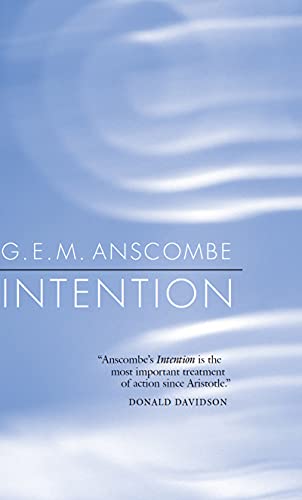
Ebook Info
- Published: 2000
- Number of pages: 106 pages
- Format: PDF
- File Size: 4.35 MB
- Authors: G. E. M. Anscombe
Description
Intention is one of the masterworks of twentieth-century philosophy in English. First published in 1957, it has acquired the status of a modern philosophical classic. The book attempts to show in detail that the natural and widely accepted picture of what we mean by an intention gives rise to insoluble problems and must be abandoned. This is a welcome reprint of a book that continues to grow in importance.
User’s Reviews
Reviews from Amazon users which were colected at the time this book was published on the website:
⭐G. E. M. Anscombe contended that one could not properly engage in ethics (the doing of moral philosophy) if one had not already developed a suitable analysis of the concept of intentions. Intentions underlie and, aparently, underwrite human activity, at least a great deal of it and it is the intention of the human agent that gives itself to moral evaluation. We don’t judge involuntary or reflex or coerced actions in terms of their rightness or wrongness, after all, but retain such judging for those acts which we think about and choose to do for reasons. But the concept of intention is an odd one as Anscombe demonstrates in the first half of this ninety four page monograph. Approaching the issue in terms reminiscent of the later Wittgenstein (her teacher and mentor), Anscombe undertakes a conceptual analysis of how we use the term “intention.” It’s a bit dry and can be rather didactic and abstract as she proceeds to offer examples like what we mean when we ask questions like “why are you X-ing” and after a while one’s eyes can glaze over. I’m fascinated by this stuff but even I found myself nodding off with all the abstract examples she presents. Yet the examples are salient and useful as she unravels the way in which our concept of intention informs our treatment of different kinds of actions and what kind of thing intentions are. They aren’t things at all, she ultimately concludes. The term is, rather, a way we have of describing certain kinds of actions, the kinds that lend themselves to moral evaluation.In the second part of the book she begins to offer the interesting observations that make the book significant, taking us beyond the first level analysis of how we use the relevant terms (like “intention) for certain kinds of human behavior but not others. She draws our attention here to the fact that human action implies subjectness, i.e., an aware, deliberating agent and, from this, she moves to make the important point that the very idea of human action implies the role of desire, wanting or, as she puts it at one point, appetition (the occurrence of felt needs in the organism which motivate the organism to action). Intentions consist of the agent’s direct awareness of its felt needs combined with its awareness of its actions and its beliefs about the world acted upon. We cannot, she notes, settle for an account of moral valuing such as the utilitarians offer which amounts to equating goodness with happiness since happiness is not some particular thing but a general state in which we find ourselves relative to different experiences we have. Thus “happiness” can never equate to the good even if it’s quite obvious that happiness is often, perhaps even mostly, held to be good. Here she begins to get into the area of rationality as an explanation for our claims of goodness, arguing that practical reasoning implies the presence of the appetitive aspect of the reasoner. Arguments for or against particular value choices we make, she contends, come to an end (as Wittgenstein noted for the game of giving reasons in general) and the proper end of these is often the appetitive element in the subject’s experience. But she also notes that not all appetites (desires, needs, wants) are equal and that part of the moral game involves assessing and commending or discommending some appetites over others. And here she points us at the use of reasons as the mechanism we have for distinguishing and selecting or discarding behaviors which reinforce or weaken particular appetites we may have.What do we say to a Nazi, she asks, who, facing his death, feels that he must kill just a few more Jews in order to be a good Nazi (p. 74)? Certainly the Nazi can argue that doing so is to be a good Nazi for, in his understanding, being a good Nazi is to kill Jews when you have the chance to do so. And what can we say in response to that? Only that he must then consider whether being a Nazi is good for him as a human being and here, she notes, we move into the moral realm. But the reasoning aspect involved can be fully satisfied if the Nazi’s desire to be good as a Nazi is to be the end of the man’s reasoning process. But Anscombe, in this book, declines to step fully into the moral questions but only to point at them from the standpoint of the concept of intentional behavior. She recognizes that the presence of a subject (an aware, deliberating agent) is the underlying assumption for any moral conception. But she doesn’t offer us a path from this recognition to ethical judgments per se.Basically she argues that subjective experience which agents like ourselves have is not simply a version of the sense impressions we get via our sensory organs from the world around us, the paradigm bequeathed to us by the early British empiricist philosophers John Locke and David Hume. Rather, she avers, our experiences are experiences in action, experiences OF acting and that these consist of a broad array of subjective occurrences from the traditional sense impressions we get from the world around us to our felt needs, our desires, our hungers and, indeed, our actual movements as we make them. Here our intentionality in action is to be found and here, too, must be the place where the moral dimension kicks in. But this little book stops before that happens, leaving a moral account based on this picture of things for others to make. For Anscombe in this book it appears to be enough that she has unpacked the implications of our notion of intention in regard to how we see and talk about human behavior. Whether being a Nazi is right or wrong, or any other moral decision is, must finally be left for another inquiry where ethical judgments themselves are the subject matter to be taken up.
⭐Classic, required reading. Enjoyable to read though – echoes of Witty in the presentation 🙂
⭐great copy
⭐If you thought the cinnamon challenge was dry, then whoa baby, you should pick this one up. Not only does Anscombe fail to convey premises that she deems especially important, she writes in such a way to confuse and disorient from the main points she is desperately trying to demonstrate.So freaking boring, I am having way more fun writing this review than I did reading the first 19 sections.
⭐A political philosopher friend of mine who dotes on Richard Rorty, John Dewey, and- least impressive of all- Daniel Dennett, calls Intention, “Anscombes crummy little book.”. That may rank as one of the most wrongheaded reviews of all time. On a quick, superficial reading, Intention IS easy to dismiss with a shrug. However, a closer, slower reading reveals the extraordinary riches of this brief, brilliant, book. Anscombe was almost unique among twentieth century philosophers, in that she was a Plato and Aristotle scholar( First Class honors in “Greats” at Oxford.), who was also a student and disciple of wWittgenstein. In this remarkable book, Anscombe uses a Wittgensteinian mode and manner to approach Aristotelian (and Thomistic) themes in action theory. Intention is extraordinarily succinct and siffused with a remarkably dry, understated, wit. J.M Cameron once wrote that Anscombe wrote in a “dorian mode”, without ruffles or flourishes. That is true. It is also true that she was a brilliant minaturist. Like the stories of her fellow Catholic Flannery O’Connor, Anscombe philosophical texts are akin to exqusitely crafted and detailed medieval ivories.
⭐I was introduced to Elizabeth Anscombe’s *Intention* in a class I took as an undergraduate with one of the other reviewers, Jerry Nora, and I thought it was bunk; surely there was a wealth of thought about human action available ca. 1957, say *Toward a General Theory of Action*, which Anscombe was dismissing out of hand in this short work. Shows what I knew. Donald Davidson famously exclaimed *Intention* was “The most important treatment of action since Aristotle”, and he and many others who would contribute to the fairly narrowly-construed subdiscipline ‘philosophy of action’ owed a great deal to Anscombe’s analysis of events being “intentional under a description”. However, if you expand your horizons a little beyond the “accordion effect”, Anscombe’s book reveals itself to be one of the most telling works of “Wittgensteinian” philosophy. This last item is hardly surprising: Anscombe is famous for translating Wittgenstein’s *Philosophical Investigations* and generally palling around with him at the end of his life. He called her “Old Man”; surely this “Old Man” knew something worth relating about how to pursue L.W.’s insights further.If we keep this in mind, the 100 pages of *Intention* become even more exciting as a philosophical monograph. The concepts of Wittgenstein’s later philosophy can induce a kind of heady disorientation, enough to convince many people to “quietistically” let philosophy alone (as Wittgenstein often personally advised folks to do). However, if you must analyze a topic philosophically, a Wittgensteinian like Anscombe knows to look very, very carefully at the language used to describe the philosophical concepts under consideration. To the untutored there may seem to be no difference between this and the “ordinary language philosophy” of, for example, J.L. Austin — who also wrote on the philosophy of action — but there are critical differences. Wittgensteinians do not regard “use” as the only criterion of what is interesting, but look at what he termed “grammar” — how philosophical questions are genuinely intertwined around a particular word or piece of usage. Wittgenstein’s famous discussions of rule-following and so on need not be the end of such an activity.Anscombe’s book examines two pieces of such “philosophical grammar”, centering on how a particular bit of human behavior can be termed an ‘intentional action’ and then how human beings can be said to execute what is classically termed the “practical syllogism”, where knowledge and value join and become rational action: this second, later part of the book on practical reasoning receives less attention than the ‘event ontology’, but is the retroactive key to understanding the earlier parts of the book as something other than a sterile exercise in analytic metaphysics. Truly spoken, it is not that the “description” of an action automatically confers a rather meaningless plaudit of ‘voluntary’ to it: the description is a cheque which can be cashed as definitive proof of the human “care” for the world implicit in action — a form of ‘aboutness’ handled in an excessively mentalistic manner by others. Similarly practical reason does not require a “pure will”, but a directedness created by a “form of life” we live our lives in.A valuable and accessible contribution to 20th century thought.
⭐The book itself is a classic philosophical text and was what I expected. Her view on “intentionality” (in 1958) was original and, of course very much influenced by Wittgenstein. Anscombe writes in a very dense style. This is good but her work, therefore, commands careful reading. As a second hand book I would have expected to be warned that some text had been highlighted with a gem marker. This was not a problem but something to know before ordering. Surprised no receipt included.
Keywords
Free Download Intention 2nd Edition in PDF format
Intention 2nd Edition PDF Free Download
Download Intention 2nd Edition 2000 PDF Free
Intention 2nd Edition 2000 PDF Free Download
Download Intention 2nd Edition PDF
Free Download Ebook Intention 2nd Edition