Ebook Info
- Published:
- Number of pages:
- Format: PDF
- File Size: 2.06 MB
- Authors: Immanuel Kant
Description
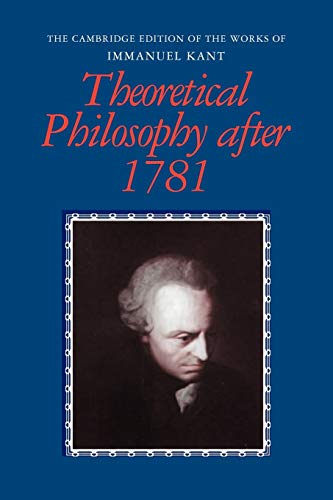
This volume is the first to assemble the writings that Kant published to popularize, summarize, amplify and defend the doctrines of his masterwork, the 1781 Critique of Pure Reason. The Prolegomena is often recommended to students, but the other texts are also important representatives of Kant’s intellectual development. The series includes copious linguistic notes and a glossary of key terms. The editorial introductions and explanatory notes reveal much about the critical reception given Kant by the metaphysicians of his day as well as his own efforts to derail his opponents.
User’s Reviews
Reviews from Amazon users which were colected at the time this book was published on the website:
⭐I came to this page hoping to find capsule reviews by at least one or two Kant specialists. Instead there were no reviews at all. As a stopgap, then, here is one reader’s experience with this edition.As philosophically inclined readers know, Kant’s explication of the Transcendental Deduction in his 1781 watershed Critique of Pure Reason placed him firmly within the first rank of philosophers. This generous collection (almost as large as Cambridge’s Critique edition itself) presents many of the essential texts Kant produced in the decade following first publication of the Critique. Kant was not one to rest on his laurels, so these subsequent works clarify, broaden, and extend the critical methods used in the Critique.The first and perhaps foremost of these texts, Prolegomena to Any Future Metaphysics that Will Be Able to Come Forward as Science, is a refactoring, if you will, of the Critique’s arguments into a more accessible form. The Prolegomena is readily available elsewhere in sturdy and inexpensive English translations. Why spend more?What makes this edition special (aside from its fluency): * participation of four outstanding Kant scholars in the translations; * the texts’ well-considered embodiments of insights gleaned from quite recent scholarship; * informed and astute commentaries on the place of the texts in Kant’s output; * the editorial apparatus, in which, for example, parallels between the Critique and the Prolegomena are detailed; and * a German-English glossary and textual notes documenting original German terms where the translation is not literal.I particularly appreciate the last feature. Looking forward, Kant may have been one of the godfathers of analytic philosophy, but in terms of rigor his use of language cannot be compared with that of later analytic philosophers. Looking backward, Kant was the first important scholastic philosopher since the late middle ages; as with other scholastics, terminology was important to him. Putting these together: Kant’s terminology can be slippery, yet how one reads it in particular passages impacts significantly how one understands Kant’s philosophy. Accordingly, readers who want an informed conversation with Kant’s texts will appreciate the care with which the philosopher’s original terminology has been kept available.Similarly, while Kant wisely insists that psychology is not foundational in his synthetic analytics, he speaks frequently in 18th-century terms of psychological matters. Concepts “spring from the mind,” for instance. Here, too, easy access to Kant’s original terminology at important points helps clarify both what he may mean and what he certainly does not mean.The edition continues with one of Kant’s most important and ambitious works, Metaphysical Foundations of Natural Science.* It also includes his survey of then-recent philosophy, What Real Progress has Metaphysics Made in Germany since the Time of Leibniz and Wolff, which casts significant light on numerous features of the first Critique. I have browsed these parts of the edition but have not yet worked with them closely. So I will forego any extraneous comments and simply say: For any English reader who is more than curious about Kant, getting What Real Progress and Metaphysical Foundations in modern translations of this caliber is a no-brainer.————————————-*2017 addendum. Since this review was written, Cambridge UP has published Michael Friedman’s important monograph on the Metaphysical Foundations of Natural Science, titled Kant’s Construction of Nature. You will definitely want to have the current translation at hand when reading that.
⭐The hardback was in pristine condition. If you want to pay less, order a paperback. The translations are excellent. I wanted to make sure the binding lasts.
⭐kant here is the best in philosophy
⭐
Keywords
Free Download Theoretical Philosophy after 1781 (The Cambridge Edition of the Works of Immanuel Kant) 1st Edition in PDF format
Theoretical Philosophy after 1781 (The Cambridge Edition of the Works of Immanuel Kant) 1st Edition PDF Free Download
Download Theoretical Philosophy after 1781 (The Cambridge Edition of the Works of Immanuel Kant) 1st Edition PDF Free
Theoretical Philosophy after 1781 (The Cambridge Edition of the Works of Immanuel Kant) 1st Edition PDF Free Download
Download Theoretical Philosophy after 1781 (The Cambridge Edition of the Works of Immanuel Kant) 1st Edition PDF
Free Download Ebook Theoretical Philosophy after 1781 (The Cambridge Edition of the Works of Immanuel Kant) 1st Edition