Ebook Info
- Published: 1982
- Number of pages: 288 pages
- Format: PDF
- File Size: 14.04 MB
- Authors: Richard Rorty
Description
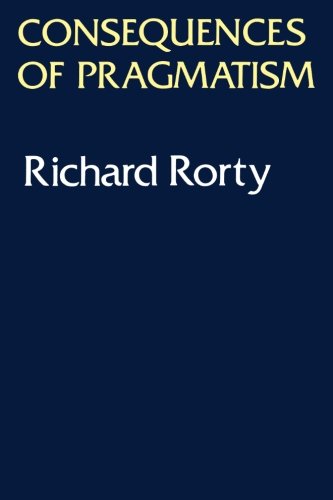
Rorty seeks to tie philosophy’s past to its future by connecting what he sees as the positive (and neglected) contributions of the American pragmatic philosophers to contemporary European developments. What emerges from his explorations is a revivified version of pragmatism that offers new hope for the future of philosophy.“Rorty’s dazzling tour through the history of modern philosophy, and his critical account of its present state (the best general introduction in print), is actually an argument that what we consider perennial problems–mind and body, consciousness and objects, the foundations of knowledge, the fact/value distinction–are merely the dead-ends this picture leads us into.” Los Angeles Times Book Review“It can immediately be said that Consequences of Pragmatism must be read by both those who believe that they agree and those who believe that they disagree with Richard Rorty. [He] is far and away the most provocative philosophical writer working in North America today, and Consequences of Pragmatism should make this claim even stronger.”The Review of Metaphysics“Philosophy, for Rorty, is a form of writing, a literary genre, closer to literary criticism than anything else, a criticism which takes for one of its major concerns the texts of the past recognized as philosophical: it interprets interpretations. If anyone doubts the continued vigor and continuing relevance of American pragmatism, the doubts can be laid to rest by reading this book.” Religious Studies Review
User’s Reviews
Reviews from Amazon users which were colected at the time this book was published on the website:
⭐Excellent is always fun. He is an insightful critic of contemporary, stuffed shirt, academic (professional) philosophy.
⭐Please, don’t buy the kindle edition of the book. It is unusable. I want my money back.
⭐This was a gift. I have yet to read it. This was the second time I have tried unsuccessfully to introduce Rorty to others. Evidently people firmly grounded in Plato’s notion of Reality and Cartesian dualism resit alternative points of view.
⭐fast service good quality
⭐An important work!
⭐Rorty has collected a selection from his vast number of essays under the title “Consequences of Pragmatism”. Spanning the time range of his work from the early 1970s to the early 1980s, they represent Rorty’s development and exposition of his views after he made the sudden turn from analytic philosophy to his anti-essentialist pragmatism. Many of the essays are meant to explain how his view contrasts with the tradition in philosophy he is arguing against, which he identifies as the Cartesian-Kantian one, as well as the analytic philosophical tradition he used to belong to. However, some of the later essays also serve to defend his views against some common criticisms. Also included are essays which compare his views with those of people working or having worked along similar ‘counter-tradition’ lines, such as of course his inspiration Dewey, but also Heidegger, Foucault, and Cavell.The essays are well-written and generally not too difficult, so they should be an accessible summary of his philosophical views for the intellectual reader. Despite the sometimes rather dry subject-matter, such as reviewing the developments in 20th Century philosophy of language, Rorty applies humor and optimism to skilfully polemicize against this tradition. This leads to witty phrases and interesting observations such as: “taking how and what one does in bed as definitive of one’s being seems a specifically masculine trait”, “granted that Derrida is the latest and largest flower on the dialectical kudzu vine of which the ‘Phenomenology of Spirit’ was the first tendril, does that not merely show the need to uproot this creeping menace? Can we not all see (…) the need to strip the suckers of this parasitic climber from the still unfinished walls and roofs of the great Kantian edifice which it covers and conceals?” or “our tyrants and bandits are more hateful than those of earlier times because (…) they pose as intellectuals. Our tyrants write philosophy in the morning and torture in the afternoon; our bandits alternatively read Hölderlin and bomb people to bloody scraps”.Despite the repetition of the collection, unfortunately inherent due to the need for exposition of the same misunderstood theme over and over again, this kind of writing keeps it intriguing and insightful. And since Rorty is committed to seeing philosophy as similar to literature, this is serious praise.
⭐This book might be a good place to start trying to gain a complete knowledge of the historicity of secret thoughts. “Hegel’s historicism” (p. 3) might be compared with Americans who thought that World War Two was a great event, but this book is more concerned with “The notion of alternative conceptual frameworks.” (p. 3). There is no entry in the index for historicity, but the idea of historicity, which is so important in understanding arguments about right and wrong, could teach us more than the index, which has the names of lots of philosophers in unusual conceptual combinations: Hegel and truth, Hegel and Kuhn, Hegel and Bloom, Nietzsche and James, Kant and James, and names that only appear in the notes at the end of the essays in this book. Published in 1982, the final note for Essay 3, “Overcoming the Tradition: Heidegger and Dewey” contains an acknowledgement, thanking “my late colleague Walter Kaufmann for helpful comment on a draft of this paper.” (p. 59, n. 73). Essay 3 was originally read at a conference in 1974 and published in `The Review of Metaphysics’ in 1976, a few years before Walter Kaufmann’s death in September, 1980. Overcoming tradition might be a small accomplishment, compared to living in a time so comic that laughter might be considered an important cause of the death of an arguer. Having many philosophers and no Philosophy, as much of this book implies, might be as funny as the fatal truth that hardly anyone could believe any of this stuff before, during, or after its historicity.I would prefer to review this book as if the particular philosophical questions which it collected in the essays (set in the subtitle in the timeframe 1972-1980) serve as a better example of the comedy which was popular in the field of topical humor about politics in a time of turbulent opinions during those years after the death of Lenny Bruce from an overdose of narcotics and before we could watch “South Park” and, unfortunately, of more interest to us today than what Truth or Philosophy might mean. The Introduction, in particular, which attempted to tie the essays together in a manner which suggests that Rorty would prefer some intellectual position that defines the nature of his self, but admitting that a thorough reading might convince us that he had not yet achieved an understandable consistency, fades into insignificance when we readers confront such statements as “Even if I were thinking, which I am not, that would not show that I exist.” (p. 7). Ha? Ha? Ha?Is a title like “The World Well Lost” (pp. 3-18) even decent? Does humor form a barrier to understanding the title “Keeping Philosophy Pure: An Essay on Wittgenstein” (pp. 19-36) when a key theme of the essay is “Yet Wittgenstein came in the end to mock his own creation,” (p. 19) “vapid imitation” (p. 22), and that philosophers’ attempts to understand Wittgenstein involve “the same paradoxes elaborated by Wittgenstein himself (who cheerfully tosses out half-a-dozen incompatible metaphysical views in the course of the INVESTIGATIONS).” (p. 23) ? Moving right along, Essay 4, “Professionalized Philosophy and Transcendentalist Culture” (pp. 60-71) begins with the suggestion that “Santayana saw us as one more great empire in the long parade. His genial hope was that we might enjoy the imperium while we held it. In a famous essay on American philosophy, he suggested that we were still spoiling our own fun.” (p. 60). Our society produces a fine mix of “joy in business itself” (p. 60), “We can afford to smile at this,” (p. 61), “the contempt the successful feel for the shabby genteel.” (p. 61), “pointing with scorn to the low level of argumentative rigor among the competition” (p. 62), and ultimately:”American sociology, whose early stages had been satirized as the expenditure of a five-thousand-dollar grant to discover the address of a whorehouse, came to be satirized as the expenditure of a five-million-dollar grant to plot the addresses of a thousand whorehouses against a multidimensional array of socio-economic variables.” (pp. 63-64).Now that home computers make this much information readily available to millions of curious web surfers for study at a level that could be used to see how the number of credit card transactions at the whorehouses compared with the rate of personal bankruptcy in the area around each whorehouse, we are closer than ever to “the highbrow and the academic philosopher viewing each other with equal suspicion, each harping on the vices of each other’s virtues.” (p. 65). This could be the basis for a humorous aside on cross-disciplinary studies, in which the cross aspect is something like a euphemism for the word aghast, but that is far beyond the scope of this book.
⭐There is no way I can do justice in reviewing such a dense volume of work, however, it would be of interest and benefit to philosophy students and those interested in modern philosophical movements in particular. Rorty focuses on American philosophy, and especially “Pragmatism” in light of Hegel, Kant, Heidegger, and others. It is a little disconcerting that right from the start he states that he no longer agrees with some of the material, and one wonders whether it is worth investing hours of study and effort in understanding the material. Though by going through the essays readers would be assured of having a greater understanding of at least “Pragmatism”, modern philosophy, and some of the main arguments for and against ideas from some of the big philosophers of the past.
Keywords
Free Download Consequences of Pragmatism in PDF format
Consequences of Pragmatism PDF Free Download
Download Consequences of Pragmatism 1982 PDF Free
Consequences of Pragmatism 1982 PDF Free Download
Download Consequences of Pragmatism PDF
Free Download Ebook Consequences of Pragmatism