

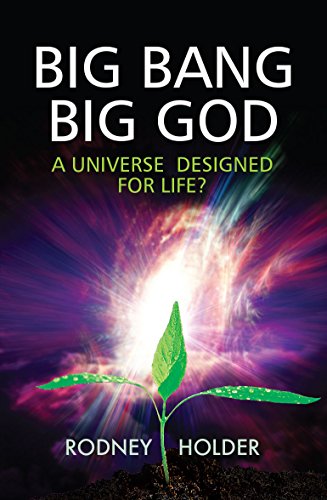
Ebook Info
- Published:
- Number of pages:
- Format: PDF
- File Size: 1.56 MB
- Authors: Rodney Holder
Description
How did the universe begin and how has it evolved? Does a scientific explanation mean that we can do without God? Why are the laws of nature so special (‘fine-tuned’) as to produce a universe with intelligent creatures like us in it in the first place? Can the existence of a multiverse, a vast or infinite collection of universes, explain the specialness of this universe? This book argues that only God provides an explanation for the universe to exist at all, and that design by God provides the best and most rational explanation to adopt for the fine-tuning.
User’s Reviews
Reviews from Amazon users which were colected at the time this book was published on the website:
⭐I was first introduced to the ordained minister and Cambridge physicist, Dr. Rodney Holder, when watching to Bill Craig’s presentation `The Origin of the Universe: Has Hawking Eliminated God,’ a critique of Stephen Hawking’s The Grand Design (“TGD”) [Bill Craig’s book review `Much Ado About Nothing’ in Philosphia Chiristi is the best critique available]. The topic was `Has contemporary Physics Eliminated God as a Cause of the Universe,’ and Holder shared the stage in critiquing TGD. Holder’s book, Big Bang Big God (“BBBG”) is an abbreviated version of his essay, `Quantum Theory and Theology,” in the Blackwell Companion to Science and Religion released in 2012. For those readers lucky enough to have purchased the above-referenced book, there is no need to purchase the BBBG. Dr. Holder’s BBBG is fairly small and the topics are written with a rich brevity that will not disappoint those curious about the intersection of cosmology, natural theology and meta-scientific issues–especially the present state of cosmology.BBBG is meant for all interested readers on issues ranging from fine-tuning, level I to IV multiverse views, the nature and definition of science and the intersection between science and Christianity. The contents of BBBG presuppose that the reader has some familiarity with the topics Holder writes about, but this does not undermine Dr. Holder’s target audience or his main argument. This is actually one of the accomplishments of BBBG as the summaries and definitions of the topics presented include rigorous simplifications of the ideas of other scientists and philosophers of science that make BBBG an unintentional primer on whether the fine-tuning of our universe containing embodied conscious agents (a term borrowed from Robin Collins) signifies that there is a Creator behind our universe; or, does it signify that our universe is simply a chance byproduct of a vast (or infinite) array of universes, also known as level II to IV multiverse models, taken from Max Tegmark, also discussed in BBBG. Holder states “For convenience, we restrict ourselves to two explanatory options: (1) God creates a single universe fine-tuned for us to be in it; and (2) there is no God but there is an uncaused multiverse” (pg. 166). Holder’s argument is that the multiverse option fails for scientific and philosophic reasons and Holder does a good job in leaving no stone unturned. BBBG ends by presenting a Bayesian form of his argument, which is then presented more formally in the appendix.In order to arrive at this bifurcation, Holder jumps right into modern Big Bang cosmology and does an excellent job of getting to the point without needless exposition. The reader is exposed to the views of practically every relevant scientist or philosopher of science that contribute to the two explanatory options above. Dr. Holder is more than descriptive and offers numerous critiques of models and scenarios such as “closed causal time loops,” a view of John Wheeler and Paul Davies that states we are caused by past events, and we are even the ones responsible for causing ourselves, which is an alternative to invoking God as Creator (chapter 10 of Paul Davies, The Goldilocks Enigma: Why is the Universe Just Right for Life?). Holder finds such ad hoc views as paradoxical and painfully question-begging when asserting both that non-conscious matter pre-exists and causes my conscious existence and that I cause its existence. Holder states “. . . even if we do ascribe creation of reality to the human observer (Copenhagen view of quantum theory), this is far from `creation out of nothing’ since the superposition of states must have pre-existed the observation. The reason for the existence of the self-excited circuit in not explained–and requires explanation for the same reason that the existence of anything at all requires explanation . . .” (pgs. 77-78). Holder backs up his critiques with endnotes for the reader to explore the arguments themselves.There are so many views and critiques I fear I will lose the reader. One more example should prove interesting for the reader to consider purchasing BBBG. Dr. Holder presents the multiverse view of Paul Davies and Nick Bostrom. Whether the reader ends up scratching their heads because of Davies/Bostom’s views or because they may not believe what they are reading is a wholly different issue, but this does encapsulate the present state of affairs in modern cosmology.Under the heading “The Prevalence of Fake Universes,” and following a discussion of Tegmark’s level I through IV multiverse viewpoints, Holder arrives at the issue of the likelihood that we reside in a “fake universe.” Holder presents Paul Davies’ view that as soon as we entertain the possibility of a multiverse, there is no good reason to rule out universes that contain “computer simulations” of other universes. What Davies means is that “in a multiverse [level II through IV] technological civilizations like ours will emerge in some subset of universes, and civilizations more technologically advanced than ours will attain the capacity to simulate consciousness” (emphasis added). Davies continues that it is only a small leap to simulations of conscious beings to simulate an entire virtual world for them to inhabit (pg. 152, quoting pg. 496 of Paul Davies article `Universes Galore: Where Will it all End’ from Universe or Multiverse? ed. by Bernard Carr).Philosopher and self-proclaimed ‘transhumanist’ Nick Bostrom’s justifiably takes Davies’ view a step further ending in the conclusion that “we”–yes, you the reader–are very likely computer simulations (Bostrom’s `simulation argument’) and we could be the simulations of the human ancestors of post-humans, rather than real humans. Using an argument from probability Bostrom concludes that simulations are likely to be overwhelmingly dominant and that we should conclude that our universe is more likely to be a simulation than a real universe; and, “we are therefore not real biological persons but simulated ones” (pg. 153). These are live options in present cosmology. As Hilary Putnam would state, we are essentially a “Brain in a Vat.” I will skip the critique and bring this review to a close.For those readers whose theological leanings are closer to William Lane Craig a caveat would be in order. Holder embraces theistic evolution (implicitly presupposed in the book, but I am unsure if his views are monistic or dualistic). Also, one finds Dr. Holder making unnecessary, almost caustic, assertions against Intelligent Design such as ID “. . . seeks precisely to locate God in Gaps is the scientific story of biological evolution” (page 76). This is a common distortion of ID theory and it is an assertion made by one unfamiliar with the arguments and counter-arguments. Whether one agrees or disagrees that the above are caveats is besides the point of this review as there are too many good arguments in BBBG to pass up. I recommend purchasing Dr. Holder’s book and look forward to reading other reviews that will undoubtedly bring other issues I have intentionally left out.
⭐On the first page of the book, some well-credentialed critic refers to this as “a highly accessible book for the general reader.” That is to laugh.The last time I had this experience was decades ago when somebody decided to throw the Miller Analogies standardized test at a bunch of theology students. I loved standardized tests. Ate them up. My score in this one was the fiftieth percentile. Nor, after about the fifth question was I surprised. I had no idea what they were talking about. I rarely understood the question. This time also.My problem was science. A subject I did not really understand. In my last two years of college, Dr. Giesen walked over from St. Thomas to teach us seminarians science. A week before finals he would invariably show up with a set of questions he had used on premed students at the college the week before as helpful guide to what he might ask us. And then on the fatal day of the big exam he would show up with the same questions. Why? He thought us hopeless.This book makes a case for the existence of God from the hair-splittingly design of everything to allow for the existence of us, conscious beings. The basic argument is that the only random, that is “Godless,” way to get to a human-friendly universe is to have multiple universes that do not work in order, by dumb luck, to get one that does. Not likely.Now this argument seems simple, but need not be. The author who has for his jousting companions such as Einstein and Hawking takes the long way on this through some exceedingly, to me recondite arguments involving formulas consisting mostly of letters or near letters. Half, at least, of the book, leaves me just blinking. But apparently when all is said and done Dr. Holder has proven his point. There is one God, the maker of heaven and earth. As a theist, I appreciate this.So why tell you?First, I am happy to know there is a book out there that wins that argument for my side. Of course, I suppose, there are books out there that win it for the non-theist side, but I will not dwell on that. Nor subject myself to the humiliation of not understanding formulas. (Did you know that after a bit Einstein added a symbol that looks a little like a Delta with the bottom chopped off. And he really regretted that addition but no one would let him remove it, because it was useful for their purposes. The sound you hear is me running screaming down the hall.)Second, I know two people who might understand this. Both are very smart cookies with advanced degrees in science. So maybe you are one of their lot? You would love this book.If you will look Big Bang Big God up on the Amazon page it is being sold on you will find a reviewer who understands this who will give you an extensive précis of it. As I read his review I thought this could be helpful to someone else. Maybe you. Not me.It might be a great book even. The reviewers all of whom seem to understand it give it very high marks.
⭐Very good book. Excellent overview of the history of the Big Bang theory, reasons for believing that the universe clearly has a beginning, and an overview of many of the most popular multiverse theories. I would highly recommend this book. He quotes the top experts in the field, both theists and atheists, abundantly, and footnotes well. It is not always an easy read for the non-scientist, but it was not over my head either.I gave it 4 stars instead of 5 for a couple of reasons.1. The conclusion chapter was his version of why God is a simpler explanation than the multiverse, an appeal to Ockam’s razor. I thought that the book made a much better case than his odd appeal to the idea that God is simple. If all I read was his conclusion I would have learned little.2. Not a fan of Baye’s theorem as evidence for (or against) a creator. I felt the chapter and appendix on that were not so helpful.Overall, an excellent book. Recommended.
⭐This book presents an excellent case for theism from the evidence for the beginning of the universe and the fine-tuning of the universe. The title of the book is a little bit strange but make no mistake that this is a well thought-out book by a PhD in Astrophysics. It is more accessible to the educated layman compared to a book like “New Proofs for the Existence of God”.Dr. Holder writes of the history of the Big Bang theory from the beginning to today. A strong aspect of this book is description of just how exact the fine tuning of the universe is. He also interacts with popular multiverse theories showing the weaknesses of these theories. If you want to buy just one book arguing from the theistic point of view then this book is a good choice.
⭐Rodney Holder has gone to great lengths to provide readers of any persuasion a detailed examination of arguments for and against the existence and nature of God. He presents views ranging across both atheist and pro-God positions. He highlights issues of logic and probability which shed light on the pros and cons of various stances. Though unashamedly in favour of a Christian viewpoint, he does allow atheistic stances a chance to breathe and make their case.
⭐Impeccably logical in its approach to a complex subject. I found it also very appealing from a philosophical viewpoint. I spent a long but rewarding time reading this book trying to fully understand the arguments. Thoroughly recommended.
⭐Excellent book and awe inspiring. explains how Big Bang and Genesis explain how the universe came about. Recommend it. A must.
⭐Excellent presentation in language that all can understand. Rodney is a theologian and a scientist – and it shows!.
⭐An outstanding defence of the Christian Faith and natural theology in relation scientific thinking and made with great humility, Highly recommended.
Keywords
Free Download Big Bang, Big God: A Universe Designed For Life? in PDF format
Big Bang, Big God: A Universe Designed For Life? PDF Free Download
Download Big Bang, Big God: A Universe Designed For Life? PDF Free
Big Bang, Big God: A Universe Designed For Life? PDF Free Download
Download Big Bang, Big God: A Universe Designed For Life? PDF
Free Download Ebook Big Bang, Big God: A Universe Designed For Life?