

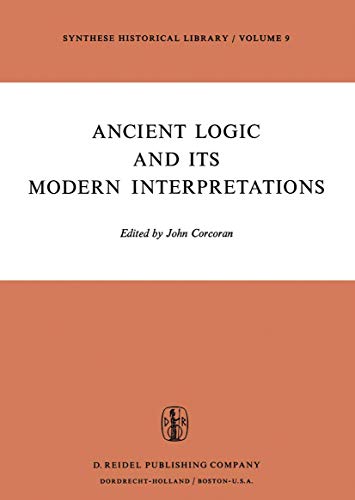
Ebook Info
- Published: 1974
- Number of pages: 227 pages
- Format: PDF
- File Size: 7.34 MB
- Authors: J. Corcoran
Description
During the last half century there has been revolutionary progress in logic and in logic-related areas such as linguistics. HistoricaI knowledge of the origins of these subjects has also increased significantly. Thus, it would seem that the problem of determining the extent to which ancient logical and linguistic theories admit of accurate interpretation in modern terms is now ripe for investigation. The purpose of the symposium was to gather logicians, philosophers, linguists, mathematicians and philologists to present research results bearing on the above problem with emphasis on logic. Presentations and discussions at the symposium focused themselves into five areas: ancient semantics, modern research in ancient logic, Aristotle’s logic, Stoic logic, and directions for future research in ancient logic and logic-related areas. Seven of the papers which appear below were originally presented at the symposium. In every case, discussion at the symposium led to revisions, in some cases to extensive revisions. The editor suggested still further revisions, but in every case the author was the finaljudge of the work that appears under his name.
User’s Reviews
Reviews from Amazon users which were colected at the time this book was published on the website:
⭐This book treats ancient logic: the logic that originated in Greece by Aristotle and the Stoics, mainly in the hundred year period beginning about 350 BCE. Ancient logic was never completely ignored by modern logic from its Boolean origin in the middle 1800s: ancient logic was prominent in Boole’s writings and it was mentioned by Frege and by Hilbert. Nevertheless, the first century of mathematical logic did not take ancient logic seriously enough to study its texts. A renaissance in ancient logic studies occurred in the early 1950s with the publication of the landmark Aristotle’s Syllogistic from the Standpoint of Modern Formal Logic by Jan Lukasiewicz, Oxford UP 1951, 2nd ed. 1957. Despite its title, the Lukasiewicz book treats the logic of the Stoics as well as that of Aristotle. Lukasiewicz was a distinguished mathematical logician. He had created many-valued logic and the parenthesis-free prefix notation known as Polish notation. He co-authored with Alfred Tarski’s an important paper on metatheory of propositional logic and he was one of Tarski’s the three main teachers at the University of Warsaw. Lukasiewicz’s stature was just short of that of the giants: Aristotle, Boole, Frege, Tarski and Gödel. No mathematical logician of his caliber had ever before quoted the actual teachings of ancient logicians.Not only did Lukasiewicz inject fresh hypotheses, new concepts, and imaginative modern perspectives into the field, his enormous prestige and that of the Warsaw School of Logic reflected on the whole field of ancient logic studies. Suddenly, this previously somewhat dormant and obscure field became active and gained in respectability and importance in the eyes of logicians, mathematicians, linguists, analytic philosophers, and historians. Next to Aristotle himself and perhaps the Stoic logician Chrysippus, Lukasiewicz is the most prominent figure in ancient logic studies. A huge literature traces its origins to Lukasiewicz.The book under review, Ancient Logic and Its Modern Interpretations, is based on the 1973 Buffalo Symposium on Modernist Interpretations of Ancient Logic, the first conference devoted entirely to critical assessment of the state of ancient logic studies. There are five parts. Part I Ancient Semantics contains articles by Norman Kretzmann, Ronald Zirin, and Newton Garver. Part II Modern Research in Ancient Logic contains articles by Ian Mueller and John Mulhern. Part III Aristotle’s Logic contains articles by John Corcoran and Mary Mulhern. Part IV Stoic Logic contains articles by John Corcoran and Josiah Gould. Part V contains the edited transcript of the panel discussion held in final plenary session of the symposium and an article by John Corcoran on the future of research in the field that he presented before the panel discussion. Some of the papers have become classics. The fact that the book remains in print over 35 years after its initial publication is testimony of its quality and importance.
⭐
Keywords
Free Download Ancient Logic and Its Modern Interpretations: Proceedings of the Buffalo Symposium on Modernist Interpretations of Ancient Logic, 21 and 22 April, 1972 (Synthese Historical Library, 9) 1974th Edition in PDF format
Ancient Logic and Its Modern Interpretations: Proceedings of the Buffalo Symposium on Modernist Interpretations of Ancient Logic, 21 and 22 April, 1972 (Synthese Historical Library, 9) 1974th Edition PDF Free Download
Download Ancient Logic and Its Modern Interpretations: Proceedings of the Buffalo Symposium on Modernist Interpretations of Ancient Logic, 21 and 22 April, 1972 (Synthese Historical Library, 9) 1974th Edition 1974 PDF Free
Ancient Logic and Its Modern Interpretations: Proceedings of the Buffalo Symposium on Modernist Interpretations of Ancient Logic, 21 and 22 April, 1972 (Synthese Historical Library, 9) 1974th Edition 1974 PDF Free Download
Download Ancient Logic and Its Modern Interpretations: Proceedings of the Buffalo Symposium on Modernist Interpretations of Ancient Logic, 21 and 22 April, 1972 (Synthese Historical Library, 9) 1974th Edition PDF
Free Download Ebook Ancient Logic and Its Modern Interpretations: Proceedings of the Buffalo Symposium on Modernist Interpretations of Ancient Logic, 21 and 22 April, 1972 (Synthese Historical Library, 9) 1974th Edition