

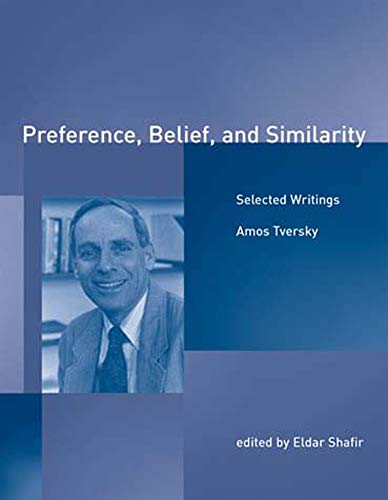
Ebook Info
- Published: 2003
- Number of pages: 1040 pages
- Format: PDF
- File Size: 6.38 MB
- Authors: Amos Tversky
Description
Amos Tversky (1937–1996), a towering figure in cognitive and mathematical psychology, devoted his professional life to the study of similarity, judgment, and decision making. He had a unique ability to master the technicalities of normative ideals and then to intuit and demonstrate experimentally their systematic violation due to the vagaries and consequences of human information processing. He created new areas of study and helped transform disciplines as varied as economics, law, medicine, political science, philosophy, and statistics. This book collects forty of Tversky’s articles, selected by him in collaboration with the editor during the last months of Tversky’s life. It is divided into three sections: Similarity, Judgment, and Preferences. The Preferences section is subdivided into Probabilistic Models of Choice, Choice under Risk and Uncertainty, and Contingent Preferences. Included are several articles written with his frequent collaborator, Nobel Prize-winning economist Daniel Kahneman.
User’s Reviews
Product description レビュー “Amos Tversky may have shown that basketball players do not have ‘hot hands, ‘ but he proved the opposite for psychologists. Tversky always made his basket, and in the process changed psychology, and also economics, forever.”–George Akerlof, Koshland Professor of Economics, University of California, Berkeley, 2001 Nobel Laureate in Economic Sciences”Amos Tversky was one of the most important social scientists of the last century. This extraordinary collection demonstrates his range and brilliance, and in particular his genius for showing how and why human intuitions go wrong. Is there a ‘hot hand’ in basketball? Is arthritis pain related to the weather? Why do we exaggerate certain risks? Why are some conflicts so hard to resolve? Tversky’s answers will surprise you. Indispensable reading, and full of implications, for everyone interested in social science.”–Cass R. Sunstein, Law School and Department of Political Science, University of Chicago”Amos Tversky’s research on preferences and beliefs has had a shattering and yet highly constructive influence on the development of economics. The vague complaints of psychologists and dissident economists about the excessive rationality assumptions of standard economics, going back over a century, had little impact. It required the careful accumulation of evidence, the clear sense that Tversky did not misunderstand what economists were assuming, and above all his formulation of useful alternative hypotheses to change dissatisfaction into a revolutionary change in perspective.”–Kenneth J. Arrow, Professor of Economics Emeritus, Stanford University”Amos Tversky’s work has produced an ongoing revolution in our understanding of judgment and choice. The articles in this book show why. They also show how: the articles are written with grace, wit, and a brilliance that frequently verges on the pyrotechnic.”–Richard E. Nisbett, author of “The Geography of Thought: How Asians and Westerners Think Differently . . . and Why””It is deeply ironic that ‘similarity’ and ‘bounded rationality’ were two of the many topics that Amos Tversky studied–ironic because he seemed to be unboundedly rational and similar to no one. No one shared his combination of brilliance, precision, intuition, breadth, and enormous good humor. Few scholars change their own disciplines before they reach 40, as Tversky did, and even fewer then transform other disciplines, as he and Daniel Kahneman did for economics. Their influence on economics, recognized by the 2002 Nobel Prize, is still growing, and the discipline will never be the same. Nor will anyone who reads these papers: It is impossible to read Tversky without changing the way you think.”–Richard H. Thaler, Robert P. Gwinn Professor of Economics and Behavioral Science, University of Chicago”This collection offers the best of Tversky, the best of the best. It is amazing how many of these articles are already classics, not only in the fields of choice and decision making, but in psychology in general.”–Edward E. Smith, Arthur W. Melton Professor of Psychology, University of Michigan& quot; Amos Tversky may have shown that basketball players do not have ‘hot hands, ‘ but he proved the opposite for psychologists. Tversky always made his basket, and in the process changed psychology, and also economics, forever.& quot; –George Akerlof, Koshland Professor of Economics, University of California, Berkeley, 2001 Nobel Laureate in Economic Sciences& quot; Amos Tversky was one of the most important social scientists of the last century. This extraordinary collection demonstrates his range and brilliance, and in particular his genius for showing how and why human intuitions go wrong. Is there a ‘hot hand’ in basketball? Is arthritis pain related to the weather? Why do we exaggerate certain risks? Why are some conflicts so hard to resolve? Tversky’s answers will surprise you. Indispensable reading, and full of implications, for everyone interested in social science.& quot; –Cass R. Sunstein, Law School and Department of Political Science, University of Chicago& quot; Amos Tversky’s research on preferences and beliefs has had a shattering and yet highly constructive influence on the development of economics. The vague complaints of psychologists and dissident economists about the excessive rationality assumptions of standard economics, going back over a century, had little impact. It required the careful accumulation of evidence, the clear sense that Tversky did not misunderstand what economists were assuming, and above all his formulation of useful alternative hypotheses to change dissatisfaction into a revolutionary change in perspective.& quot; –Kenneth J. Arrow, Professor of Economics Emeritus, Stanford University& quot; Amos Tversky’s work has produced an ongoing revolution in our understanding of judgment and choice. The articles in this book show why. They also show how: the articles are written with grace, wit, and a brilliance that frequently verges on the pyrotechnic.& quot; –Richard E. Nisbett, author of The Geography of Thought: How Asians and Westerners Think Differently . . . and Why& quot; It is deeply ironic that ‘similarity’ and ‘bounded rationality’ were two of the many topics that Amos Tversky studied–ironic because he seemed to be unboundedly rational and similar to no one. No one shared his combination of brilliance, precision, intuition, breadth, and enormous good humor. Few scholars change their own disciplines before they reach 40, as Tversky did, and even fewer then transform other disciplines, as he and Daniel Kahneman did for economics. Their influence on economics, recognized by the 2002 Nobel Prize, is still growing, and the discipline will never be the same. Nor will anyone who reads these papers: It is impossible to read Tversky without changing the way you think.& quot; –Richard H. Thaler, Robert P. Gwinn Professor of Economics and Behavioral Science, University of Chicago& quot; This collection offers the best of Tversky, the best of the best. It is amazing how many of these articles are already classics, not only in the fields of choice and decision making, but in psychology in general.& quot; –Edward E. Smith, Arthur W. Melton Professor of Psychology, University of Michigan” Amos Tversky may have shown that basketball players do not have ‘hot hands, ‘ but he proved the opposite for psychologists. Tversky always made his basket, and in the process changed psychology, and also economics, forever.” –George Akerlof, Koshland Professor of Economics, University of California, Berkeley, 2001 Nobel Laureate in Economic Sciences” Amos Tversky was one of the most important social scientists of the last century. This extraordinary collection demonstrates his range and brilliance, and in particular his genius for showing how and why human intuitions go wrong. Is there a ‘hot hand’ in basketball? Is arthritis pain related to the weather? Why do we exaggerate certain risks? Why are some conflicts so hard to resolve? Tversky’s answers will surprise you. Indispensable reading, and full of implications, for everyone interested in social science.” –Cass R. Sunstein, Law School and Department of Political Science, University of Chicago” Amos Tversky’s research on preferences and beliefs has had a shattering and yet highly constructive influence on the development of economics. The vague complaints of psychologists and dissident economists about the excessive rationality assumptions of standard economics, going back over a century, had little impact. It required the careful accumulation of evidence, the clear sense that Tversky did not misunderstand what economists were assuming, and above all his formulation of useful alternative hypotheses to change dissatisfaction into a revolutionary change in perspective.” –Kenneth J. Arrow, Professor of Economics Emeritus, Stanford University” Amos Tversky’s work has produced an ongoing revolution in our understanding of judgment and choice. The articles in this book show why. They also show how: the articles are written with grace, wit, and a brilliance that frequently verges on the pyrotechnic.” –Richard E. Nisbett, author of “The Geography of Thought: How Asians and Westerners Think Differently . . . and Why”” It is deeply ironic that ‘similarity’ and ‘bounded rationality’ were two of the many topics that Amos Tversky studied–ironic because he seemed to be unboundedly rational and similar to no one. No one shared his combination of brilliance, precision, intuition, breadth, and enormous good humor. Few scholars change their own disciplines before they reach 40, as Tversky did, and even fewer then transform other disciplines, as he and Daniel Kahneman did for economics. Their influence on economics, recognized by the 2002 Nobel Prize, is still growing, and the discipline will never be the same. Nor will anyone who reads these papers: It is impossible to read Tversky without changing the way you think.” –Richard H. Thaler, Robert P. Gwinn Professor of Economics and Behavioral Science, University of Chicago” This collection offers the best of Tversky, the best of the best. It is amazing how many of these articles are already classics, not only in the fields of choice and decision making, but in psychology in general.” –Edward E. Smith, Arthur W. Melton Professor of Psychology, University of Michigan–Cass R. Sunstein, Law School and Department of Political Science, University of Chicago–Edward E. Smith, Arthur W. Melton Professor of Psychology, University of Michigan–George Akerlof, Koshland Professor of Economics, University of California, Berkeley, 2001 Nobel Laureate in Economic Sciences–Kenneth J. Arrow, Professor of Economics Emeritus, Stanford University–Richard E. Nisbett, author of “The Geography of Thought: How Asians and Westerners Think Differently . . . and Why”–Richard H. Thaler, Robert P. Gwinn Professor of Economics and Behavioral Science, University of Chicago 著者について Amos Tversky (1937–1996) was a mathematical psychologist whose research in the cognitive and decision sciences has been enormously influential. From 1978 to 1996, Tversky taught at Stanford University, where he was the inaugural David-Brack Professor of Behavioral Sciences and Principal Investigator at the Stanford Center on Conflict and Negotiation.Eldar Shafir, a student, close friend, and collaborator of Tversky’s, is Class of 1987 Professor of Behavioral Science and Public Policy at Princeton University.
Reviews from Amazon users which were colected at the time this book was published on the website:
⭐The subject says it all. Sure, you can probably download all of these articles for free. But it’s nice to have them all in one book.
⭐While I have an interest in behavioural economics, I have no expertise in psychology. Nevertheless, the works of Amos Tversky are immediately accessible to the outsider. I have read some of his work in other collections (particularly “Judgement under uncertainty”) and it is a real pleasure exploring more of his writing.
⭐This is a must-have for psychologists, behavioral economist, and decision scientists, get one and will be impressed.
⭐
Keywords
Free Download Preference, Belief, and Similarity: Selected Writings (A Bradford Book) in PDF format
Preference, Belief, and Similarity: Selected Writings (A Bradford Book) PDF Free Download
Download Preference, Belief, and Similarity: Selected Writings (A Bradford Book) 2003 PDF Free
Preference, Belief, and Similarity: Selected Writings (A Bradford Book) 2003 PDF Free Download
Download Preference, Belief, and Similarity: Selected Writings (A Bradford Book) PDF
Free Download Ebook Preference, Belief, and Similarity: Selected Writings (A Bradford Book)