Ebook Info
- Published: 2017
- Number of pages: 262 pages
- Format: PDF
- File Size: 1.56 MB
- Authors: Penelope Maddy
Description
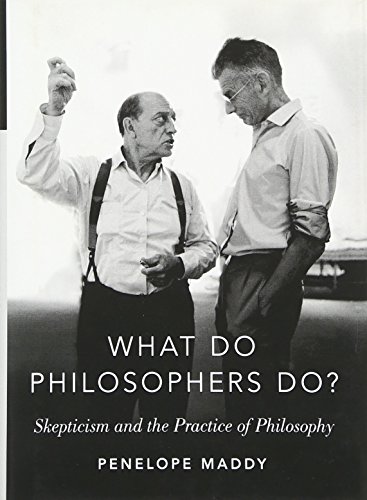
How do you know the world around you isn’t just an elaborate dream, or the creation of an evil neuroscientist? If all you have to go on are various lights, sounds, smells, tastes and tickles, how can you know what the world is really like, or even whether there is a world beyond your own mind? Questions like these — familiar from science fiction and dorm room debates — lie at the core of venerable philosophical arguments for radical skepticism: the stark contention that we in fact know nothing at all about the world, that we have no more reason to believe any claim — that there are trees, that we have hands — than we have to disbelieve it. Like non-philosophers in their sober moments, philosophers, too, find this skeptical conclusion preposterous, but they’re faced with those famous arguments: the Dream Argument, the Argument from Illusion, the Infinite Regress of Justification, the more recent Closure Argument. If these can’t be met, they raise a serious challenge not just to philosophers, but to anyone responsible enough to expect her beliefs to square with her evidence. What Do Philosophers Do? takes up the skeptical arguments from this everyday point of view, and ultimately concludes that they don’t undermine our ordinary beliefs or our ordinary ways of finding out about the world. In the process, Maddy examines and evaluates a range of philosophical methods — common sense, scientific naturalism, ordinary language, conceptual analysis, therapeutic approaches — as employed by such philosophers as Thomas Reid, G. E. Moore, Ludwig Wittgenstein, and J. L. Austin. The result is a revealing portrait of what philosophers do, and perhaps a quiet suggestion for what they should do, for what they do best.
User’s Reviews
Editorial Reviews: Review “To write a book for non-philosophers about what it is exactly that philosophers do, is by no means easy. Still, Maddy has succeeded very well with this book. It is very well written and not at all difficult to understand for a non-philosophical audience. It is an invitation to the reader to delve deeper into the fascinating world of philosophy and metaphilosophy.” — Jan Arreman, Philosophy in Review”What Do Philosophers Do? Skepticism and the Practice of Philosophy is an incredibly original and thought-provoking book. It is also an extremely ambitious piece of work, since it knits together two of the hardest topics in philosophy- i.e. skepticism and meta-philosophy. And it does so admirably, with a clear and approachable style.” –Annalisa Coliva, International Journal for the Study of Skepticism”This is an outstanding book. It offers an extremely attractive response to standard forms of external world skepticism, and rich and illuminating readings of J.L. Austin, G.E. Moore, and Wittgenstein. The prose is clear and sparkling, the argumentation careful and compelling, and the discussion highly sophisticated without ever getting bogged down in unnecessary detail. It offers a clarion call to a certain way of approaching our subject, an approach that is both distinctive and yet deeply familiar: a return to the convictions and subtleties of real life.” — Adam Leite, Indiana University, Bloomington About the Author Penelope Maddy received her BA in Mathematics from UC Berkeley and her PhD from Princeton. Since then, she has held positions at the University of Notre Dame, the University of Illinois at Chicago, and since 1987 at the University of California at Irvine. Since 1998, her appointment has been in Irvine’s Department of Logic and Philosophy of Science, of which she was the founding chair. She is the author of Realism in Mathematics, Naturalism in Mathematics (Lakatos Award 2002), Second Philosophy, Defending the Axioms, and The Logical Must.
Reviews from Amazon users which were colected at the time this book was published on the website:
⭐As an accessible and well-informed introduction to the modern philosophical treatment of the more radical forms of skepticism, I can’t praise “What Do Philosophers Do?” highly enough. But the author’s rather unimaginative account of philosophy’s contemporary mission, far too indebted to a “groundskeeper/handmaiden” conception of philosophy’s relation to the sciences, fails to offer much sense of philosophy’s still-vibrant possibilities. Equally disappointing is the outmoded framework she chooses to explore the perennial question of epistemic justification.The question “How do we come to know anything at all about the world around us?” seems an apt starting point for an introduction to science-based philosophical practice. Unfortunately, Dr. Maddy approaches it through the user-friendly, but grievously flawed, frame of the solitary investigator or “Plain Inquirer”. This focus on the individual as an isolated knowledge worker has a long history in modern philosophy stretching back to Descartes, and made sense at a time when all forms of traditional intellectual authority were under siege. But there is ample reason for reflective, scientifically informed philosophers today to either shun this simplistic framework entirely or to place it in a much broader context of knowledge acquisition.Our most rigorous and successful projects for understanding ourselves and our situation– including those devoted to understanding what makes such projects possible – are rooted in ongoing and highly sophisticated forms of collaboration and joint action. If a philosophy student today has good reason to feel confident in her ability to amass “ordinary evidence” for what she believes beyond everyday certainties, this is owing to contemporary knowledge of the world based on projects originating in vibrant, self-correcting epistemic communities, not on heroic solitary study. Focusing on a hypothetical isolated pursuer of knowledge gives students an avoidable false first impression of the sources and nature of contemporary knowledge of the world.Approaching questions regarding “how we come to know” through isolated inquiry has other dire philosophical consequences. Doing so obscures the ambiguity behind the collective pronoun “we” – this can be read as “all of us as epistemic agents” or “all of us as epistemic-community members”, or both. This in turn lends spurious credence to the notion that knowledge-seekers are, by definition, on a solitary hunt for information about a world inhabited by an isolated self. This ironically provides radical-skeptical arguments from illusion or dreaming with an easy target: the student, programmed to think of herself as a victim of epistemic isolation, now suddenly called on to explain why such a loner thinks “she” knows anything at all. The “we” of robust epistemic communities lacks such blatant vulnerability.A perhaps more serious problem is that by not expressly delineating the agent/community aspects of knowledge projects, Dr. Maddy obscures the distinction between two kinds of knowledge-claims, and hence between two kinds of skeptical challenges. The first claim-and-challenge pair relate to agent capabilities. These are the primary target of radical-skeptic argumentation: even reliable, generally competent members of epistemic communities can and do fail, sometimes catastrophically, due to various forms of individual impairment and situational deception. The second pair of claims and challenges concerns the resources, fallibilities and limitations of knowledge communities themselves, arguably a more significant issue for 21st century thinkers. No one would describe the view of the world shared by even the most educated and well-traveled Europeans in 1500 – or, for that matter, in 1900 – as epistemically rigorous or deeply insightful by today’s standards. Nor is there any reason to think a kind of permanently lofty informational peak or plateau has yet been reached.Similarly, the means by which individual agents and epistemic communities “come to know” are demonstrably and profoundly distinct. For example, the conditions and processes involved in our acquiring a first language as very young children are fundamentally unlike the complex historical and cultural circumstances enabling the natural and physical sciences to flourish. There is thus little to be gained, and much to be lost, from treating knowledge acquisition as if it were simply an individual endeavor.In addition, there is serious institutional risk in a methodology that doesn’t clearly recognize the distinction between challenges to agent-possessed knowledge and those targeting the legacy of epistemic communities. Such failure increases the likelihood that insufficient philosophical attention will be paid to ways in which even our most productive modern epistemic communities can go wrong. This would be tragic, given that theorizing in fundamental physics, for instance, can be quite sloppy in weighing evidence for and against alternative theories, can fail to distinguish consistency from confirmation, and has serious difficulty consistently categorizing aspects of experimental results as epistemological or ontological artifacts. Careful, reflective and informed analysis – philosophy, in other words – can help determine where interpretational overreach and irrational exuberance have led even brilliant scientific practitioners astray. This seems to me a much more important project for contemporary philosophy to undertake than such secondary pursuits as ordinary-language analysis.Finally, neglecting the epistemic-agent/epistemic-community distinction trivializes genuine existential unease. As fallible human beings, endowed with limited resources and facing an uncertain future, we don’t need to respect extraordinary forms of deception to sometimes find ourselves experiencing anxiety, confusion, self-doubt or despair concerning what we know. Philosophical “therapy” targeting demands for extraordinary evidence has little of value to contribute to the relief of actual cases of epistemic angst.All this is not to discourage readers from buying, and enjoying, “What Do Philosophers Do?” I may not agree with Professor Maddy’s general view of philosophy and disapprove of her methodology, but I greatly admire, and recommend, her deep scholarship, keen analytic insight, and bracing style.
⭐I’m interested in philosophy, but the academized version tends to bore me with its distinctions and quibbles. Maddy is an academic, but she does a great job communicating a history of skepticism here, her most accessible work yet.She balances her exposition among classic philosophers (such as Descartes and Berkeley) and those from the past century (such as Stroud and Austin), showing how skepticism itself requires presumptions that could not be ignored if one is to maintain one’s skepticism.She doesn’t spell it out exactly like this, but what I get from the book is that we are ultimately practical beings, however much we strive for certainty.
⭐I am impressed with Penelope Maddy’s writing. She’s a brilliant philosopher and I found this book very helpful and a clear exposition of her thinking.
⭐This book describes how philosophers think and operate by using skepticism as a case study. Skepticism is the idea that questions how we ultimately know what we know and, in the extreme, asserts that we cannot actually know anything. Professor Maddy takes the reader through the exercise by describing, analyzing and responding to skeptical assertions through the viewpoints of two protagonists: the Plain Man and the Plain Inquirer. The Plain Man is Thomas Reid’s common sense observer, who determines that he knows something based on rational and reasonable belief; the Plain Inquirer is the equivalent of the scientist, who uses more sophisticated and technical methods to arrive at conclusions about knowledge. A chair, for example, may be said to exist by the Plain Man because he sees it, and feels it, and when he attempts to sit upon it, he manages to do so without falling to the ground. The Plain Inquirer would add to those observations that the chair is indeed there, even if she can determine that it is ultimately made of molecules and space. She may also note whether or not conditions in any way, of lighting or physical exhaustion, may hamper the ability to note if the chair is actually there or not. Both of these protagonists would be thwarted by the skeptic by pulling first the Dream Card and, after the Plain Inquirer successfully refutes the notion that an observer may be dreaming, pulling then the Extraordinary Dream card, which claims that you could be in a dream that makes you think you are awake and includes regular dream time. Throughout, Maddy introduces other philosophers who have something to add to this conversation. For example, AJ Austin is invited into the discussion to present his theses on how ordinary language can be sufficient to settle epistemological questions. Grice is brought on board to add his concept of implicature. These and other philosophers provide for a rich discussion on the topic. In the end, Maddy successfully accomplishes her goal of demonstrating what philosophers do by doing philosophy herself on the topic of epistemology and skepticism, and by inviting other philosophers into the discussion.
⭐I’m very satisfied.
Keywords
Free Download What Do Philosophers Do?: Skepticism and the Practice of Philosophy (The Romanell Lectures) 1st Edition in PDF format
What Do Philosophers Do?: Skepticism and the Practice of Philosophy (The Romanell Lectures) 1st Edition PDF Free Download
Download What Do Philosophers Do?: Skepticism and the Practice of Philosophy (The Romanell Lectures) 1st Edition 2017 PDF Free
What Do Philosophers Do?: Skepticism and the Practice of Philosophy (The Romanell Lectures) 1st Edition 2017 PDF Free Download
Download What Do Philosophers Do?: Skepticism and the Practice of Philosophy (The Romanell Lectures) 1st Edition PDF
Free Download Ebook What Do Philosophers Do?: Skepticism and the Practice of Philosophy (The Romanell Lectures) 1st Edition