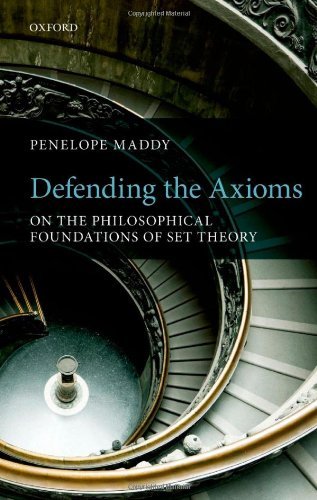
Ebook Info
- Published: 2011
- Number of pages: 161 pages
- Format: PDF
- File Size: 0.00 MB
- Authors: Penelope Maddy
Description
Mathematics depends on proofs, and proofs must begin somewhere, from some fundamental assumptions. For nearly a century, the axioms of set theory have played this role, so the question of how these axioms are properly judged takes on a central importance. Approaching the question from a broadly naturalistic or second-philosophical point of view, Defending the Axioms isolates the appropriate methods for such evaluations and investigates the ontological and epistemological backdrop that makes them appropriate. In the end, a new account of the objectivity of mathematics emerges, one refreshingly free of metaphysical commitments.
User’s Reviews
Reviews from Amazon users which were colected at the time this book was published on the website:
⭐“Defending the Axioms” offers a “post-metaphysical” conception of objectivity as a means of assessing the value and significance of axioms in set theory, one that avoids having to take a realist or anti-realist position on the nature of mathematical objects. Professor Maddy argues, forcefully and well, that the “objective underpinning” of mathematics, as actually done by mathematicians, is “mathematical fruitfulness”: the way a mathematical concept, theorem or method presents itself to specialists as deep, important, or illuminating. Her arguments against various forms of “reality”-oriented justification are powerful and cogent, and her central claim, that “the be-all and end-all of mathematics isn’t a remote metaphysics…but the entirely palpable facts of mathematical depth” is clearly presented and well-defended. In particular, her “heretical” advocacy for the primacy of extrinsic justifications over intrinsic considerations like self-evidence is thoughtful and convincing.As a reader more interested in what kind of an epistemic project mathematics is than in the weeds-level analysis of particular mathematical axioms, I particularly enjoyed Doctor Maddy’s brief, but deeply informed and perceptive account of how our understanding of the relationship between mathematics and science has evolved since Galileo and Newton.While I’ve given this book five stars, I have to take a moment to point out the ways in which I think it falls short if construed as any kind of last word on “the be-all and end-all” of mathematics, or as a comprehensive means of treating philosophical problems. The author’s second-philosophical approach, in which she takes up mathematical-philosophical claims as a kind of freelance, open-minded but scientifically informed inquirer, shows to good advantage here as a way of getting at what “objectivity” really means to mathematicians themselves. But there’s a danger of the most profound questions about mathematics’ status getting lost through excessive deference to the conceptual framework in which specialists go about their business.How, for example, are we to conceive of the abstract mathematical “spaces” and “structures” that pure mathematics now takes as its immediate subject? On the one hand, these seem to have kinship with, indeed a conceptual origin in, the actual spaces of the physical world and the structures we find in nature; the success of applied mathematics reinforces this sense of a useful parallel. But it seems equally clear that the “worlds” of mathematics shares an affinity with the creative, imaginative “space” where writers devise their fictions and musicians compose their aesthetic abstractions. Math is as much an art, in this sense, as it is a science: depth, importance, and illumination are artistic as much as scientific virtues. Human creativity is as critical a component to mathematical insight as anything like fact-finding or logical cataloging.What we mean by “objective” is also ambiguous in a way neither Professor Maddy nor her illustrious predecessors make clear. It’s one thing to think of a widely-accepted claim of any kind as independent of any specific symbol-set, formalism, or language, and as not dependent on the experiences or abilities of any particular human practitioner, and something entirely different to think of the facts such a claim stipulates as being wholly independent of human language and epistemology. Our working conceptions, whether in mathematics, the natural sciences, or the arts, can be “objective” in the first sense, while the latter form of “objectivity” appears more a matter of religious faith and personal belief than a concern of formal epistemic projects. In secular affairs, we can’t do ontology without also doing epistemology. Since this is a condition all human epistemic projects have to wrestle with, it would be interesting to specifically consider how exactly mathematics gets to an “objective” subject-matter of its own.Finally, it’s unclear why, even though pure mathematics has long since severed its once-simple isomorphic connection to the natural sciences, its practitioners almost uniformly speak of valid mathematical statements as being “truthful” rather than as “meaningful”: the latter term, while less lofty, seems more natural. Depth, importance, and illumination are, after all, conceptual qualities, not truth-markers. This clinging to “truth”-talk goes hand-in-hand with pure mathematics’ claim to being a “science”, a self-characterization that the deposing of Euclidean geometry as a straightforward representation of the structure of the physical world has long since rendered problematic. Holding on to such honorific language, which understandable, only masks what makes math such a unique and glorious epistemic specialty.
⭐I found this book a thoroughly enjoyable read. The author gives an excellent overview of the different forms of evidence in set theory and outlines two possible philosophies about the nature of the practice, suggesting that it is indeterminate which one of them is correct. I felt the author made a convincing case for her views about the correct methodologies for set theory. I found myself resisting the conclusion that it is indeterminate whether Thin Realism or Arealism is correct, thinking rather that she had merely shown that it is indeterminate which one we have most reason to believe in.
⭐It’s hard to understand. I’m not into philosophy much anymore anyway.
Keywords
Free Download Defending the Axioms: On the Philosophical Foundations of Set Theory 1st Edition in PDF format
Defending the Axioms: On the Philosophical Foundations of Set Theory 1st Edition PDF Free Download
Download Defending the Axioms: On the Philosophical Foundations of Set Theory 1st Edition 2011 PDF Free
Defending the Axioms: On the Philosophical Foundations of Set Theory 1st Edition 2011 PDF Free Download
Download Defending the Axioms: On the Philosophical Foundations of Set Theory 1st Edition PDF
Free Download Ebook Defending the Axioms: On the Philosophical Foundations of Set Theory 1st Edition