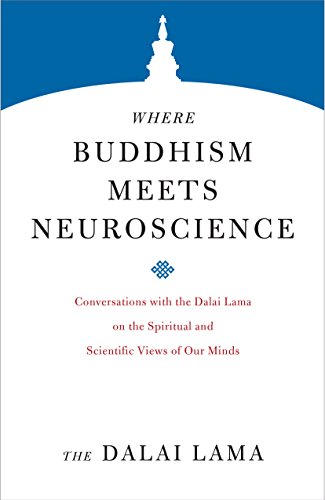
Ebook Info
- Published: 2018
- Number of pages: 216 pages
- Format: PDF
- File Size: 1.55 MB
- Authors: The Dalai Lama
Description
Designed as a conversation between the Dalai Lama and Western neuroscientists, this book takes readers on a journey through opposing fields of thought—showing that they may not be so opposing after all Is the mind an ephemeral side effect of the brain’s physical processes? Are there forms of consciousness so subtle that science has not yet identified them? How does consciousness happen? Organized by the Mind and Life Institute, this discussion addresses some of the most troublesome questions that have driven a wedge between Western science and religion. Edited by Zara Houshmand, Robert B. Livingston, and B. Alan Wallace, Where Buddhism Meets Neuroscience is the culmination of meetings between the Dalai Lama and a group of eminent neuroscientists and psychiatrists. The Dalai Lama’s incisive, open-minded approach both challenges and offers inspiration to Western scientists. This book was previously published under the title Consciousness at the Crossroads.
User’s Reviews
Editorial Reviews: About the Author THE DALAI LAMA is considered the foremost Buddhist leader of our time. The exiled spiritual head of the Tibetan people, he is a Nobel Peace Laureate, a Congressional Gold Medal recipient, and a remarkable teacher and scholar who has authored over one hundred books.
Reviews from Amazon users which were colected at the time this book was published on the website:
⭐In the forward, it talks about the conference being shortened from five days to two days. I definitely can see where this book could have benefited from more conversation exchange. That said, what exists is a quick read and a motivation to explore neuroscience from a different perspective.What is most remarkable is the ability for two seemingly different approaches to be compatible, or in the very least capable of respectful conversation.There are better neuroscience books and there are better books on Buddhism, but this is the first one I have found to combine the two, and it was very much enjoyable.
⭐Consciousness at the Crossroads: Conversations with the Dalai Lama on Brain Science and Buddhism is from the 1989 Mind and Life Conference, the second series of talks sponsored by the Mind and Life Institute. The institute is an organization promoting dialogue between the scientific and contemplative traditions. The first series of meetings, published as Gentle Bridges (Shambhala, 1992), provided a broad overview of the different areas that the field of Buddhism and science could potentially impact. The second conference similarly provides more breadth than depth, yet with a bit more focus on cognitive science, philosophy of mind, and meditation. The contributors are from a variety of fields, including neuroscience, philosophy, and psychiatry.The dialogue recounted in this book lays the foundations for future work in the realm of Buddhism and cognitive science. Some topics covered include the nature and phenomenology of consciousness, mental illness, and notions of the self. Tackling a young field, the discussion lacks systematic analysis and each contributor even seems to speak in isolation at times. Prior knowledge of Buddhism and/or science is recommended, but the content is so interesting almost any reader could find some merit in this book. This work is compelling, but incomplete, an understandable critique considering the book narrates one of the earlier series of many talks.
⭐This is a fantastic read as it dives into the science and specifics of Buddhism and the brain. One of many books I will suggest my psychology friends to read.
⭐As can be expected, a great discourse by the Dalai Lama
⭐Interesting convergence of neuroscience and Buddhist thinking. It was difficult not to like the Dalai Lama and I found his pragmatism about science a refreshing change from other religious leaders.
⭐Thank you!
⭐As I’ve learned more about Buddhism, I’ve been impressed by its emphasis on evidence and science – Buddhists believe that their theories need to be abandoned or updated if there is specific evidence disproving them. As a clinical psychologist, I’m also very interested in the workings of the brain, so when I saw this book at a used book sale, I snapped it up. This book stems from the Mind & Life dialogues, a series of conference-type conversations between the Dalai Lama and top scientists. I had never heard of these before happening upon this book, but in turns out that they date back to 1987. These conferences have been held every two years since that time, and according to the Mind & Life Institute website, the latest dialogue, the 33rd, was held in 2018.This book was based on an early dialogue, the second one, held in 1989. The dialogue centered around consciousness, including looking for areas of consensus between neuroscience and Buddhism, coming up with consensus definitions, and exploring areas for future direction. The book is written like a conversation–or, more accurately, the scientists presenting knowledge to the Dalai Lama, with the Dalai Lama frequently asking probing questions and occasionally providing the Buddhist perspective. Both sides are completely respectful, acknowledging that they have much to learn from each other. In fact, in his opening remarks, Dr. Robert Livingston, a neuroscience professor, states “We pay our respects to two different cultural traditions which have been separated for so very long…we must acknowledge our own humility and naivete: there are many things we don’t yet know about the brain and the mind.” After the introduction, each chapter of the book focuses on a specific area of consciousness, such as gross vs. subtle, specific brain functions, memory, dreaming, and mental illness. The book concludes with an overview of basic Buddhist tenets and beliefs, including how these apply to a scientific inquiry.I thoroughly enjoyed reading this book. I feared it might be overly scientific or technical, but the conversational nature made it very approachable. The only issue with this book is the length of time since the discussion took place. I am generally aware that our knowledge of consciousness has significantly increased in the 31 years since 1989, and I know specifically that much of what was described in Chapter 11 (“Psychiatric Illness and Psychopharmacology”) is now out-of-date. I would love to read an account of this same dialogue, but from 2020! This book is part of a series of 12 volumes, but the others appear to address different teachings of the Dalai Lama rather than the conferences per se. I definitely plan to seek out more of the Dalai Lama’s work and to follow the continued course of these amazing conferences.
⭐Very little material is presented at a very high price.
⭐Adorei o livro
⭐
Keywords
Free Download Where Buddhism Meets Neuroscience: Conversations with the Dalai Lama on the Spiritual and Scientific Views of Our Minds (Core Teachings of Dalai Lama) in PDF format
Where Buddhism Meets Neuroscience: Conversations with the Dalai Lama on the Spiritual and Scientific Views of Our Minds (Core Teachings of Dalai Lama) PDF Free Download
Download Where Buddhism Meets Neuroscience: Conversations with the Dalai Lama on the Spiritual and Scientific Views of Our Minds (Core Teachings of Dalai Lama) 2018 PDF Free
Where Buddhism Meets Neuroscience: Conversations with the Dalai Lama on the Spiritual and Scientific Views of Our Minds (Core Teachings of Dalai Lama) 2018 PDF Free Download
Download Where Buddhism Meets Neuroscience: Conversations with the Dalai Lama on the Spiritual and Scientific Views of Our Minds (Core Teachings of Dalai Lama) PDF
Free Download Ebook Where Buddhism Meets Neuroscience: Conversations with the Dalai Lama on the Spiritual and Scientific Views of Our Minds (Core Teachings of Dalai Lama)