Ebook Info
- Published: 2012
- Number of pages: 319 pages
- Format: PDF
- File Size: 27.91 MB
- Authors: Rudolf Carnap
Description
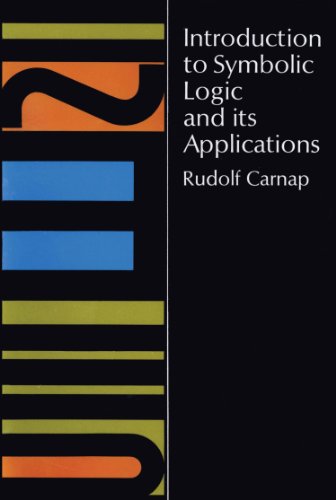
This book is one of the clearest, most comprehensive and rigorous introductions to modern symbolic logic available in any language. Professor Carnap, a world authority on symbolic logic, develops the subject from elementary concepts and simple exercises through the construction and analysis of a number of relatively complex logical languages. He then considers, in great detail, the application of symbolic logic to the clarification and axiomatization of various theories in mathematics, physics, and biology. Such topics as the nature and use of constants and variables, predicates, sentential connectives, truth-tables, universal and existential sentences, definitions, identity, isomorphism, syntactical and semantical systems and the relations between them, the system of types, varieties of relations, linear order, special operators, structures and cardinal numbers, descriptions, finite and infinite concepts, continuity, thing languages, coordinate languages, axiom systems for set theory, arithmetic, geometry, space-time topology, biological concepts, and many other subjects, are covered in detail. The logic of relations is given a particularly extensive treatment. Hundreds of problems, examples, and exercises are included to give students practice in the techniques of symbolic logic and their usage.
User’s Reviews
Reviews from Amazon users which were colected at the time this book was published on the website:
⭐Kurt Godel came along and sorta messed up the Vienna Circle’s dream of a completely axiomatic basis for human knowledge, but, if it could be done, this is the manual for it. Still, when I teach, I like to “crack the topic open and show my students what’s under the hood and how those things work” and, although it’s not terribly easy to follow Mr. Carnap, he certainly shows the inner workings of logic. It’s a classic. It deserves classic status.
⭐Without a doubt the best work out there on symbolic logic I have come across. Even though that’s the title and primary focus of the work (i.e. Symbolic Logic), Carnap also manages to brilliantly and effortlessly tie in many related topics (rudiments of modality, relations, analytical/synthetic distinctions, etc.) with incredible dexterity and clarity. A true work of genius and a model for all would-be instructors on how to present.
⭐I suggest reading Symbolic Logic, 3rd Edition first- this book id ok but I would not start with it
⭐Good Quality
⭐Thorough, but difficult for non-mathematician.
⭐Great book! Great service!
⭐Rudolf Carnap was one of the greatest philosophers of the 20th century, and the only student of Frege’s worth thinking about. But what a student!This is his intro text, a doubtful first text, but full of insight for those who already know some logic. Carnap trained as a mathematician; surprisingly, his text is of value mainly for philosophers. For instance, this is the ONLY undergrad logic text I know that grapples with the intension-extension dichotomy, with the Carnap-Morris syntax-semantics-pragmatics trichotomy. Metatheory is nonexistent, and Carnap’s notion of proof is emphatically too casual for my taste.The book is also dated. In its treatment of first order logic, Carnap is a bit too loyal to Principia Mathematica. His axioms are a bit pedantic, a bit inelegant for my taste. (Quantified formulae are much easier to work with than Carnap and his contemporaries realized; all you need to do with quantified variables is to instantiate them! See the “main method” of Quine’s Methods of Logic.) You won’t learn any natural deduction, truth trees, or Gentzen sequents here. You most definitely won’t learn anything about recursion. But the exposition incorporates thoughout Carnap’s greatest discovery: his formal theory of semantics. You will also learn more about the logic of relations than you will in any other undergrad text. You will be given an idea of the mathematical power of logic (infinity, continuity, numbers). You will even be introduced to the lambda calculus, Alonzo Church’s great discovery. Carnap was comfortable with the notion of a predicate letter like few logicians since.Part II of the book is without parallel anywhere: an introduction to a very wide range of axiomatic theories, presented as interesting applications of modern formal logic. This is a wonderful reference for ZF set theory, Peano axioms, Tarski’s axioms for the reals, the Hausdorff- Bohnenblust axioms for topology, axioms for geometry, space-time, and mirabile dictu, even mereology. Other texts present at most the first 2 items on this list.
⭐It is my experience as a reader that good books are always books that have lots of examples because they make our understanding easier. Therefore, if this math book has examples in it, then it must mean it is very good.So I recommend that whenever you have a chance to see it that you buy it.
⭐A mio parere, una delle migliori introduzioni alla logica simbolica e ai fondamenti della matematica mai scritte. Ne esiste una traduzione italiana, che però, purtroppo, presenta alcuni errori tipografici.
⭐
Keywords
Free Download Introduction to Symbolic Logic and Its Applications in PDF format
Introduction to Symbolic Logic and Its Applications PDF Free Download
Download Introduction to Symbolic Logic and Its Applications 2012 PDF Free
Introduction to Symbolic Logic and Its Applications 2012 PDF Free Download
Download Introduction to Symbolic Logic and Its Applications PDF
Free Download Ebook Introduction to Symbolic Logic and Its Applications