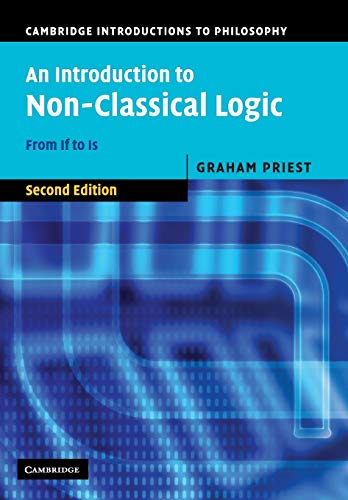
Ebook Info
- Published: 2008
- Number of pages: 646 pages
- Format: PDF
- File Size: 3.16 MB
- Authors: Graham Priest
Description
This revised and considerably expanded 2nd edition brings together a wide range of topics, including modal, tense, conditional, intuitionist, many-valued, paraconsistent, relevant, and fuzzy logics. Part 1, on propositional logic, is the old Introduction, but contains much new material. Part 2 is entirely new, and covers quantification and identity for all the logics in Part 1. The material is unified by the underlying theme of world semantics. All of the topics are explained clearly using devices such as tableau proofs, and their relation to current philosophical issues and debates are discussed. Students with a basic understanding of classical logic will find this book an invaluable introduction to an area that has become of central importance in both logic and philosophy. It will also interest people working in mathematics and computer science who wish to know about the area.
User’s Reviews
Editorial Reviews: Review “This revised and considerably expanded second edition is over twice as long and contains a new second part on quantification and identity for all the logics appearing in the first part of the book, which also contains much new material. Due to the author’s clear and approachable style, this book may be interesting to a large circle of logicians, mathematicians and philosophers. Students with a basic understanding of classical logic will find this book an invaluable introduction to an area that has become of central importance in logic, philosophy and, generally, in the methodology of science.” Branislav Boricic, Mathematical Reviews Book Description This revised and considerably expanded 2nd edition brings together a wide range of topics, including modal, tense, conditional, intuitionist, many-valued, paraconsistent, relevant, and fuzzy logics. All of the topics are explained clearly using devices such as tableau proofs, and their relation to current philosophical issues are explained. About the Author Graham Priest is Boyce Gibson Professor of Philosophy, University of Melbourne. His most recent publications include Towards Non-Being (2005) and Doubt Truth to be a Liar (2006). Read more
Reviews from Amazon users which were colected at the time this book was published on the website:
⭐If you are like me and find the tableaux method, alternatively referred to as “truth trees,” annoying preferring the axiom approach then this is not the book for you. If you are indifferent or enjoy the tableaux method then this is an excellent book that would be a five star rating for you. It depends on your logical proclivities.
⭐Beautiful book. I learned in hours what I had been trying to learn for months. The only bad thing is now I’m spoiled and feel like any presentation of a logical system not done by Priest isn’t clear enough for me.
⭐no comment
⭐very easy to understand and extremely clear, that was unexpected!
⭐The author has apparently never heard of free-prose, as every paragraph is numbered! Odd style aside, its a fairly complete compendium of non-classical logics.
⭐It totally did. Actually, the books is way better than I was expecting.
⭐Not a user friendly book. In good condition though.
⭐Priest does a wonderful job in explaining a surprisingly wide spectrum of non-classical logics, with a crystal-clear style, from both the mathematical and the philosophical point of views.For those who are only used to classical logic, this book is simply illuminating.Some points need to be improved though : the list of symbols is missing and the index is far from complete…The difficulty of part II is not due so much to the intrinsic intricacies but mostly to the constant need to review the corresponding chapters of part I… But this is unavoidable if one wants to include quantifiers and identity… And, here again, Priest does a terrific job in unifying the underlying concepts of possible-worlds semantics.This book now stands in my list of outstanding books on logic :1. A. Tarski’s “Introduction to Logic”, a jewel, followed by P. Smith’s superb entry-point “An introduction to Formal logic” and the lovely “Logic, a very short introduction” by Graham Priest2. D. Goldrei’s “Propositional and Predicate calculus”3. Wilfrid Hodges’ “Logic”, followed by Smullyan’s “First-order logic”.4. P. Smith’s “An introduction to Gödel’s theorems”.5. Kleene’s “Introduction to metamathematics” & “Mathematical Logic”.6. G. Priest’s ” Introduction to non-classical logic”.Hence forgetting altogether Van Dalen’s indigestible “Logic & Stucture” as well asthe even more indigestible Enderton, Mendelson & al…
⭐A classic, thought-provoking and engaging textbook.
⭐Delivery was fast and the book is a good resource for learning non-classical logic. It is fairly technical so I would reccomend having some prior knowledge of logic. Priest is very knowledgable on the subject; in addition to this text he wrote the Oxford Very Short introduction for Logic which is an excellent companion to this text and goes over basics in an easily comprehensible form.
⭐Priest does a wonderful job in explaining a surprisingly wide spectrum of non-classical logics, with a crystal-clear style, from both the mathematical and the philosophical point of views.For those who are only used to classical logic, this book is simply illuminating.Some points need to be improved though : the list of symbols is missing and the index is far from complete…The difficulty of part II is not due so much to the intrinsic intricacies but mostly to the constant need to review the corresponding chapters of part I… But this is unavoidable if one wants to include quantifiers and identity… And, here again, Priest does a terrific job in unifying the underlying concepts of possible-worlds semantics.This book now stands in my list of outstanding books on logic :1. A. Tarski’s “Introduction to Logic”, a jewel, followed by P. Smith’s superb entry-point “An introduction to Formal logic” and the lovely “Logic, a very short introduction” by Graham Priest2. D. Goldrei’s “Propositional and Predicate calculus”3. Wilfrid Hodges’ “Logic”, followed by Smullyan’s “First-order logic”.4. P. Smith’s “An introduction to Gödel’s theorems”.5. Kleene’s “Introduction to metamathematics” & “Mathematical Logic”.6. G. Priest’s ” Introduction to non-classical logic”.Hence forgetting altogether Van Dalen’s indigestible “Logic & Stucture” as well asthe even more indigestible Enderton, Mendelson & al…
⭐This is a superb survey of non-classical logic. I’ve used it several times in advanced undergraduate reading courses and it presents an enormous amount of material in a brisk yet very accessible way. Suitable for those who have already taken some basic logic.
⭐Great book, but it arrived damaged.
Keywords
Free Download An Introduction to Non-Classical Logic, Second Edition: From If to Is (Cambridge Introductions to Philosophy) in PDF format
An Introduction to Non-Classical Logic, Second Edition: From If to Is (Cambridge Introductions to Philosophy) PDF Free Download
Download An Introduction to Non-Classical Logic, Second Edition: From If to Is (Cambridge Introductions to Philosophy) 2008 PDF Free
An Introduction to Non-Classical Logic, Second Edition: From If to Is (Cambridge Introductions to Philosophy) 2008 PDF Free Download
Download An Introduction to Non-Classical Logic, Second Edition: From If to Is (Cambridge Introductions to Philosophy) PDF
Free Download Ebook An Introduction to Non-Classical Logic, Second Edition: From If to Is (Cambridge Introductions to Philosophy)