

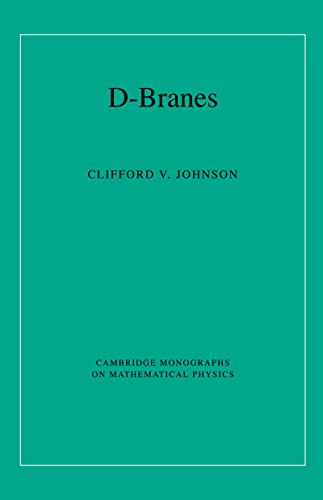
Ebook Info
- Published: 2002
- Number of pages: 574 pages
- Format: PDF
- File Size: 3.21 MB
- Authors: Clifford V. Johnson
Description
D-branes represent a key theoretical tool in the understanding of strongly coupled superstring theory and M-theory. They have led to many striking discoveries, including the precise microphysics underlying the thermodynamic behaviour of certain black holes, and remarkable holographic dualities between large-N gauge theories and gravity. This book provides a self-contained introduction to the technology of D-branes, presenting the recent developments and ideas in a pedagogical manner. It is suitable for use as a textbook in graduate courses on modern string theory and theoretical particle physics, and will also be an indispensable reference for seasoned practitioners. The introductory material is developed by first starting with the main features of string theory needed to get rapidly to grips with D-branes, uncovering further aspects while actually working with D-branes. Many advanced applications are covered, with discussions of open problems which could form the basis for other avenues of research.
User’s Reviews
Reviews from Amazon users which were colected at the time this book was published on the website:
⭐This book has some highlights and some dark places. First of all Johnson is not Witten and so he is not able to explain like the master himself with the clarity and insight that Witten does in his coauthored two volumes. Yes he does give some very handful insights on some topics, specially when addressing bosonic and super-strings. One thing that I really liked was his discussion of T-duality and how from there he explains the natural appearance of the so called D-brane objects. But after chapter seven which is about superstrings things start getting very VERY ESOTERIC, I just skipped most of chapters 8 & 9, to land on chapter 10 about Geometry of Branes where he gives a good discussion of standard black hole material, like the Reissner-Nordstrom metric and then uses this for the metrics you can get using Branes, at least I saw the different dualities (apart from the T-duality) the S-duality and the Large N-gauge duality but after chapter 12 I just started skipping most of the material because the level of esoteric discussions is high, more specifically I just skipped the whole of chapters 13 and 15 called “D-branes and Geometry I” and “D-Branes and Geometry II” respectively, I did have a go through chapter 14 “K3 orientifolds and compactifications” and it was nice to see the so called “Eguchi-Hanson” metric of K3 manifold and the understanding of the “blowing up” procedure that takes you from an Orientifold into a K3 manifold (although these topics are on chapter 7) and they connect for obvious reasons with chapter 14, but since chapter 14 is more on compactification than on K3 manifolds and I had already gone through Green, Schwarz and Witten all the way into compactifications I just skipped the rest of it. He talks about the F-string (Fundamental string) and the D-string but I didn’t get it quite clear sadly, also on chapter 16 “Towards M- and F-Theory” he talks about the so called (p,q)-Fivebrane and the Sevenbrane but I didn’t know what the heck was he talking about! the material is just simply too esoteric and you need better explanations, also the book is plagued with typos my god! this makes reading quite difficult at times! As I was interested in dualities, M-theory, F-theory, Matrix Theory, D-Branes but not on how to describe or count the entropy of a blackhole to make contact with the Thermodynamics of these I didn’t even bother with chapter 17 “D-branes and black holes”, went straight to some of 18 “D-branes, gravity and gauge theory” where he addresses the AdS/CFT correspondence. IN this chapter he gives the recipe or dictionary between the AdS gravity theory and the Conformal field theory, although he never talks before this about the conformal theory in the boundary! The dictionary is basically that you can equate both partition functions of the theories evaluated with their respective fields Zads=Zcft.But again Johnson is not a brilliant expositor for such esoteric themes in general and the book does not take you too much in depth because you get los in the esoterics of the maths and explanations that’s why I gave it only 3 stars…………My plan now is to come back to the second half of Zwiebach which precisely talks of D-branes but for undergraduates and then after that take the book of Richard J Szabo and after that pick Kiritsis “String Theory in a Nutshell” after that I probably will come back on Johnsons D-brane’s and on Becker Becker and Schwarz (BBS) for the end chapters, ah! Johnson simply does not talk anything about fluxes and flux compactifications which BBS does! But this book will add some value to your understanding although not all of that you may had wished for though.
⭐It is not an exaggeration to say that string theory is the most complicated physical theory ever constructed. But the complexity of string theory does not have its origin in the underlying physics, but rather in the type of mathematics that is used. To do research in the frontiers of string theory entails that one needs to become an expert in areas such as algebraic geometry, complex manifolds, and algebraic and differential topology. And this expertise does mean a mere formal or computational mastery of these areas, but rather deep insight into the concepts that are used in them. This insight is best obtained from speaking directly to the mathematicians who developed these concepts, but they are not always accessible to the researcher. Therefore such researchers must rely on what is in print, and the string theory literature, along with the mathematical literature that supports it, is usually not written in a way that gives the interested reader the needed insight. The latter is typically much too formal, and in the interest of mathematical rigor the intuition behind the concepts has been completely removed.This book, which emphasizes the research in string theory that has been done in the last decade (the so-called “second superstring revolution”), is one that is of assistance in granting this insight. The author discusses the theory of D-branes, which loosely speaking is a high-dimensional generalization of string theory. The theory of D-branes though was not invented out of sheer fancy, but rather to resolve certain issues in ordinary string theory. Ordinary string theory was invented because of the difficulties in deriving a workable theory of quantum gravity from quantum field theory. That string theory gives a successful theory of quantum gravity is currently hotly debated, but the author of this book believes that it has, at least in what is ubiquitously called the `perturbative regime.’ But just as in ordinary quantum field theory, where the performing of calculations involving particles that subjected to strong interactions is difficult, so is the understanding of strongly coupled strings.The theory of D-branes tackles the issue of strong coupling by bringing in the concept of `duality.’ Loosely speaking, duality is a kind of transformation that operates on a strongly coupled theory of strings and gives a weakly coupled theory. The author introduces duality by studying the spectrum of strings that are propagating in a spacetime with a compact direction. Readers who have done calculations in quantum field theory in Kaluza-Klein spacetimes will find somewhat familiar territory here. There is an interesting difference in the case of strings however in relation to the compact dimension. As the author points out, closed strings can wrap around the compact direction, the net result being that the spectrum of states will contain some with mass proportional to the radius. Therefore if the radius decreases, these states, called `pure winding states’ will become lighter. Further, they form a continuum as the radius decreases to zero, leading to the reappearance effectively of the uncompactified dimension. The mathematical formula for the spectrum also has the property that it is invariant under the interchange of the radius with its inverse, implying that a string that propagates on a large circle can be related to a string that propagates on a small circle. This is the famous `T-duality’ that is widely discussed in the literature. When one considers the case of open strings, where attention must be paid to the boundary conditions, the T-duality transformation interchanges Neumann and Dirichlet boundary conditions. The ends of the string lie on special hypersurfaces called D-branes, which are of course the main focus of this book.So what do D-branes do for a theory of elementary particle interactions? Why should an inspiring researcher in elementary particle physics choose to study their properties? The author’s treatment of these properties in the book reveals many reasons why D-branes are important. One has to do with the possibility of discovering a new conception of spacetime than what was available in quantum field theory. Another reason was mentioned above: D-branes allow one to probe the non-perturbative regime, which has traditionally been very difficult to deal with. Also, D-branes are “localized” solutions to string theory, and provide backgrounds in which strings can propagate. In addition, the low-energy dynamics of D-branes can be related to ordinary gauge theory, in that the spacetime in which the D-branes move can be interpreted with reference to the vacuum expectation values of scalars in a world-volume gauge theory.Further, D-branes can be used to study M-theory, the latter being the formulation of string theory that caused so much excitement among theorists. M-theory related the five different string theories to each other using duality transformations, but it is still unclear as to the true nature of M-theory. There have been several proposals for studying M-theory, going by the names `matrix theory’ and `F-theory.’ The author studies these approaches and how D-branes are used in them in the book. The reader will note that the mathematics begins to get very esoteric in these discussions, particularly in the use of algebraic geometry in the examining the properties of the type IIB string in terms of F-theory.Since D-branes shed light on the non-perturbative properties of string theory, and the latter is viewed as a theory of quantum gravity, it would be natural to assume that D-branes could be used to understand the physics of black holes. The author spends a good portion of the book in discussing just how effective D-branes are in accomplishing this. He shows that one can construct a black hole out of the geometry of D-branes for D = 5, and derives the metric for this geometry. Even more interesting (and controversial) is that he claims when doing this that he has found a microscopic description of black holes. These properties of D-branes motivate him to consider in more detail the consequences of duality, which he does by showing a duality between large N gauge field theory and gravity.
⭐This book hits a huge range of topics which you won’t find in other string books, and it includes numerous extremely useful mathematical tidbits and tricks of the trade. It is very concise, hence moves quickly and one may not always be able to fill in all the gaps; but try getting the same material out of the original literature before being too critical! The number of typos is dismaying and I certainly hope this is corrected. Nevertheless, I think a very good first stop for this material (note, NOT a good first stop for string theory in general. Do not try to learn string theory basics from this book).
Keywords
Free Download D-Branes (Cambridge Monographs on Mathematical Physics) in PDF format
D-Branes (Cambridge Monographs on Mathematical Physics) PDF Free Download
Download D-Branes (Cambridge Monographs on Mathematical Physics) 2002 PDF Free
D-Branes (Cambridge Monographs on Mathematical Physics) 2002 PDF Free Download
Download D-Branes (Cambridge Monographs on Mathematical Physics) PDF
Free Download Ebook D-Branes (Cambridge Monographs on Mathematical Physics)