

Ebook Info
- Published: 2012
- Number of pages: 723 pages
- Format: PDF
- File Size: 5.13 MB
- Authors: Peter West
Description
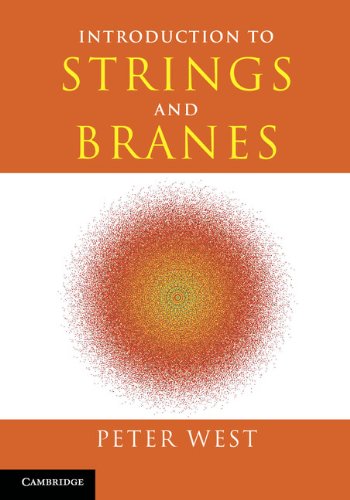
Supersymmetry, strings and branes are believed to be the essential ingredients in a single unified consistent theory of physics. This book gives a detailed, step-by-step introduction to the theoretical foundations required for research in strings and branes. After a study of the different formulations of the bosonic and supersymmetric point particles, the classical and quantum bosonic and supersymmetric string theories are presented. This book includes accounts of brane dynamics and D-branes and the T, S and U duality symmetries of string theory. The historical derivation of string theory is given as well as the sum over the world-sheet approach to the interacting string. More advanced topics include string field theory and Kac–Moody symmetries. The book contains pedagogical accounts of conformal quantum field theory, supergravity theories, Clifford algebras and spinors, and Lie algebras. It is essential reading for graduate students and researchers wanting to learn strings and branes.
User’s Reviews
Reviews from Amazon users which were colected at the time this book was published on the website:
⭐December 2016 and October 2017, I had the pleasure of reading two interviews with Physicist Steven Weinberg. Being a longtime student of Steven Weinberg (his textbooks: General Relativity, Quantum Field Theory, Cosmology), I took to heart two things that Weinberg stated in those interviews: “theory can only go so far without experiment ” (Cern Courier, 2016) and “…string theory is still the best hope we have…” (Hong-Jian He, 2017). Which brings me to the text by Peter West: one amazon reviewer has written that a possible sequence to studying the topic would be Hatfield (1992), Zwiebach (2004), Becker (2007) then to West, finally Polchinski. I had vowed not to open another string theory textbook (having studied from all of the above except Polchinski ). Yet, Weinberg’s comments nagged at my conscience ! So, I re-visited the topic utilizing Peter West’s textbook. I’m glad I did. At least, glad I followed Peter West’s advice (preface) for the shortest route to follow: Study sections 1.1 to 1.23, then, Chapters 2, 3, 4, 5, 7, Sections 8.1-8.3, Chapters 9,10, Sections 13.3-13.84, Chapter 14, finally, Sections 18.1-18.2. Read: “…to get to grips with the basics of string theory in the quickest possible time…” Sound advice ! Given my lack of knowledge as it pertains to string theory, I can only add that Peter West has produced a pedagogic masterwork. West supplies physical motivation and provides enough detail to understand the derivations (leaving the easier manipulations for the reader). The writing is lucid, the sequence of topics is a bit different (if not, better) than the aforementioned Zwiebach and Becker. We get historical perspective. Keep in mind: if topics such as normal ordering or path integrals are foreign to you, revisit Hatfield’s text first ! Words from West:(1) ” twistors…are most suited to describing massless particles” (page 25), in which we get a review of twistor theory !(2) ” In general, one cannot correctly quantize a system by first solving the classical equations of motion and then using the constraints so obtained as variables in the quantum theory.” (page 45).(3) “…in some sense they–relativistic strings–take to quantum mechanics like a duck to water (chapter 3).(4) “in this book, the name superstring refers to any string theory that possesses world-sheet supersymmetry, whether or not this results in a theory with space-time supersymmetry.” (page 120).(5) “…although the theories of interest that arise in string theory are defined in two-dimensional Minkowski space, as discussed in the previous chapter (referring to chapter eight), we will Wick rotate them to Euclidean space and work in the Riemann sphere.” (page 210).(6) “A remarkable peculiarity of two dimensions is that it is possible to express fermions in terms of bosons and vice versa.” (page 221 ).(7) ” We take a supergravity theory to be one that has some supersymmetry and contains gravity, but no higher spin fields.” (page 320 ). Here, chapter 13, you get four ways to construct a supergravity theory (these being: Noether, superspace, gauging, dimensional reduction). Surely, this is one of the finest introductory accounts extant. ‘Introductory,’ of course, is in the eye of the beholder, as much of this can be quite technical ! This chapter paves the way to the next chapter:(8) P-branes: “…string duality symmetries imply that string theory should be extended to a theory that includes branes on an equal footing with strings…” (page 420).(9) The final chapter read: “….will allow the reader to see how string theory began and also gain some appreciation of these amazing calculations that are rather forgotten these days.” (page 627). Section 18.2 is the path integral approach and Section 18.3 is the group theoretical approach.(10) Appendix A (BRST and Dirac quantization) is prerequisite to the second chapter. Appendix B provides conventions for spinors. Appendix C is a survey of Riemann sphere and complex plane (very nice) and Appendix D gives properties of classical lie algebras. There are twenty pages of references (identified for each individual chapter) which concludes the textbook. Now, my study of the text followed the “shortest ” avenue as laid out by Peter West. Thus, I have neglected much. However, I thank Peter West (also Steven Weinberg ) for rekindling my interest in this topic. I may never open another text on string theory, and I really do not follow this line of research, however, I do recommend this textbook ! It is well written, thoughtful, somewhat idiosyncratic. Finally, let me quote from Professor Michael Berg’s MAA Review: “Let me say that I really, really like this book, and hope to have the time before too long to sit down for quite a spell and do what I recommended above, namely, doodle all over its margins while trying to learn this stuff…”
⭐First off, this is not for the general reader. The last page that I remember not having an equation on it was the preface. Seriously. 🙂 I’m interested in string theory, but I’m not a physicist and am now in my 40’s, so I admit that I enjoy the “glossy” overviews of the theory. While I am an engineer and took several physics classes in my youth, I’m now content with the general theories and am more a fan of Brian Greene and his ability to convey the theory to the masses.I had the privilege to receive this book for free as part of the Vine program, and I jumped at the chance to read up on strings and branes. I find the topic fascinating, and I thought that it might provide me with some good insight. I didn’t pick up on the part of the description that mentions graduate students – it really is meant for study at that level. My mistake, and clearly I’m not the smartest reviewer here. :DThere is a lot of detail in this book. Truthfully, more than I’ll ever need. If you are interested in the theories and the math behind them, this is a good choice. It really is for college-level study. If you are just interested in the general concepts, this is not a good choice. This is intended for people who want a much deeper understanding of the theories and the mathematics behind them. So, if you’re brave, order a copy and get your NoDoz ready. The mid-term exam is next Friday. 😉
⭐This is an excellent introduction to modern string theory. Accurate, precise, and gets into details that other introductions to string theory pass over in silence. Becker, Becker and Schwarz move too fast over the basics, and their coverage of conformal field theory, the operator product expansion, etc, is too perfunctory. West covers all these topics in detail and has a better treatment of the conformal Ward identities than Di Francesco et al.The most elementary, serious introduction to string theory is Zwiebach’s book which suits upper undergraduates. But Zwiebach, while excellent for its purposes, does not go too far into the subject, does not cover conformal field theory, covariant quantization, etc. West’s book takes off from the point where Zwiebach ends.Polchinski’s book is too heavy going for first year graduate students. Kritisis is too fast for beginners. Volume 1 of Green, Schwarz and Witten is excellent, but I find that West has more details. Their volume 2 is advanced, but covers topics that are by now outdated. Ortin’s book is excellent, but is basically a (super)gravity textbook. Another excellent textbook that is not so well known is Brian Hatfield’s book. Its first half is devoted to quantum field theory, primarily from a path integral point of view, while its second half is a very careful treatment of the bosonic string, primarily from Polyakov’s point of view. I think that one can read Hatfield’s book before West’s, and the right sequence to learn string theory may be Zwiebach, Hatfield, West, then Polchisnki.
⭐The interested student or researcher will meaningfully learn the theory of strings and branes from this book. There are other books pitched at different levels but this book is one which appeals to anyone who is willing to do some rough working out while reading it. Excellently written explanations of very colourful topics.
⭐Best book I’ve seen to introduce topics ranging from string theory to supergravity – Highly recommended for PhD students and research.
Keywords
Free Download Introduction to Strings and Branes 1st Edition in PDF format
Introduction to Strings and Branes 1st Edition PDF Free Download
Download Introduction to Strings and Branes 1st Edition 2012 PDF Free
Introduction to Strings and Branes 1st Edition 2012 PDF Free Download
Download Introduction to Strings and Branes 1st Edition PDF
Free Download Ebook Introduction to Strings and Branes 1st Edition