

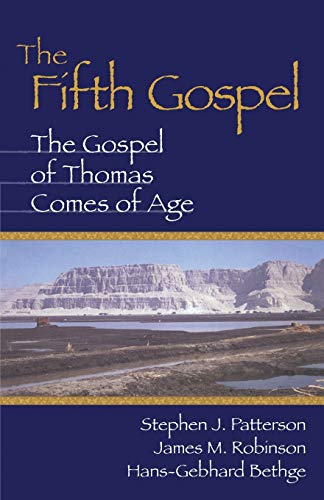
Ebook Info
- Published: 1998
- Number of pages: 128 pages
- Format: PDF
- File Size: 0.00 MB
- Authors: Stephen J. Patterson
Description
…
User’s Reviews
Editorial Reviews: Review “This is an excellent new presentation of the Gospel of Thomas for a general audience, and it will be a very useful textbook.”—Fred W. Burnett, Anderson University, reviewing for Religious Studies Review, July 1999 (Fred W. Burnett Religious Studies Review)”I hardly thought there was need for a new translation of the Gospel of Thomas until I read this one…this translation…advances the grace and ease of translation more than any previous one…This translation also distinguishes itself by clarifying some of the more obscure and difficult readings of the Gospel of Thomas. Although scholars may disagree with the reading, the general reading public will find them more accessible…In all this is an excellent translation.”—Richard Valantasis, Iliff School of Theology, as printed in Review of Biblical Literature, October 1999 (Richard Valantasis Review of Biblical Literature)”The translation will likely become the standard for citation in the future.”—Edgar Krentz, Currents (Edgar Krentz)”As an introduction to the Gospel of Thomas, The Fifth Gospel is ideal. It is the perfect book for anyone wishing to know more about its content and discovery, while also introducing the reader to the most prevelant issues regarding the relation of the Gospel of Thomas to the New Testament and the historical Jesus.”—Dr. J. Liebenberg, (UNISA) Theological Studies June 2002 (Dr. J. Liebenberg)”This is an excellent new presentation of the Gospel of Thomas for a general audience, and it will be a very useful textbook.”—Fred W. Burnett, Anderson University, reviewing for Religious Studies Review, July 1999 (Sanford Lakoff Religious Studies Review)”I hardly thought there was need for a new translation of the Gospel of Thomas until I read this one…this translation…advances the grace and ease of translation more than any previous one…This translation also distinguishes itself by clarifying some of the more obscure and difficult readings of the Gospel of Thomas. Although scholars may disagree with the reading, the general reading public will find them more accessible…In all this is an excellent translation.”—Richard Valantasis, Iliff School of Theology, as printed in Review of Biblical Literature, October 1999 (Sanford Lakoff Review of Biblical Literature)”The translation will likely become the standard for citation in the future.”—Edgar Krentz, Currents (Sanford Lakoff)”As an introduction to the Gospel of Thomas, The Fifth Gospel is ideal. It is the perfect book for anyone wishing to know more about its content and discovery, while also introducing the reader to the most prevelant issues regarding the relation of the Gospel of Thomas to the New Testament and the historical Jesus.”—Dr. J. Liebenberg, (UNISA) Theological Studies June 2002 (Sanford Lakoff) From the Back Cover In December 1945, at the base of cliffs that run along the Nile River near the modern-day town of Nag Hammadi, an Egyptian farmer discovered, in a sealed jar, thirteen ancient Coptic codices containing more than fifty separate tracts. This discovery represented arguably the most significant manuscript discovery of the twentieth century for the study of the New Testament and Christian origins. Of all the texts in this Nag Hammadi Library, none has been more celebrated than the Gospel of Thomas–a Gospel that has played a crucial role in the newly emerging view of early Christianity as a very diverse phenomenon and in the recent revival of historical Jesus studies. Now, after more than fifty years of study, the best text and the best translation of Thomas are presented here in user-friendly form by the Berlin Working Group for Coptic Gnostic Writings, with Stephen J. Patterson and James M. Robinson. In addition, two essays have been included for persons who may be unfamiliar with this new Gospel or with events that led to its discovery and publication. The first, by Patterson, is a general introduction to the Gospel of Thomas as it appears fifty years after its discovery. The second, by Robinson, tells the fascinating story of that discovery itself by one who was directly involved in bringing this new Gospel to light. An annotated list “for further reading” completes the volume. Stephen J. Patterson is Associate Professor of New Testament at Eden Theological Seminary and author of The God of Jesus: The Historical Jesus and the Search for Meaning (Trinity Press). James M. Robinson is Director of the Institute for Antiquity and Christianity, The Claremont Graduate School, and editor of The Nag Hammadi Library. About the Author … Read more
Reviews from Amazon users which were colected at the time this book was published on the website:
⭐I think the translation flows very well. Only a scant few lines of the translation didnt flow well or didnt resonate properly. I’ve read some other translations and just got an ugly feeling from them, like outside agendas or beliefs were leaking into their translation.I believe the Gospel of Thomas to be a true written account from one of the Apostles of Christ.
⭐I thought the author did a excellent job of laying out the ideas and the saying of Thomas. Highly recommened
⭐The authors, Stephen Patterson and James M. Robinson, need no introduction to anyone who follows historical N.T. studies. As members of the Jesus Seminar, both have played key roles in weaving Thomas into scholarly discussion of the gospel narratives, and Robinson in particular has had a huge hand in shaping the direction of gospel studies in general with his lead on the “Q sayings gospel”. This book also presents a fine translation of Thomas, working from a German scholarly translation, and it is worth the price of the book alone.So with a cheery intro like that and the impressive credentials of both authors (particularly Robinson), what could possibly be less than perfect? Well, let me briefly state the main problem- it boils down to a question of assumptions behind a particular methodology. I will keep the discussion general, centered on the “sayings” gospel, of which the so-called “Q” material and Gospel of Thomas are held to be representative. One of the assumptions proposed concerns the matter of weighing what was the “earliest layer” of the teachings of Jesus (as if modern scholars could nail it down with confidence)! Helmut Koester first proposed the suggestion that the earliest “layer” embedded within the narrative Synoptic gospels seemed (to him) to be a sapiential layer of “wisdom sayings” or a “wisdom gospel” (Logoi Sophon). Koester and other scholars noticed, for example, a cluster in Matthew 23:34-36 where presumably “Sophia” (Wisdom) is speaking, to the effect that She had sent numerous prophets and sages throughout Israel’s history, only to see them be rejected and persecuted. This “Sophia” quote perhaps might be referencing an old Jewish “wisdom” trajectory external to (and prior to) the formation of the gospel narratives. Not only that, other sapiential clusters found embedded in the Synoptics were also judged “early”, speculated to perhaps be closer to Jesus’ own teaching than much of the Synoptic narrative stories… These clusters consisted of various “sayings” of Jesus, the core of which were assembled by Matthew around his Sermon on the Mount (and Luke’s version “on the Plain”).Already at this point, however, we see some determinations having been made on what should be considered “primary” and what shouldn’t (I prefer the word “authentic”, as in “going back to Jesus himself” or not- so it is more clear where we stand)…We are, of course, following the reasoning of certain scholars, not only Koester but James Robinson’s work on the “Q gospel” and John Kloppenborg’s further analysis of various “layers” or “strata” in “Q”. So what’s the big deal? Let’s give an example: for the moment let’s take Koester’s working hypothesis of an “early wisdom layer” as a given. Since we are only looking at a certain type of material with that assumption, these scholars postulated that the LEAST typical of this early genre was an apocalyptic layer (such as certain difficult “Son of Man” and “end-of-the-age” content, attributed to Jesus in the Synoptics). But are we really saying anything surprising or insightful with this observation…considering the methodology we are looking at? After all, one shouldn’t expect apocalyptic material to show up if one cherry-picks only a limited range of “wisdom” material to focus in on, correct? 🙂 And this is precisely the rub: the “later trajectories” postulated by scholars such as Kloppenborg assume reasonableness *ONLY* if Koester’s initial isolation of a “sapiential layer” being the sole core is accurate. That is, one has to buy Koester’s original assumption of only a narrow range of material being “primary” before other assumptions can be made, such as judging other genre we see in the Synoptics to be “secondary redaction”.One should realize from all this that the various sequential trajectories postulated rise or fall with Koester’s own initial assumptions- if his “sapiential core” is too limited, then the “secondary” tags assigned by these scholars to non-sapiential material needs reassessment. (It may simply be impossible to determine these issues with any real certainty historically, alas).One should also remember the “wisdom genre” was originally a “working” hypothesis, a thesis, if you will, from Koester- it shouldn’t be assumed to be the result of any “historical” finding, per se. From what one reads in some of the literature concerning the “assured results of modern scholarship”, however, the speculative nature of the hypothesis tends to get lost and one finds remarkable confidence in “rediscovering” this “lost gospel since the 1st century”. Would that this confidence was shared by all scholars… :-). At any rate, let’s talk a bit more about arbitrary assumptions. What is important here to realize is that the “sayings” material has a very *specific* content – which include only a limited range of material such as the parables, wise sayings, the legal pronouncements, etc.. Think of Matthew’s Sermon on the Mount as basically representing the core of what scholars like Robinson and Patterson see as the “authentic” voice of Jesus…but not much more than this particular genre.Conservative readers might be surprised (or probably not) that a good amount of material seen in the Synoptics, such as apocalyptic content, the so-called “signs” gospel (i.e., the miracle stories), clusters showing Jesus possibly believing his own status was special, Synoptic pronouncements of judgment upon Israel, etc., are not considered authentic (i.e., going back to Jesus).Koester certainly deserves credit for noticing a connection between an ancient strata of Jewish “wisdom” literature and Jesus, but regardless of the value of his initial thesis, a tendency was already initiated here of isolating out only certain types of sayings and theological content as “typical” of the “earliest” genre. But upon what basis do we have the right to make this determination- Koester’s own views? The Jesus Seminar’s own views? What if Koester’s proposal was too limited? We certainly can’t use criteria such as the “age” of the material – in the Hebrew literature, the “wisdom” (Sophia) trajectory is no more ancient, particularly, than other layers such as apocalyptic content…how can we judge? Koester went on record revealing his agenda to pretty much strip away the “devotional” material in the Synoptics and find a “Jesus” more in tune with our modern sophistication…which he conveniently (maybe all too conveniently) found in an assumed primitive layer of wisdom sayings. With these prior assumptions of what was “primary” and what wasn’t, one would expect Koester to tweak the material until he found precisely what he wanted to find…and sure enough, he did. Viola!- it seemed to Koester the so-called “wisdom” sayings were probably closer to Jesus than embarrassing elements which didn’t jive with Koester’s own personal views – apocalyptic descriptions, miracle stories, etc..If one starts out with the hypothesis that the Sophia (Wisdom) material is the ONLY “primary” voice of Jesus, then one tends to categorize all other material through this particular assumption. If one insists on wearing a pair of gray-tinted sunglasses, the whole world tends to look gray :-). It’s remarkable how this methodology makes Jesus out to be uniquely removed from his own period, and how he seems to conform to our modern sense of what’s proper in our scientifically-oriented world! Amazing coincidence! Very convenient, don’t you think? But I suggest an alternative perspective on this “winnowing” process: it’s a great way to marginalize whatever material falls outside a scholar’s own personal comfort zone :-).Despite the confidence some scholars show in their methods, one can’t help noticing how arbitrary some of these decisions can be. Simple common sense should warn us, at any rate, that we should be cautious when a scholar talks too assuredly along this line.Alas, the 1st-century Israeli world of supernaturalism won’t go away so easily, much as some modern (liberal) scholars might wish it would.Let’s talk more about the “sayings” layer and Thomas. Patterson, as did others in the Jesus Seminar, took Koester’s early lead and ran with it. Because Thomas seems to be a list of “sayings”, and because the Jesus Seminar crowd sees few apocalyptic concerns in it (a questionable view in any case), Patterson and Co. hypothesized that Jesus himself probably did not preach an apocalyptic message. The methodology of John Kloppenborg, whose work so much influenced the views of the Jesus Seminar regarding “layers” in the sayings material, is revealing in this regard of arbitrary prior assumptions. Consider some of his methodology when he dealt with the cluster of apocalyptic “Son of Man” sayings we see often in the Synoptics. Here is a typical Kloppenborg sequential reasoning pattern: assume wisdom sayings are the primary material…allow only certain theological topics to be “typical”…a stongly future-oriented eschatology runs counter to this genre, hence must be secondary…Thomas is a list of “sayings”, therefore serves as an appropriate criterion for comparative judgements…Thomas has only one Son of Man saying, which is judged to be non-apocalyptic (#86)…ergo, the Son of Man apocalyptic material must be later redaction.I’ll leave it to others to judge whether this remarkable line of reasoning – which I personally deem fairly arbitrary on almost every point – does justice to the difficult Son of Man/end-of-the-age material in the gospels.Behind these non-apocalyptic assumptions lies a more general bias, commonly seen in modern reconstructions, that is revealing. And that is, we see a tendency of trying to keep Jesus “untainted” by primitive “supernaturalistic” worldviews and silly apocalyptic “superstitions” that were common to his time and place. This, of course, is the heritage modern scholarship appropriated from the work of Rudolph Bultmann (and others before him), who tried to weed out much of the apologetic and “devotional” aspects of the Gospels in order to find the “real” historical Jesus, behind all the baggage about miracles, supernatural events, devotional motifs, and so on. While Bultmann himself realized the apocalyptic content in the Gospels ascribed to Jesus seemed genuine, his radical disciple (Koester) took a more extreme track and started marginalizing even the apocalyptic element, with clear presuppositions to mold Jesus into an image we could identify with this day and age…i.e., a countercultural, socially-hip Jesus who is our modern role-model, a hero who spoke out against social injustices, abused social classes, etc.. But unfortunately, this particular trend resulted not only in a highly sanitized (and suspiciously artificial) picture of Jesus, even worse- it made his followers out to be the scapegoats (either confused, silly or superstitious), projecting their own naive, “primitive” worldviews back on Jesus. It appears to me these efforts to exclude Jesus from the “superstitions” of his own environment (and from his own supposedly dull followers) tells us more about assumptions of modern (liberal) scholars than anything about Jesus, or a plausible 1st-century Galilean world…But you ask, why harp on this apocalyptic theme so much? Who cares? The answer is that the Jesus Seminar inserts a (disingenuous) non-apocalyptic segment (which seems part of the above anti-supernatural bias) into the otherwise seamless apocalyptic line ocurring all the way from John the Baptist through the early church. This to me seems to be poor exegesis, when all is said and done. There’s simply little justification for it, other than certain scholars wanting to look inventive. If one doesn’t think the tendency here has been to strip off all characteristics of Jesus in the Gospels that might be rather offensive to our postmodern thinking and try to make him more like “one of us”, one simply hasn’t been paying attention to the literature put out by members of the Jesus Seminar.Be that as it may, whatever one’s own views, these are controversial issues in N.T. scholarship and by no means is there any uniformity of opinion. I’ll (again) leave it to readers to determine whether the manipulations of so-called “sayings” material (i.e., Thomas and “Q”) gives us sufficient images of Jesus, which our authors believe it does. The Jesus Seminar certainly has been vocal touting the merits of their “sayings” research…can we all cherry-pick our favorite content from the Synoptics and play too?It does seem Jesus scholars, particularly on the liberal side, sometimes get a little too enthusiastic doing micro-exegesis on Christian origins and try to yank out more than the material may justify, but maybe academic situations call for such writing…(publish or perish?). Just a guess. Nonetheless, anyone interested in N.T. scholarship should read this book, if only to appreciate the discovery of Thomas (and other early Christian documents) and to see how one stream of scholarship views such material. The Nag Hammadi library is certainly an exciting (chance) discovery, and anyone interested in early Christian developments shouldn’t need reminding that they need to pay attention to these documents. However, it must be mentioned here the approach in the present book doesn’t really provide much exegesis on the actual content in Thomas. The Gospel of Thomas is actually is a treatise with “Jesus” (I use the name loosely here) as a “Guide” whose words will presumably help you re-discover your primordial “immortal self”, like Adam before the Fall. There are even secret “passwords” given in the text that you are supposed to recite when grilled by spiritual entities on your ascent into the heavenly spheres :-). Alas, Patterson and Robinson don’t dwell much on the many curious teachings in the text itself. Rather, the authors are more interested in placing Thomas within their “sayings” methodology. Some readers will no doubt be more interested in the actual content of Thomas (including, I suppose, me).Fans of the Gospel of Thomas could profitably look elsewhere for an entirely different approach vs. the Jesus Seminar’s “sayings” layering, for instance the brilliant work on Thomas by historian April DeConick. DeConick offers an intriguing thesis that Thomas be viewed as a “mystical” (but not necessarily “Gnostic”) Syrian interiorization of the (usual) apocalyptic themes floating around Christian communities…a re-visioning prompted by the failure of the early-church expectation for a direct apocalyptic “end-of-the-age”…which obviously didn’t occur!Only three stars for this critter here. There are many insights in the book and the story of the discovery is exciting, but we have too many questionable methodological premises for my taste, and since I’m the dude writing this review, tough luck. No group-hugs today.
⭐like it
⭐This is an excellent commentary on the Gospel of Thomas. It’s concise and in places speculative, but immensely informative, representing the latest scholarship on this fascinating find.Part 1 presents a translation of the gospel; Part 2 provides commentary; Part 3 tells of its discovery at Nag Hammadi. It’s a skinny little book, but very full.The most controversial question about this gospel seems to be its dating. Is it a collection of late second- or even third-century Gnostic sayings, or does it date back to the first century and contain the words of Jesus? The answer seems to be both. As a saying gospel, it’s much more malleable than a storyline gospel, and probably the collection grew over time. Some of the sayings seem very early; others seem quite late, surely not added until the Coptic version in Egypt began to form. (The most complete version we have is in Coptic, discovered in upper Egypt, and dating back to the fourth century.)There are several reasons for dating parts of Thomas back to the first century. First, many sayings are quite similar to other first-century documents. Second, the rivalry it displays tends to suggest a time in early Christianity when local communities claimed loyalty to a particular well-known figurehead. Finally, its Christology is quite low. Jesus is not the Son of God or even the Son of Man. He’s just Jesus.The association with “Thomas” should not be confused with the “doubting Thomas” of John chapter 20. Rather, it is more likely the “Judas Thomas” of John 14, Luke 6, and Acts 1. The same Judas Thomas of the Acts of Thomas, and the person to whom the epistle of Jude is attributed. If the Acts of Thomas carries any historic authenticity, then this is possibly the brother of Jesus; the Jude of Mark 6:3. Thus, we have uncovered a gospel possibly attributed not merely to one of the Twelve, but to a blood brother of Jesus.Another confusion about this gospel is its so-called “Gnostic” bent. There just seems to no longer be a simple description of what “Gnostic” means; you won’t find any hints in Thomas of the evil creator who surfaces in other Gnostic writings. Instead, Thomas reads very much like John’s Gospel and Paul’s epistles, both in theme and theology. If Thomas is Gnostic, it’s not much more so than canonical New Testament writings, which can be just as exotic.Yet it also appears that the Gospel of Thomas provides an independent source. Might Thomas have something to teach us about the original Jesus movement? As the book’s introduction claims, it “has reshaped the discussion of Christian origins by introducing students of early Christianity to a new set of ideas and practices that, a generation ago, one could hardly imagine as deriving from the words of Jesus.”
⭐Found in 1945 and first appearing in translation from the Coptic in 1959 this is based on recent scholarship. Here is a series of the sayings of Christ, many easily recognisable from canonical gospels, but without any story line. Some will seem strange or even wrong but they offer a glimpse into an early Christian church. The authors describe its finding, help to place this gospel in time, suggest its authorship and its value in the understanding of early Christian thought.
⭐
⭐
Keywords
Free Download The Fifth Gospel: The Gospel of Thomas Comes of Age in PDF format
The Fifth Gospel: The Gospel of Thomas Comes of Age PDF Free Download
Download The Fifth Gospel: The Gospel of Thomas Comes of Age 1998 PDF Free
The Fifth Gospel: The Gospel of Thomas Comes of Age 1998 PDF Free Download
Download The Fifth Gospel: The Gospel of Thomas Comes of Age PDF
Free Download Ebook The Fifth Gospel: The Gospel of Thomas Comes of Age