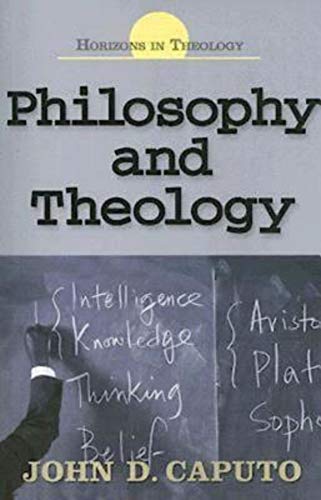
Ebook Info
- Published: 2011
- Number of pages: 100 pages
- Format: PDF
- File Size: 2.67 MB
- Authors: John Caputo
Description
A highly engaging essay that will draw students into a conversation about the vital relationship between philosophy and theology.In this clear, concise, and brilliantly engaging essay, renowned philosopher and theologian John D. Caputoaddresses the great and classical philosophical questions as they inextricably intersect with theology–past, present, and future. Recognized as one of the leading philosophers, Caputo is peerless in introducing and initiating students into the vital relationship that philosophy and theology share together. He writes, “If you take a long enough look, beyond the debates that divide philosophy and theology, over the walls that they have built to keep each other out or beyond the wars to subordinate one to the other, you find a common sense of awe, a common gasp of surprise or astonishment, like looking out at the endless sprawl of stars across the evening sky or upon the waves of a midnight sea.”
User’s Reviews
Reviews from Amazon users which were colected at the time this book was published on the website:
⭐This is a short book of about 80 pages, divided into eight chapters. The aim of the author, John Caputo, is to propose a vision of how (Western) philosophical theology might look in our postmodern era.The first six chapters go by quickly and enjoyably, mainly because Caputo is a masterful writer, about as good as any I’ve run across so far. He speaks with conversational directness and clarity while also maintaining philosophical rigor and precision. The key ideas I gleaned from these six chapters are as follows:(1) Philosophy and theology are kindred quests because they’re both concerned with the big questions, even if they (purportedly) come from different angles.(2) In the premodern era, (religious) faith dominated reason, but there was still meaningful interaction between the two.(3) During the modern era, reason became dominant and faith went into defensive retreat. Science likewise gradually managed to marginalize both philosophy and religion. Descartes delimited God to what can be understood through reason. Kant likewise limited our understanding to a rational natural and moral order, dismissing any other ideas about God as superstition. Hegel added a historical dimension, but still centered his model on reason.(4) The Romantics reacted to Enlightenment rationalism and scientism by attacking its austere incompleteness. Kierkegaard asserted that rationalism can never catch up with faith.(5) Postmodernism challenged the hegemony of reason and science by noting that all reasoning and even perception involves using a perspective (language game, paradigm, etc.), and that requires tacitly accepting all the presuppositions built into the perspective. As a result, infallible “Truth” is unattainable and faith is unavoidable. This situation evokes incredulity towards meta-narratives and steers us to instead accept and appreciate details, differences, history, multiplicity, complexity, etc.(6) In the postmodern era, each religion involves a perspective which is irreducible to any other perspective, and so it must largely be understood on its own terms, rather than according to the dictates of rationalism or science.All of this seems reasonable to me and, again, Caputo lays all of this out in beautiful prose. This prelude thus sets the stage nicely for what I hoped would be an innovative and compelling postmodern integration of philosophy and theology in the final two chapters, using Derrida and Augustine as representatives of each camp. To present his vision, Caputo’s tone shifts in these last two chapters, becoming more poetic and thus appealing largely to our aesthetic judgment rather than our critical faculties. The chapters are short, so Caputo offers only a preliminary sketch rather than a detailed portrait. Let me try to present a miniature version of his sketch, effectively a sketch of a sketch:______Augustine and Derrida are both involved in a restless search from which they can’t escape, and perhaps they don’t really want to, even though there’s plenty of suffering along the way. Augustine’s search leads him to a love of God, but he must still struggle to answer the question “What do I love when I love God?”, so his search never really ends. Derrida is unable to give the name “God” to the object of his search, so his search is more indeterminate than Augustine’s, but the fact that Derrida relentlessly continues to search reveals that he’s also motivated by a kind of faith and hope, and maybe even love. While these mutual searches are full of ambiguity and thus disorienting, the consolation prize is that they at least generate passion for life, which thereby elevates us above the superficial and mediocre and gives life a kind of meaning (this reminds me of Nietzsche in some ways).______I think Caputo makes some good points here, but I generally find his juxtaposition of premodern religion and postmodern philosophy to be somewhat anti-climactic and thus disappointing. Part of the problem is surely that he just hasn’t provided sufficient richness of detail. But even if he fleshes out his vision, I wonder if he’s on the right track in emphasizing passion for life as a sufficient consolation for the ambiguities and suffering entailed in wrestling with the big questions. I’m not so sure, but you can judge for yourself …The first six chapters of this book easily warrant 5 stars, but the culminating two chapters are closer to 3 stars, so I think 4 stars overall is fair. Regarding whether I recommend this book, that’s hard to say, since I loved most of the book, but then finished it feeling somewhat disappointed. Perhaps the book will work for if you expect only a starting point for looking at philosophy and theology in a new way.
⭐This book is a short and fairly easy read. Although it is this, it does also have some trails it runs down that are just fillers it seems. Most all of chapter 7 could have been left out and the point if the book would have been made clear. Also, the redefining of what postmodern is by the author shows that he does hold to postmodernism. A decent book but is slightly confusing.
⭐Caputo’s overall argument is summarized well by reviewers Camber and paulregent, though I understand his purpose somewhat differently. Caputo doesn’t set-out to define a “philosophical theology,” and he certainly doesn’t “synthesize the two knowledge traditions.” In fact in the end he still describes philosophy and theology as distinct disciplines, neither merged nor oppositional but “companions on dangerous seas … different ways to respond to the common darkness” (p.69).But in Caputo’s telling it hasn’t been an easy companionship. In the past one voice had always domineered the other: theology suppressed philosophy in pre-modernity, and then philosophy suppressed theology in modernity. Reconciliation is now made possible by postmodernism, Caputo writes, which knocks the arrogant certainty out of both. Only as both ‘truth-claims’ understand themselves as tentative – both requiring ‘faith’ – might each appreciate the validity of the other. In Caputo’s view, philosophy and theology, thus conceived, could be distinct but companion ways of expressing passion for the wonder and mystery of life, which is their shared purpose (ch.8).Caputo, playing couple’s counselor here, is hopeful and positive, though not unbiased. Like many theologians, he holds Enlightenment thinkers responsible for the recent estrangement (the role of Protestant reformers goes unnamed). Consequently philosophy bears the brunt of his postmodernist therapeutic efforts (ch.4-6). Almost unmentioned are the changes necessitated by postmodernism on theology, oddly represented in his case study (ch.7) not by a religious theologian but by Derrida, who “rightly passes for an atheist.” This choice might suggest the kind of theology Caputo thinks capable of reconciling with philosophy today; namely, radical, or perhaps progressive theology. It is unclear whether Caputo thinks traditional theology up to the challenge.That’s a story very well told, but it may pose a challenge for some readers, as some reviews here attest. Caputo’s “working definition of theology” (p.4) has less traditional content than conservative believers likely think mandatory. But the theology he thinks capable of joining philosophy in mature, mutual companionship is not the kind that domineered pre-modernity. Both philosophy AND theology must be transformed, he says, by and for the postmodern age.
⭐Loved the balance of philosophy and history in this book. Using it for a Philosophy for Theology class i am taking in seminary (ThM level). This is my favorite book, out of all my assigned readings.
⭐This book is extremely enlightening for anyone questioning the value of their faith. Caputo outlines the intertwining of faith in daily life and it’s importance for all people. This book is a must read for anyone looking for a better understanding of the spirituality of the world.
⭐Just when you think theology is in decline Caputo reinforces Faith and turns it into a new movement that has been gaining momentum.
⭐:)
⭐I must preface by stating that I come from a scientific background and was new to a lot of philosophy. That being said, I found this book just painful to read. The way that Caputo was trying to “logic and reason” through different ideas and then purporting them as obvious fact was just painful to me. I am used to having to have strict experimental evidence be the basis for knowledge and then having others tear that evidence apart to see if it stands up and often the results are counter intuitive to our logic and reason. I enjoyed it starting out but then quickly got disillusioned by the philosophical methods of the author.
⭐Book was as described
Keywords
Free Download Philosophy and Theology (Horizons in Theology) in PDF format
Philosophy and Theology (Horizons in Theology) PDF Free Download
Download Philosophy and Theology (Horizons in Theology) 2011 PDF Free
Philosophy and Theology (Horizons in Theology) 2011 PDF Free Download
Download Philosophy and Theology (Horizons in Theology) PDF
Free Download Ebook Philosophy and Theology (Horizons in Theology)