

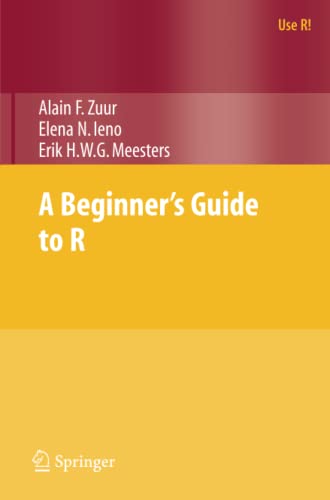
Ebook Info
- Published: 2009
- Number of pages: 240 pages
- Format: PDF
- File Size: 6.59 MB
- Authors: Alain Zuur
Description
Based on their extensive experience with teaching R and statistics to applied scientists, the authors provide a beginner’s guide to R. To avoid the difficulty of teaching R and statistics at the same time, statistical methods are kept to a minimum.
User’s Reviews
Editorial Reviews: Review From the reviews:“A Beginner’s Guide to R is just what its title implies, a quick-start guide for the newest R users. A unique feature of this welcome addition to Springer’s Use R! series is that it is devoted solely to getting the user up and running on R. Unlike other texts geared towards R beginners, …this text does not make the mistake of trying to simultaneously teach statistics. …there are straightforward homework exercises provided throughout…, and the data sets can be downloaded from the authors’ website… …A Beginner’s Guide to R is an essential resource for the R novice, whether an undergraduate learning statistics for the first time or a seasoned statistician biting the bullet and making the switch to R. “ (The R Journal Vol. 2/1, June 2010)“…most suitable for an advanced beginner or a user who needs an introduction to a wide variety of graphical methods. Overall, the book does most things quite well. It shows the beginner how to install R. how to load data into R, how to perform some subsetting operations including the sorting of data and most of all how to plot data using a variety of methods. Throughout, all methods and code are will illustrated and can be easily replicated by anyone using the book. …I learned quite a number of things about R that I did not previously know. Consequently, I would recommend the book not only for the students who need to learn R, but for professionals who need to enhance their basic working knowledge of R.” (Math Geosci 2010, 42: 133–137)“The book has many admirable features. It introduces key commands in easy stages. Each chapter has a number of illustrative examples, lucidly explained, and ends with a review of what has been covered. Chapters also contain exercises at the end that reinforce the examples provided. … useful work for self-study or for an introductory course, allowing readers to apply their knowledge of the language to begin learning how to use R for statistical analysis or other purposes. Summing Up: Highly recommended. All levels of readership.” (R. Bharath, Choice, Vol. 47 (11), July, 2010)“This book explains how to create datasets, variables, functions and plots using R. It is not a simple book though. … somewhat dense and covers each topic thoroughly. … best to follow every example. … I found this book to be well written for its intended audience and purpose. I had no difficulty reading it or following the examples. … This approach will give you a good foundation for using R in your own work and advancing to other books about specific analyses and procedures.” (Mark Bailey, Technometrics, Vol. 53 (1), February, 2011)“This book has a very clear objective. … this is a popular book about the R statistical software. … The book is true to its goal of being a text for the absolute beginner with easy to follow explanations, examples to program, and exercises to build skill. The reader who takes advantages of the available data files and R text editors will find this to be a very instructive book. It will definitely increase your desire to learn and use R in the future.” (Brandon Alleman, The American Statistician, May, 2011) From the Back Cover Based on their extensive experience with teaching R and statistics to applied scientists, the authors provide a beginner’s guide to R. To avoid the difficulty of teaching R and statistics at the same time, statistical methods are kept to a minimum. The text covers how to download and install R, import and manage data, elementary plotting, an introduction to functions, advanced plotting, and common beginner mistakes. This book contains everything you need to know to get started with R.”Its biggest advantage is that it aims only to teach R…It organizes R commands very efficiently, with much teaching guidance included. I would describe this book as being handy–it’s the kind of book that you want to keep in your jacket pocket or backpack all the time, ready for use, like a Swiss Army knife.” (Loveday Conquest, University of Washington)”Whilst several books focus on learning statistics in R…, the authors of this book fill a gap in the market by focusing on learning R whilst almost completely avoiding any statistical jargon…The fact that the authors have very extensive experience of teaching R to absolute beginners shines throughout.” (Mark Mainwaring, Lancaster University) “Exactly what is needed…This is great, nice work. I love the ecological/biological examples; they will be an enormous help.” (Andrew J. Tyne, University of Nebraska-Lincoln)Alain F. Zuur is senior statistician and director of Highland Statistics Ltd., a statistical consultancy company based in the UK. He has taught statistics to more than 5000 ecologists. He is honorary research fellow in the School of Biological Sciences, Oceanlab, at the University of Aberdeen, UK.Elena N. Ieno is senior marine biologist and co-director at Highland Statistics Ltd. She has been involved in guiding PhD students on the design and analysis of ecological data. She is honorary research fellow in the School of Biological Sciences, Oceanlab, at the University of Aberdeen, UK.Erik H.W.G. Meesters is a researcher at the Dutch Institute for Marine Resources and Ecosystem Studies (IMARES). He specializes in coral reef ecology and applied statistics and conducts research on North Sea benthos and seal ecology. About the Author Alain F. Zuur is senior statistician and director of Highland Statistics Ltd., a statistical consultancy company based in the UK. He has taught statistics to more than 5000 ecologists. He is honorary research fellow in the School of Biological Sciences, Oceanlab, at the University of Aberdeen, UK.Elena N. Ieno is senior marine biologist and co-director at Highland Statistics Ltd. She has been involved in guiding PhD students on the design and analysis of ecological data. She is honorary research fellow in the School of Biological Sciences, Oceanlab, at the University of Aberdeen, UK.Erik H.W.G. Meesters is a researcher at the Dutch Institute for Marine Resources and Ecosystem Studies (IMARES). He specializes in coral reef ecology and applied statistics and conducts research on North Sea benthos and seal ecology. Read more
Reviews from Amazon users which were colected at the time this book was published on the website:
⭐I’ve been wanting to learn R for a while now, but teaching and meetings have gotten in the way. I’ve been using this book for about a month and spend an hour per day. I do the exercises and also type in all of the R code in the book to see what works (though you can download the code from the book’s website). I have found the book very straightforward. Certainly R takes some getting used to and ultimately I’ll be using it for statistical applications, but, as noted by the authors, this book is written to introduce the reader to R, not to statistics with R. The explanations for what you are doing (and why) are very clear. The authors have experience teaching a well-constructed workshop for learning R, and it shows in the flow of the book. The text is clearly written and the steps are easy to follow. Learning builds from chapter to chapter. I would suggest, however, that though the authors indicate you can skip chapter 4 on simple functions with the first read, enough of what comes later hints at chapter 4 that I found it made more sense to go back and read chapter 4 rather than wonder what was going on. I have not found the same need to read Chapter 6 on the first pass, though I expect it will help in later understanding how to run statistical tests with R.I am an ecologist, and the authors use strictly ecological examples, which also makes the book very accessible. I’ve also been working on a data set of my own and it is VERY satisfying to take what I’ve learned in this book and apply it directly to my own data. At my university, we have limited access to major stats packages (Minitab – yes, Systat – no) and the draw to R, a free and very adaptable system, is strong.Aside from R, another aspect of this book that I really like is that the authors use lots of instances of practical “exploratory data analysis” such as examination of data for outliers. These are steps that are easy to forget about and I like the fresh reminder. I’m also intrigued by the authors’ hints at what they like and don’t like about particular approaches that I’ve purchased their related book, Analyzing Ecological Data (hasn’t arrived yet).In sum – this is a great book for teaching yourself the basics of R.
⭐If you want to start (from scratch) to learn to use R for data manipulation and graphics get this book. The authors say, in the forward, that it was designed to support a 3 day (8 hour per day) introduction to the R language without teaching statistics and it does a fabulous job. It covers R data types and data manipulation nearly as well as my favorite book on the topic
⭐but it also does a good job covering basic plots (all the typical one or two variable plots) out to intermediate graphics (making a lattice with lots of pictures) (a good next step for graphics is
⭐) and also gives a very accessible introduction to applying functions to sets of variables and the R version of looping.The organization and flow are excellent. Each chapter has many exercises and as you read their are pointers saying to go try the corresponding problems. There is no answer key for the problems but they are so closely tied to the material that should not be a major issue.The index is okay but not good because there are functions used in the body of the book that are not indexed and it is missing an overall summary index/table that covers all the functions.If the publisher will clean up the indexing, so that it is easier to return and find the information in the book, it is a solid 5 star product. Another possible complaint is that it is very expensive for a 200 page paperback but the quality of the writing offsets for the bloated price.
⭐I have modified my initial review to a much more favorable one in light of the author’s response. I have not worked through this book yet, but at this point I am trying to have an open mind about it. But here is my initial complaint below (modified somewhat), which I am leaving because I think it would be helpful to other potential readers:************************************(Original comments)Like many other reviewers, I have looked all over for a book that teaches R completely from scratch. It is kind of bizarre how this seeming easy request is so hard to fulfill. It must the fact that R is open source. There are many “tutorials” on the web for R, but they seem to assume a fairly high level of proficiency with it. I think the book could have been priced somewhat less given its relatively small size. Okay, so maybe it would be worth it if I could learn R. But right at the beginning, on P. 13, the authors highly recommend using TINN as an text editor to R, from which one can send code directly to R. Then they write “We refer to the online manuals of Tinn-R for their use with R.” They don’t say anything more about Tinn-R. I downloaded Tinn-R, but it is not at all intuitive. I could not get it to send commands to R. So I went back to the web to look for tutorials on how to use Tinn-R. But there is less information about Tinn-R than there is on R. I feel that the authors could have devoted at least a few pages to Tinn-R.
⭐I found it hard to read and most of the content I was looking for was not in the book. Such as how to trouble shoot common issues, write up statistical outputs or even basic statistical tests in R were nowhere to be found.
⭐if you need to know about r thern you will need a book to get started this is it – if you want exciting beach read you want want to know about r starts – you pays your money, but this is one of the easier basic books on the subject
⭐Was a great help for a beginner using R for the first time.
⭐Ich habe das Buch nun schon ein Jahr und bin ein erfahrener R-Nutzer geworden. Ich habe am Anfang mal etwas darin gelesen und drei, vier Sachen nachgeschlagen. Aber in der Regel bot mir schon das Internet bessere Einführungen. Inzwischen verstaubt das Buch nur noch. Meiner Erfahrung nach benutze ich gute Einführungsbücher auch Jahre später noch immer mal als Nachschlagewerk, um Besonderheiten der Sprache nachzuschlagen (z. B. bei Python welche Daten immutable und welche mutable sind).Außerdem merkt man, dass es von Bioinformatikern für Bioinformatiker geschrieben ist. Die Systematik hinter der Syntax wird aus dem Buch heraus nicht klar. Eine wirkliche Einführung und Darstellung in Datenstrukturen wird nicht gegeben. Daher ist es schwer von den Beispielen abzuweichen, bei denen von existierenden Dateien oder vorhandenen Beispielsstrukturen abgewichen werden soll. Dieses Wissen muss man sich definitiv aus anderen Quellen holen.Das Buch eignet sich also wirklich nur für Leute, die sich mit Skriptsprachen schwer tun und im Buch ihr Fallbeispiel finden wollen, das abtippen und dann hoffen, dass es funktioniert. Für jeden, der Skriptsprachen beherrscht oder Programmieren kann, empfehle ich definitiv ein anderes Buch zu kaufen.As other Zuur books, useful, thorough and easy to follow.
Keywords
Free Download A Beginner’s Guide to R (Use R!) 2009th Edition in PDF format
A Beginner’s Guide to R (Use R!) 2009th Edition PDF Free Download
Download A Beginner’s Guide to R (Use R!) 2009th Edition 2009 PDF Free
A Beginner’s Guide to R (Use R!) 2009th Edition 2009 PDF Free Download
Download A Beginner’s Guide to R (Use R!) 2009th Edition PDF
Free Download Ebook A Beginner’s Guide to R (Use R!) 2009th Edition