

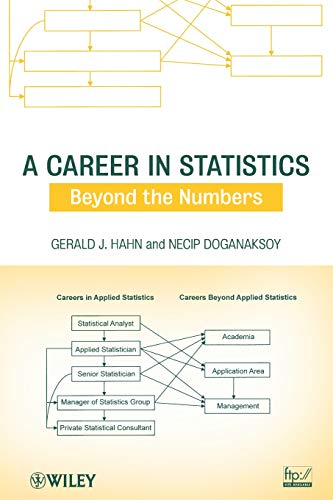
Ebook Info
- Published: 2011
- Number of pages: 358 pages
- Format: PDF
- File Size: 8.95 MB
- Authors: Gerald J. Hahn
Description
A valuable guide to a successful career as a statisticianA Career in Statistics: Beyond the Numbers prepares readers for careers in statistics by emphasizing essential concepts and practices beyond the technical tools provided in standard courses and texts. This insider’s guide from internationally recognized applied statisticians helps readers decide whether a career in statistics is right for them, provides hands-on guidance on how to prepare for such a career, and shows how to succeed on the job. The book provides non-technical guidance for a successful career. The authors’ extensive industrial experience is supplemented by insights from contributing authors from government and academia, Carol Joyce Blumberg, Leonard M. Gaines, Lynne B. Hare, William Q. Meeker, and Josef Schmee. Following an introductory chapter that provides an overview of the field, the authors discuss the various dimensions of a career in applied statistics in three succinct parts:The Work of a Statistician describes the day-to-day activities of applied statisticians in business and industry, official government, and various other application areas, highlighting the work environment and major on-the-job challengesPreparing for a Successful Career in Statistics describes the personal traits that characterize successful statisticians, the education that they need to acquire, and approaches for securing the right jobBuilding a Successful Career as a Statistician offers practical guidance for addressing key challenges that statisticians face on the job, such as project initiation and execution, effective communication, publicizing successes, ethical considerations, and gathering good data; alternative career paths are also described The book concludes with an in-depth examination of careers for statisticians in academia as well as tips to help them stay on top of their field throughout their careers. Each chapter includes thought-provoking discussion questions and a Major Takeaways section that outlines key concepts. Real-world examples illustrate key points, and an FTP site provides additional information on selected topics.A Career in Statistics is an invaluable guide for individuals who are considering or have decided on a career in statistics as well as for statisticians already on the job who want to accelerate their path to success. It also serves as a suitable book for courses on statistical consulting, statistical practice, and statistics in the workplace at the undergraduate and graduate levels.
User’s Reviews
Editorial Reviews: Review “From now on whenever someone asks me about a career in statistics I will point them to this book which I think addresses their questions and concerns much better than I could with just my personal account.” (Significance, 1 September 2011)”This book needs to be readily available to majors or potential majors at any college or university that grants degrees in mathematics or statistics.” (Mathematical Association of America Reviews, 16 March 2012)”A valuable guide to a successful career as a statistician A Career in Statistics: Beyond the Numbers prepares readers for careers in statistics by emphasizing essential concepts and practices beyond the technical tools provided in standard courses and texts … A Career in Statistics is an invaluable guide for individuals who are considering or have decided on a career in statistics as well as for statisticians already on the job who want to accelerate their path to success.” (Green Technology, 29 November 2011) From the Inside Flap A valuable guide to a successful career as a statisticianA Career in Statistics: Beyond the Numbers prepares readers for careers in statistics by emphasizing essential concepts and practices beyond the technical tools provided in standard courses and texts. This insider’s guide from internationally recognized applied statisticians helps readers decide whether a career in statistics is right for them, provides hands-on guidance on how to prepare for such a career, and shows how to succeed on the job.The authors’ extensive industrial experience is supplemented by insight from contributing authors from government and academia. Following an introductory chapter that provides an overview of the field, the authors discuss the various dimensions of a career in applied statistics in three succinct parts:The Work of a Statistician describes the day-to-day activities of applied statisticians in business and industry, official government, and various other application areas, highlighting the work environment and major on-the-job challengesPreparing for a Successful Career in Statistics describes the personal traits that characterize successful statisticians, the necessary course of study, and approaches for securing the right jobBuilding a Successful Career as a Statistician offers practical guidance for addressing key challenges that statisticians face on the job, such as project initiation and execution, effective communication, publicizing successes, ethical considerations, and gathering good data; alternative career paths are also describedThe book concludes with an in-depth examination of careers for statisticians in academia as well as tips to help them stay on top of their field throughout their careers. Each chapter includes thought-provoking discussion questions and a Major Takeaways section that outlines key concepts. Real-world examples illustrate key points, and an FTP site provides additional information on selected topics.A Career in Statistics is an invaluable guide for individuals who are considering or have decided on a career in statistics as well as for statisticians already on the job who want to accelerate their path to success. It also serves as a suitable book for courses on statistical consulting, statistical practice, and statistics in the workplace at the undergraduate and graduate levels. From the Back Cover A valuable guide to a successful career as a statisticianA Career in Statistics: Beyond the Numbers prepares readers for careers in statistics by emphasizing essential concepts and practices beyond the technical tools provided in standard courses and texts. This insider’s guide from internationally recognized applied statisticians helps readers decide whether a career in statistics is right for them, provides hands-on guidance on how to prepare for such a career, and shows how to succeed on the job.The authors’ extensive industrial experience is supplemented by insight from contributing authors from government and academia. Following an introductory chapter that provides an overview of the field, the authors discuss the various dimensions of a career in applied statistics in three succinct parts:The Work of a Statistician describes the day-to-day activities of applied statisticians in business and industry, official government, and various other application areas, highlighting the work environment and major on-the-job challengesPreparing for a Successful Career in Statistics describes the personal traits that characterize successful statisticians, the necessary course of study, and approaches for securing the right jobBuilding a Successful Career as a Statistician offers practical guidance for addressing key challenges that statisticians face on the job, such as project initiation and execution, effective communication, publicizing successes, ethical considerations, and gathering good data; alternative career paths are also describedThe book concludes with an in-depth examination of careers for statisticians in academia as well as tips to help them stay on top of their field throughout their careers. Each chapter includes thought-provoking discussion questions and a Major Takeaways section that outlines key concepts. Real-world examples illustrate key points, and an FTP site provides additional information on selected topics.A Career in Statistics is an invaluable guide for individuals who are considering or have decided on a career in statistics as well as for statisticians already on the job who want to accelerate their path to success. It also serves as a suitable book for courses on statistical consulting, statistical practice, and statistics in the workplace at the undergraduate and graduate levels. About the Author Gerald J. Hahn, PhD, worked at the GE Global Research Center for 46 years, where he managed its statistics group for 28 years and was elected a Coolidge Fellow, the organization’s highest honor, in 1984. A Fellow of the American Statistical Association (ASA) and American Society for Quality (ASQ), Dr. Hahn is the author of numerous papers and the coauthor of Statistical Models in Engineering; Statistical Intervals: A Guide for Practitioners; and The Role of Statistics in Business and Industry, all published by Wiley. He has received many professional awards and served as adjunct professor at various universities. Necip Doganaksoy, PhD, is a Statistician and Principal Technologist at the GE Global Research Center, where he has worked for over 20 years; he is also an Adjunct Professor at Union Graduate College. A Six Sigma Master Black Belt and a Fellow of ASA and ASQ, Dr. Doganaksoy has written more than 60 articles on quality, reliability, and productivity improvement and coauthored The Role of Statistics in Business and Industry (Wiley). He received ASQ’s William G. Hunter Award in 2009. Read more
Reviews from Amazon users which were colected at the time this book was published on the website:
⭐Good!
⭐”
⭐” has the look and feel of a textbook. It includes advice for instructors, chapter summaries, and chapter-end discussion questions, and it’s published by a textbook publisher. It also reads like a (good) textbook, which means that it is well-written, well-organized, and fairly dry. That’s the way it goes. If “A Career in Statistics” is required for a class you’re taking, just bite the bullet and buy the book.Most other potential purchasers will be reading “A Career in Statistics” because they’re looking for some specific advice. They may want to know whether they have what it takes to be a successful statistician (ch. 6) and whether any of the career options available to statisticians appeal to them (ch. 2-4, 12-13). They may want to know whether they should pursue an undergraduate or graduate degree, or whether an MA/MS makes more sense than a PhD (ch. 7). They may already be statisticians who are trying to land a job (ch. 8) or hoping for advice on how to function more effectively and advance their professional careers (ch. 5, 9-10, 14).To sum up what the authors have to say in a few sentences: A statistical career is for people who enjoy doing math and love solving problems. It is not for asocial nerds, however; especially outside of academia, being able to communicate simply and clearly and to cooperate with others is essential. An undergraduate degree in statistics is worthwhile, but you will get much farther with a graduate degree. Unless you want to be an academic theoretician (and it’s fine if you do), pick up substantive knowledge in a secondary field that interests you, whether it’s health or business or whatever. Once you have a job, do your best to convince non-statistician colleagues and managers (where applicable) that statisticians need to be brought in during the design phase of research projects; too often, statisticians are treated like alchemists who can turn garbage (terrible data) into shining treasure. (They see the lack of quality data as such a problem that the only truly statistical chapter in the whole book, ch. 12, has data gathering as its topic.) Communication skills are as important as statistical skills; be sure you understand what you’re being asked to do before you begin to do it, and be sure once you’re done that you can explain your results in non-technical language (and graphics). Don’t compromise on ethics; if you’re being asked to slant conclusions, refuse or resign. At the same time, put organizational needs ahead of the desire to use the most sophisticated or fashionable statistical method wherever practical. Cultivate relationships with mentors, and be on the look-out for new ways to use statistical knowledge and research to advance organizational objectives. Use a sensible model for planning projects (see the book for details). Be active in professional associations.Note that much of the authors’ advice is of the “under-promise and over-deliver” variety, which you can get anywhere. However, even in their fairly general chapters on job search and on being successful in academia, they add substantial value with statistics-specific pointers.Note also that I am not a statistician; I am a PhD-level sociologist with experience using statistics in government and academia. I requested the book because I am considering additional education in statistics. The book has given me much to think about while providing me with sound advice on work/career-related topics that, I’m sure, will prove valuable later.Bottom line: Recommended for the book’s target audiences — students considering a career in statistics, graduates just embarking on a career, and journeyman statisticians looking for advice on advancing their careers. May also be of interest to non-statisticians like myself who use or expect to use statistics regularly in their work, as well as to non-statisticians who manage statisticians.P.S. I forgot to mention two book highlights: First, many of the sections begin with amusing or provocative quotations. My favorite is: “If you don’t like sampling, next time you take a blood test, tell them to take it all” (attributed to CBS News). Second, the authors interviewed a number of professional statisticians for the book and quote them occasionally. You can find a particularly helpful block of interview excerpts discussing tips for aspiring statisticians on pp. 190-193.
⭐First let me say that I have a positive bias toward this book. Gerry Hahn is a good friend of mine and in my opinion a very good author. He invited me, among others, to review a draft version of the book. I made many suggestions and provided some quotes that were used in the book and I got a very nice acknowledgement in the preface. So that is worth keeping in mind when you read the review. Those of you that know me and my reviews probably realize that I take the reviewing process very seriously and mainly review books that I like and think I can help prospective readers decide if the book is right for them. Some books are more suited for technical audiences, others for the general public and others cater to a special group.”Careers in Statistics: Beyond the Numbers” is geared toward undergraduate or graduate students considering a career in statistics. It is also useful to those think of a career change. As you can see from the back cover Gerry worked for GE for practically his entire career (an amazing 46 years) and he managed the statistical research group there for 28 years. At one time I was considering taken a position working for him at GE. He is now retired but is providing a great service to other statisticians by writing books about his experience as a statistician. Necip Doganaksoy is a colleague of Gerry’s who worked for Gerry at GE for many years and continues to work there for Roger Hoerl since Gerry’s retirement. Hahn and Doganaksoy also recently published a book together titled “The Role of Statistics in Business and Industry.” Gerry and Necip definitely have the knowledge and experience to write an authoritative book about what it is like to be a statistician in industry.This book covers what a statistician in business and industry does on a daily basis including what skills are required and what degrees might be needed. That is covered in the first section “The Work of a Statistician.” The section also describes the differences between careers in health, national defense, academia and the social and behavioral sciences.The second section “Preparing for a Successful Career in Statistics” covers the attributes that comprise a successful statistician and what courses and degrees to obtain for a career in statistics.The third section discusses what it takes to move from an initial position to a successful career in the field making the book also attractive to current statisticians. The fourth section provides additional perspectives on the differences between careers in academia and industry and how to continue to develop as a statistician.There is great practical advice and insight in the book coming mainly from Gerry and Necip but also from the five other statisticians that they invited to contribute to the writing of the book. These statisticians also provide great insight from a variety of perspectives. They are Carol Blumberg, Leonard Gaines,Lynne Hare, Bill Meeker and Josef Schmee. As can be seen from the acknowledgement there were many others besides me that contributed to the review of the book and several who provided quotes that were used in the book.I often get asked by young prospective statisticians what it is like to have a career as a statistician. They have many questions and I try to give good answers. This book however is unique as a text that provides such guidance and from now on whenever someone asks me about a career in statistics I will point them to this book which I think addresses their questions and concerns much better than I could with just my personal account.
⭐I have once considered a career in statistics few decades back and I didn’t have a very informative source of different possibilities in the field of statistics. This book is a great resource for such questions.The book is a result of a good amount of hard work and professional experience in the field of statistics. The authors structured the topic into four different parts, namely -* What does a statistician do?* How to prepare a career in statistics?* What are the key qualities of a good statistician?* What are the career options for a statistician in academia?There are fourteen chapters that go around the above mentioned topics but the best way, in my opinion, to read this book is to select a question in mind and look through the contents and directly go to the relevant sections for an answer. I also liked the simple and practical advices on how to prepare a career in statistics and what people should expect out of a job in given industry. This book is a good quick reference for someone who wants to check the available career options in the field of statistics and one, who is ready to dive deep to find the answer.
⭐Context: I am halfway through an undergraduate degree in statistics and about to start my first job as a data analyst.This book is excellent so far. (I am about 1/3 of the way through so I will update this review once I am finished.) I have hesitated buying it for, literally, years because of the price – nearly £40 when I got it; however, I am now very glad I did. I have read just about everything on the internet, from reliable to rubbish, about a career in statistics. But this book is still useful for (at least) several features.First, it collates a great many things you will (have) read online into one portable, offline format.Second, and very important to me – and should be to you as a budding statistician! – this evidence is authoritative: both authors have maybe 70+ years in industrial statistics and they both also have PhDs. So, when I found myself reading advice (personality traits needed for success in statistics) that I have previously read and dismissed, as it was not to my taste (I know, I know!) I found myself biting the bullet and accepting it. If these experts talk, we novices should listen!Third, the entire thing is, perhaps unintentionally, a model for clear communication. It is written for those at least interested in professional statistics yet is remarkably jargon-free. Everything is clearly laid out and written concisely and precisely. The language is not literary – it is almost terse – yet not for a moment does it seem cold or boring.You can probably see the contents for yourself but it looks at as varied things as: personality traits required to succeed in statistics (mentioned above); what technical content should be covered in a good course; how far to take your education; how to get a good job; how to change to a better job; what academia is like contrasted with industry; how and why you need to sell yourself even after you get the job; tips for women in the field.The latest version is 2011. At this point, I’m not sure ‘data science’ had overtaken ‘statistics’ as the so-called ‘sexy job’ of the decade. And machine learning was not what attractive young people would post about on Instagram. So I am interested to see if there are parts of the book that have not aged well. So far, so good.I would suggest this book can act as something of a, non-technical, statistical mentor for people who want to know if statistics is for them. I have certainly now realised, more than I already had before reading this book, the importance of (i) being proactive rather than reactive, (ii) being practical rather than perfect, (iii) being the technical servant (of the business need) rather than the intellectual master, (iv) accepting and embracing rapid change as exciting and an opportunity to learn and prove (to) yourself what you can do. Never has (iv) been more vivid than now, as I go to my first day as an analyst, with my planned workload suspended, to work on COVID-19 data.In summary: as a distillation of maybe 7+ decades of education and experience, this is a very reasonable price, and a good investment, in your career.
Keywords
Free Download A Career in Statistics: Beyond the Numbers 1st Edition in PDF format
A Career in Statistics: Beyond the Numbers 1st Edition PDF Free Download
Download A Career in Statistics: Beyond the Numbers 1st Edition 2011 PDF Free
A Career in Statistics: Beyond the Numbers 1st Edition 2011 PDF Free Download
Download A Career in Statistics: Beyond the Numbers 1st Edition PDF
Free Download Ebook A Career in Statistics: Beyond the Numbers 1st Edition