

Ebook Info
- Published: 2010
- Number of pages: 296 pages
- Format: PDF
- File Size: 11.14 MB
- Authors: Gaurav Suri
Description
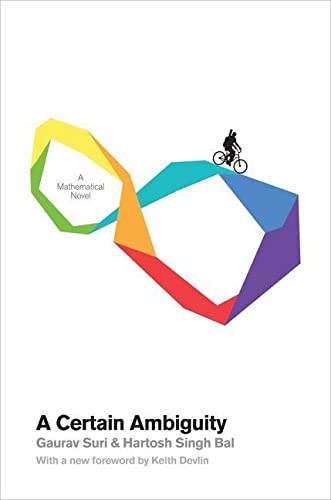
While taking a class on infinity at Stanford in the late 1980s, Ravi Kapoor discovers that he is confronting the same mathematical and philosophical dilemmas that his mathematician grandfather had faced many decades earlier–and that had landed him in jail. Charged under an obscure blasphemy law in a small New Jersey town in 1919, Vijay Sahni is challenged by a skeptical judge to defend his belief that the certainty of mathematics can be extended to all human knowledge–including religion. Together, the two men discover the power–and the fallibility–of what has long been considered the pinnacle of human certainty, Euclidean geometry. As grandfather and grandson struggle with the question of whether there can ever be absolute certainty in mathematics or life, they are forced to reconsider their fundamental beliefs and choices. Their stories hinge on their explorations of parallel developments in the study of geometry and infinity–and the mathematics throughout is as rigorous and fascinating as the narrative and characters are compelling and complex. Moving and enlightening, A Certain Ambiguity is a story about what it means to face the extent–and the limits–of human knowledge.
User’s Reviews
Editorial Reviews: Review “Winner of the 2007 Award for Best Professional/Scholarly Book in Mathematics, Association of American Publishers””The joy that accompanies [Suri and Bal’s] early excursions into proof will buoy up a floundering newcomer, while allowing old hands to recall the thrill of meeting the ideas for the first time.”—Katherine Körner, Nature”Good stories need rich characters that we care about, not mathematical theorems, however fascinating. So a work of fiction subtitled A mathematical novel makes you fear that it may only expose the tremendous difficulty of blending science and logic with the emotion and dramatic tension required of good literature. Fortunately, in this case that fear is misplaced, because A Certain Ambiguity succeeds both as a compelling novel and as an intellectual tour through some startling mathematical ideas…. A Certain Ambiguity is a brilliant and unusual novel.” ― New Scientist”Here is a book that succeeds both as fiction and nonfiction. . . . The book sweeps up those who are sensitive to the intellectual adventure of mathematics. It accurately portrays the attraction and enjoyment that are to be found in the play of ideas. I recommend it highly to all those who have an interest in mathematics.”—William Byars, SIAM Review”In the delightful, yet deep tradition of Lewis Carroll, Martin Gardner, A.K. Dewdney, and Marco Abate comes A Certain Ambiguity by Gaurav Suri and Hartosh Singh Bal…There is no doubt that Suri and Bal have set a difficult goal for themselves and have succeeded in making difficult mathematical ideas accessible…[W]hat makes the work of Suri and Bal a fine example of this tradition is what makes any successful and more traditional novel work–rich and warm characterization, an interesting plot, and a conclusion that illustrates the equal proportions of ingredients of certainty, ambiguity, frustration, and joy in the proof of our human-ness.”—Gurunandan R. Bhat, The Financial Express”I loved this novel. I hope we see more ‘mathematical novels’ being published in the future.”—Donald L. Vestal, MAA Review”The writers have created a book that could fascinate those who have just a rudimentary knowledge of math.” ― India Abroad”Suri and Bal’s unconventional book praises the beauty of mathematics and the logical inevitability of its proofs. The book is also a discourse on the struggles between truth, faith, and reason. All this is woven into two weeks in the life of Ravi, an Indian student at Stanford University, and his accidental discovery that his grandfather was once convicted of blasphemy in a New Jersey town…Among the many books that aim to make mathematics more accessible to the nonmathematician, this is a remarkably pleasant and successful achievement.”—J. Mayer, Choice Review “A Certain Ambiguity is an amazing narrative that glows with a vivid sense of the beauty and wonder of mathematics.”―Martin Gardner”This is a truly captivating thriller that will take you on a whirlwind tour to infinity―and beyond. But be warned: once you start reading, you won’t be able to put it aside until finished! A masterly-told story that weaves together criminal law, ancient and modern history, a young man’s quest to know his deceased grandfather-and some highly intriguing mathematics.”―Eli Maor, author of e: the Story of a Number and The Pythagorean Theorem: A 4,000-Year History”This rich and engaging novel follows the path that leads one young person to become a professional mathematician. By deftly blending the young man’s story with mathematical ideas and historical developments in the subject, the authors succeed brilliantly in taking the reader on a tour of some of the major highlights in the philosophy of mathematics. If that were not enough, the book also examines, through the minds of its characters, the natures of faith (religious and other) and truth. I am strongly thinking of building a university non-majors math course around this novel.”―Keith Devlin, Stanford University, author of The Math Gene”A Certain Ambiguity is a remarkably good effort to work through some fundamental issues in the philosophy of mathematics in the context of a novel. Crucial to the success of such a venture is creating characters and a plot that are strong enough to hold a reader’s interest. Suri and Bal succeed particularly well in the story of Vijay Sahni and Judge Taylor. This well-written book will, I believe, find readers not only among mathematicians, but in a wider audience that is intrigued by mathematical meaning.”―Joan Richards, Brown University”Suri and Bal convey the beauty and elegance―as well as the fascination―of basic mathematical concepts.”―Alexander Paseau, University of Oxford From the Back Cover “A Certain Ambiguity is an amazing narrative that glows with a vivid sense of the beauty and wonder of mathematics.”–Martin Gardner”This is a truly captivating thriller that will take you on a whirlwind tour to infinity–and beyond. But be warned: once you start reading, you won’t be able to put it aside until finished! A masterly-told story that weaves together criminal law, ancient and modern history, a young man’s quest to know his deceased grandfather-and some highly intriguing mathematics.”–Eli Maor, author of e: the Story of a Number and The Pythagorean Theorem: A 4,000-Year History”This rich and engaging novel follows the path that leads one young person to become a professional mathematician. By deftly blending the young man’s story with mathematical ideas and historical developments in the subject, the authors succeed brilliantly in taking the reader on a tour of some of the major highlights in the philosophy of mathematics. If that were not enough, the book also examines, through the minds of its characters, the natures of faith (religious and other) and truth. I am strongly thinking of building a university non-majors math course around this novel.”–Keith Devlin, Stanford University, author of The Math Gene”A Certain Ambiguity is a remarkably good effort to work through some fundamental issues in the philosophy of mathematics in the context of a novel. Crucial to the success of such a venture is creating characters and a plot that are strong enough to hold a reader’s interest. Suri and Bal succeed particularly well in the story of Vijay Sahni and Judge Taylor. This well-written book will, I believe, find readers not only among mathematicians, but in a wider audience that is intrigued by mathematical meaning.”–Joan Richards, Brown University”Suri and Bal convey the beauty and elegance–as well as the fascination–of basic mathematical concepts.”–Alexander Paseau, University of Oxford About the Author Gaurav Suri, a partner at a global management consulting firm in San Francisco, holds a master’s degree in mathematics from Stanford. Hartosh Singh Bal, a leading independent journalist in New Delhi, holds a master’s degree in mathematics from New York University. Read more
Reviews from Amazon users which were colected at the time this book was published on the website:
⭐A Certain Ambiguity was disappointing and bordering on the trivial, sadly. In 1919, a fictional, yet exceptional Indian mathematician, worthy of being invited to a US university after living in Great Britain, believes like a child, that Euclid wrote about truth, and of course, rigid Christians jailed him. The only thing missing from the test is an angry mob at night with pitchforks ready for a lynching. However, good leadership by the New Jersey governor saved the day. Thank God for educated elites!In 1919, Riemann, Poincare, were evidently not known to all expert mathematicians as the conceit of this book. OK. A few physicists still believed in the ether also. To be fair, Riemann’s 1854 lecture may not have been well known, but Poincare was pretty famous at the turn of the century. By the time of the setting of this story, topology, not geometry, was the focus of study, because formalism was well understood as the refuge for mathematics. See the fifth paragraph below.Still, the first person narration by an intelligent Stanford grad student, who evidently didn’t know anything about series from high school math, but is worthy of a full scholarship to graduate school in mathematics, was far more improbable. Maybe he took Calculus in summer school after being accepted.The conclusion that happiness and contentment are found by knowing that absolute certainty cannot be proven may be a mantra for some, maybe a majority, of intelligent people, but patting oneself on the back, which seems to be the point of the book, is fairly self-serving at the very least. Cool people don’t believe in truth, just games, evidently.A more honest and useful book would have stressed that before Riemann, Western thought, buttressed by Kant, believed that “a priori synthetic” systems existed: that our mind by itself (a priori) could obtain real knowledge (synthetic) of the world. Euclidean geometry was the prime example of this. As a result, a proof of God, while not rigorously found, could reasonably exist. The main counter to this belief was found in “personal idealism,” which Bishop Berkeley, along with many, many others lectured. At it’s extreme, everything is in one’s mind and it is difficult, if not impossible to truly know anything about the real world (if it even exists!). This is very unsatisfying. “A priori synthetic” was important psychologically to many people. Other philosophies, such as positivism in 1919 in Great Britain, arose to try to bridge the gap with dubious success. Note that in German, I believe, the word order in a prior synthetic is synthetic a priori (after Kant)However, the authors, Suri and Bal, could have taken another, less well known, but perhaps, more valuable interpretation of Godel’s work and resolved the issue better; although not as correct politically. Godel proved that every logical system would have at least one truthful statement that could not be proved by the axioms of the system. In short, any system is not complete by axioms alone. This is supposed to destroy full certainty of knowledge. Maybe, but it provides one GREAT and AWESOME question: from where do the unprovable truthful statements arise? They have to come from something outside of the system! In other words, the real world isn’t found in “a priori synthetic,” but in “synthetic a priori!” There is something out there so to speak. What it is – is the unanswerable question! God may exist, or at least a reality, for that is now certain!The greatest problems with the book are the two horrible math errors made by the authors that invalidate so much of what they wrote. Most critically, curved space doesn’t invalidate Euclid at all. Maybe Gauss initially thought so; but Riemann in 1854 showed that planar geometry was merely a special case of when a triangle had 180 degrees in space. Other spaces had either less or more than 180 degree triangles (like those on a sphere). There is NO CONTRADICTION of Geometry by validating Einstein, if anything, it increases Geometry’s validity. Duh! Second, and not critically, the fifth postulate is not evidence of a statement that’s true but unprovable after Godel as the authors claim. This is obvious since more than one fifth postulate is possible, not just one. Duh!A Certain Ambiguity is novel on math written by poseurs without ambiguity – an embarrassment on many levels.
⭐The book is fantastic at introducing several of the most well known and intellectually stimulating theorems in mathematics. From the Pythagorean Theorem, to the infinitude of primes, to the Continuum Hypothesis, and even the logical equivalency of Euclidean and non-Euclidean geometry. While I do feel that a person without any mathematics instruction at the undergraduate level would struggle to fully follow the proofs and specificities of the mathematics, such a person would still greatly benefit by reading this book, as there is likely not a better place to find all of these concepts introduced in such elementary and casual terms. This is where the book succeeds, however it falls short in other aspects.From a literary standpoint, the book is certainly not spectacular. Far too often sentences start with “So…” and go on to explain the implications of the previous passage. It is a minor caveat, but the frequency with which “So…” is used just makes it obvious the writers are mathematicians and not fiction authors. There are also several fortuitous happenstances that are all too unbelievable. However, if you are willing to forgive the author’s literary shortcomings, then the book is still a nice read.The philosophical component of the book is indeed stimulating. It makes one think quite a lot about what absolute “certainty” means. I do, however, find the conclusions at the end of the book to be all but unsatisfying. Essentially, the book concludes by saying that mathematical logic is still the best way to “know” something, but we can never be entirely sure which axioms are certainly true. It says that everyone must decide which axioms they think are true based on a feeling of overall “connectedness” and deduce their beliefs from those axioms; as long as people are “connected”, then everything will be great. I guess I was expecting more out of the ending of this book. To simply end on a relativistic worldview in which cold hard logic built upon axioms derived from a sense of “connectedness” does no justice to the complexities of the religious faith, romantic encounters, and mathematical implications found in the bulk of the book. I am not saying that developing a philosophy that adequately incorporates all these things is an easy task, but I am simply saying that the authors did not succeed in doing so. I find that the philosophical outlook propounded by the authors comes up short in synthesizing absolute certainty with human experiences such as love, friendship, faith.Overall, the book did earn all the three stars that I am giving it. I would recommend this book to those who are interested in two people’s take on the philosophy of mathematics, certainty, and faith and are not shy of some stimulating mathematics. However, do not expect this novel to give you a fully satisfactory conclusion about the relationship between all these things.
⭐A little mathematics sprinkled over a mediocre story…supposedly intelligent mathematics teacher comes off as mediocre in mathematics overall. A well published, Oxford educated (?) mathematician who has not heard of non Euclidian geometry and on top of it, this brings about an artificial and idiotic, but sadly important climax in the story. The mathematician is not smart enough to identify the fallacy and foolishness of a judge’s creationist argument and he was supposed to have a well formed atheistic world view… Overall it was a pain to read on..Still I am giving three stars because1) it covers some interesting concepts in Maths2) the author might have selected somewhat foolish characters so that any layman could follow the argument.but I feel a layman should be treated as an intelligent fellow who is not conversant with that particular subject..rather than a fool. It made a relatively long description for relatively simple concepts.3) may be fearing American religionism, authors have created artificial blindspots in rationalist views and created artificial authenticity to creationism…..for me it was a big let down…felt like pushing an agenda4) there is a chance that it is just me ……the narrative may suit some other reader….
⭐I personally found the descriptions invigorating and quite profoundly stated in a manner filled with passion I only wish I had in math teachers. I found, however, near the end, that the beauty of the subject was seemingly being forced to fit a certain view on God and the universe. Nevertheless, a book worth reading.
⭐Have fallen in love with mathematics after reading this book. Great things explained in simple terms and it wasthe presentation that I liked the most in this book. Its a ride to a different world altogether – go for it!!
⭐Never the mathematician, and chose not to read this as work of mathematics. It was a great way to think about thinking. It was also a very engaging story.
⭐Entertaining + enlightening!
Keywords
Free Download A Certain Ambiguity: A Mathematical Novel in PDF format
A Certain Ambiguity: A Mathematical Novel PDF Free Download
Download A Certain Ambiguity: A Mathematical Novel 2010 PDF Free
A Certain Ambiguity: A Mathematical Novel 2010 PDF Free Download
Download A Certain Ambiguity: A Mathematical Novel PDF
Free Download Ebook A Certain Ambiguity: A Mathematical Novel