Ebook Info
- Published: 2018
- Number of pages: 240 pages
- Format: PDF
- File Size: 10.87 MB
- Authors: W. W. Sawyer
Description
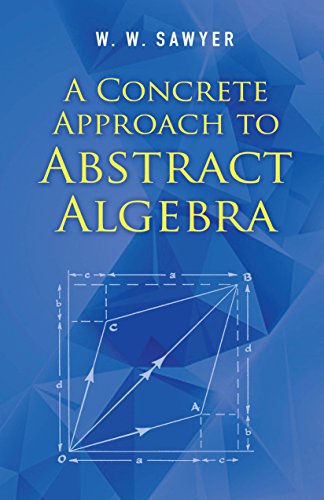
Brief, clear, and well written, this introduction to abstract algebra bridges the gap between the solid ground of traditional algebra and the abstract territory of modern algebra. The only prerequisite is high school–level algebra.Author W. W. Sawyer begins with a very basic viewpoint of abstract algebra, using simple arithmetic and elementary algebra. He then proceeds to arithmetic and polynomials, slowly progressing to more complex matters: finite arithmetic, an analogy between integers and polynomials, an application of the analogy, extending fields, and linear dependence and vector spaces. Additional topics include algebraic calculations with vectors, vectors over a field, and fields regarded as vector spaces. The final chapter proves that angles cannot be trisected by Euclidean means, using a proof that shows how modern algebraic concepts can be used to solve an ancient problem. Exercises appear throughout the book, with complete solutions at the end.
User’s Reviews
Editorial Reviews: About the Author Walter Warwick Sawyer (1911–2008) studied mathematics at St. John’s College, Cambridge, and taught all over the world, starting at the universities of Dundee and Manchester and later at the University of Ghana and Canterbury College in New Zealand. He was Professor of Mathematics at Wesleyan University in Connecticut and on the faculty at the University of Toronto. His 11 books include the Dover publications Prelude to Mathematics, Mathematician’s Delight, Vision in Elementary Mathematics, and A First Look at Numerical Functional Analysis.
Reviews from Amazon users which were colected at the time this book was published on the website:
⭐W.W. Sawyer was one of the most innovative mathematics teachers of histime. The idea of this book was to make abstract mathematics understandableto those looking in from the outside – such as engineers. This book has muchto offer the reader in terms of originality and pedagogy. However, be warned thatalthough it is above the level of bedtime reading, this bookis not suitable for use as a textbook in a university abstract algebra course asit does not cover all the requisite material. Readers looking for a glimpse into modern algebrawho do not want to deal with the turgid theorem/proof style of modern mathematicstexts will find this book easy and rewarding reading. Those taking a class in abstract algebrawill find this book more useful as supplementary reading. If you enjoy this bookI would also recommend the more mainstream (but still excellent and original)text “A Book of Abstract Algebra” by Pinter. The combination of these booksgave me the tools I needed to learn the basics of abstract algebra withouthaving to subject myself to the snobbish and elitist undertones found in most advancedmathematics texts on this subject matter.Good Luck !~
⭐Very helpful explaining a very complex subject
⭐This is another excellent mathematics textbook written by WW Sawyer. If you would like to learn what Modern Algebra (or “Abstract Algebra”) is about, this book starts from simple examples and builds up your intuition excellently. You understand why some axioms or properties are chosen for study, and how they can be used to enrich our understanding of number systems. I also thought the exercises were well crafted. The only complaint I have is that the the degree of a field extension was covered too quickly, and so was not clear to me until I consulted a different abstract algebra book. Other than that, I thought Sawyer clearly presented concepts, motivated them, and gave useful examples. He goes through the steps of examples, as well, which I often find as useful as the surrounding explanations.The book is really an introduction to the subject, however, so if you want a full treatment of modern algebra, you will need to consult other texts.
⭐This book is wonderful. At first glance it may seem too elementary, especially for those who have already studied some mathematics, but don’t be fooled by the central part where the fundamentals of vector spaces are exposed. You can safely skip these two chapters if you have studied engineering or mathematics or physics. The important thing is to understand that in a book of this type the vector spaces are then used as a tool for the theory of the extensions of algebraic fields! In reality, this book wonderfully explains, with a practical approach, the theory of the extensions of algebraic fields, and then crowns the whole treatment arriving at the demonstration of the impossibility of constructing some angles with ruler and compass. That’s all it takes to have a first coherent and contained exposure to the way impossibility theorems are proved in abstract algebra! I suggest reading this book and then moving on to a manual that talks about Galois groups and isomorphisms.
⭐Un testo di algebra abbastanza semplice e profondo. L’autore di pone dal punto di vista delle difficoltà del lettore cercando di sviscerare i concetti e lo spirito dell’algebra moderna.This is a classic book that takes an unusual approach to abstract algebra. Worth a look. Not recommended as a standard course though.
Keywords
Free Download A Concrete Approach to Abstract Algebra (Dover Books on Mathematics) in PDF format
A Concrete Approach to Abstract Algebra (Dover Books on Mathematics) PDF Free Download
Download A Concrete Approach to Abstract Algebra (Dover Books on Mathematics) 2018 PDF Free
A Concrete Approach to Abstract Algebra (Dover Books on Mathematics) 2018 PDF Free Download
Download A Concrete Approach to Abstract Algebra (Dover Books on Mathematics) PDF
Free Download Ebook A Concrete Approach to Abstract Algebra (Dover Books on Mathematics)