Ebook Info
- Published: 1987
- Number of pages: 176 pages
- Format: PDF
- File Size: 6.60 MB
- Authors: D. J. H. Garling
Description
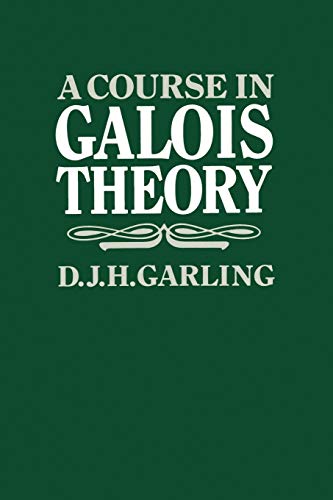
Galois theory is one of the most beautiful branches of mathematics. By synthesising the techniques of group theory and field theory it provides a complete answer to the problem of the solubility of polynomials by radicals: that is, the problem of determining when and how a polynomial equation can be solved by repeatedly extracting roots and using elementary algebraic operations. This textbook, based on lectures given over a period of years at Cambridge, is a detailed and thorough introduction to the subject. The work begins with an elementary discussion of groups, fields and vector spaces, and then leads the reader through such topics as rings, extension fields, ruler-and-compass constructions, to automorphisms and the Galois correspondence. By these means, the problem of the solubility of polynomials by radicals is answered; in particular it is shown that not every quintic equation can be solved by radicals. Throughout, Dr Garling presents the subject not as something closed, but as one with many applications. In the final chapters, he discusses further topics, such as transcendence and the calculation of Galois groups, which indicate that there are many questions still to be answered. The reader is assumed to have no previous knowledge of Galois theory. Some experience of modern algebra is helpful, so that the book is suitable for undergraduates in their second or final years. There are over 200 exercises which provide a stimulating challenge to the reader.
User’s Reviews
Editorial Reviews: Review “This is a marvellous little book. It is characterized by good mathematical taste, plain and elegant language, and an earthy but precise style.” Carl Riehm, Mathematical Reviews Book Description This textbook, based on lectures given over a period of years at Cambridge, is a detailed and thorough introduction to Galois theory.
Reviews from Amazon users which were colected at the time this book was published on the website:
⭐In the main, I find myself agreeing with the earlier reviewer. The paucity of exercises is NOT a weakness of this book. On the contrary, the exercises in the book are carefully chosen and serve to illustrate and reinforce the theory really well. It is really well written: simple and lucid. It is a pity that one must not hold out high hopes for more books on algebra or number theory written by this author who appears to be an analyst. I am grateful for this contribution from him to my mathematical education at any rate.
⭐I’m using this book to help plan a basic algebra course. It is very lucid and a pleasure to read.
⭐book as described, fast delivery
⭐Very well written, and the exercises are really helpful to learn too. It has an extensive treatment of fields, which is important to understand well before getting to Galois Theory. Strongly recommended!
⭐Anyone who has at least perused the works of Hardy, Dirac, Swinnerton-Dyer, or any of their suit will know what I mean. There is something unmistakable about this style: pithy, perhaps to a fault, but without any loss of charisma, these authors sacrifice conversational ease for surveyability and structural integrity. With this book, Garling takes a place in the rich British tradition of mathematical artistry.This is a pretty short book, and while it covers somewhat more than bare-minimum (the ch. on transcendental extensions is unusually deep, for example) it does not aspire to as complete a coverage as something like Dummit and Foote would give. But while theirs is an excellent “standard reference” type text, Garling conveys as much about craftsmanship and mathematical aesthetic as he does about fields and galois groups. This matching of topic and style of course works incredibly well, and here again we find a rich tradition of beautiful exposition (*cough* Artin).Of course, I shouldn’t neglect to mention my favorite part of any text (endeavor?): the problems. Here again Garling displays excellent taste (“Remember that mathematics is not a spectator sport!”). His rule of thumb is to can the (sometimes) dozens of trivial problems commonly presented, opting rather for a choice few interesting and challenging ones. I certainly learn better from this approach – perhaps more importantly, I have a lot more fun. Mathematics is for those with unrealistic daring, temperedby a dedication so extreme as to make the former at worst asymptotically realistic.Joshua James Wiley
⭐Although the final goal of the book is to present Galois theory, the author builds up to that point by selecting the relevant theorems from groups, fields, vector spaces, and rings. Therefore, the only real prerequisite to read this book is the ability to read and understand formal proofs (this is usually achieved after a couple of courses in formal mathematics).Books in abstract algebra usually explain generalizations of the same material and only spend a couple of pages proving the Galois theorems (this is the approach in Dummit and Foote, and Hungerford). So, if you are only interested in Galois theory, you would probably need to understand very general versions of the relevant theorems before you can get your hands on the topic. Lastly, the exercises are quite interesting, and complement the material quite well.
Keywords
Free Download A Course in Galois Theory 1st Edition in PDF format
A Course in Galois Theory 1st Edition PDF Free Download
Download A Course in Galois Theory 1st Edition 1987 PDF Free
A Course in Galois Theory 1st Edition 1987 PDF Free Download
Download A Course in Galois Theory 1st Edition PDF
Free Download Ebook A Course in Galois Theory 1st Edition