Ebook Info
- Published: 2006
- Number of pages: 560 pages
- Format: PDF
- File Size: 22.05 MB
- Authors: Edouard Goursat
Description
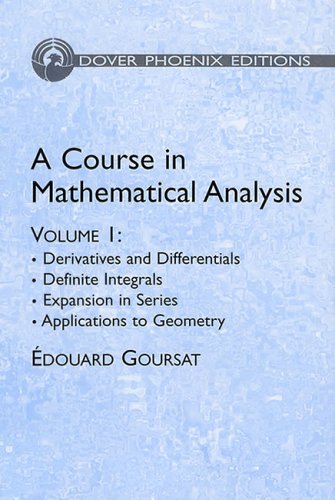
Édouard Goursat’s three-volume A Course in Mathematical Analysis remains a classic study and a thorough treatment of the fundamentals of calculus. As an advanced text for students with one year of calculus, it offers an exceptionally lucid exposition.Subjects in this, the first of the three volumes, include derivatives and differentials; implicit functions; functional determinants; change of variable; Taylor’s series; maxima and minima; definite and indefinite integrals; double and multiple integrals; integration of total differentials; infinite series; power series; trigonometric series; plane and skew curves; and surfaces. Volume 2 addresses functions of a complex variable and differential equations; and Volume 3 explores variations of solutions, partial differential equations of the second order, integral equations, and calculus of variations.
User’s Reviews
Reviews from Amazon users which were colected at the time this book was published on the website:
⭐This text is an older (1904) gem of mathematical exposition. Goursat’s First Volume is as unique as one is likely to find at this level. That level, by the way, would be (for an American student) at, or beyond (better) the ‘Calculus-Three’ course. Thus, if you’ve already assimilated calculus (single and multivariable) at a rudimentary level, then Goursat’s publication will prove a delight of further excursion into these topics. Now, having made the mistake of purchasing the text while a high-school student, I foolishly attempted to understand its contents. Not until many years later,and many a mathematics course later, was I able to comprehend and appreciate what it is that Goursat is attempting. What would that be ? Volume One (Derivatives, Integrals, Series, Geometry) reconsiders much of single and multi-variable calculus in a geometric setting. I believe Goursat provides the preliminary geometric conceptions useful asan aid to a full-fledged differential geometry text (say, Barrett O’Neil). Recalling mathematician Einar Hille’s words: “…differentials are one of the diffuse concepts and have caused endless confusion and misunderstanding. It is only for functions of several variables that the concept is really important.” (Analysis, volume one, 1964, page 212).Whereas Whittaker and Watson, their Modern Analysis tome (1902), are decidedly more advanced (and, rigorous), Goursat, on the other hand, writes in a more pedagogic vein. Theorems are first described in words.Take Note: Closed Intervals denoted by parentheses, that is, modern textbooks utilize brackets for closed intervals.So, preliminaries aside, let us take a quick tour:(1) A nice, brief exposition of the logarithm function, and its relationship to Jacobians (page 57). Potential Equation,in curvilinear coordinates, explicitly constructed (pages 80-83). Taylor series (fifty pages, Chapter Three) goes far beyond the usual introductory accounts from elementary calculus.(2) Integration, a fine exposition (chapter four): Highlights include Dedekind cuts (page 141), Intermediate Value Theorem (page 146). We are alerted to “…a paradox, of which the explanation later in the study of definite integrals taken between imaginary limits.” (page 156). Quite an interesting discussion of arc length (pages 161-164) and a beautiful discussion of the transcendental nature of ” e ” (page 171). Differentiation under the integral sign, here is an exposition as lucid as any in modern dress (pages 192-194). For a first-rate elaboration of approximation evaluation of integrals, one can hardly surpass Goursat’s lucid account (pages 196-203).(3) Fifth chapter, Indefinite Integrals, sure to pave the way for the analytical Whittaker and Watson. An introduction to rational functions, hyperbolic Functions (page 219) and elliptic integrals (page 231). Geometrical considerations kept to the fore (an example: page 220). Sixth chapter, double integrals and Green. Goursat describes most Theorems in descriptive words, first. Analogy is invoked (page 261). Again, geometrical considerations kept to the fore (Elemental Surface Area, pages 275-277). Euler gamma function, too (pages 279-280). A nice exposition of differentiation under the integral sign recurs (pages 287-289) and, a lovely derivation of the Stirling approximation (page 290).(4) Multiple integration is continued to the next chapter (seven). Analogy invoked. (page 309). Divergence Theorem (not, however, in now-standard vector notation, pages 309-310). And, for those with knowledge of differential forms, Goursat provides much preliminary background. Infinite series: always a favorite topic, arrives late in the game for my tastes. Happily, they are given leisurely and extensive consideration. That is, about one-hundred pages which retraces material which you may have learned in an elementary calculus course, now it is presented much better !(5) The text culminates with applications (again and again throughout) to Geometry. Curves to curvature and much more besides. A lovely presentation of basics: see page 469 for a ‘derivation’ of ‘Radius- of- Curvature’ formula and later the Frenet formulae (page 477, though not in vectorial notation–all is explicitly spelled out).There you have it. A quick tour of the contents, though, I have left much out. Needless to say, get hold of the book(in any extant format). It will make for wonderful excursions in calculus: advanced, but not too much so !Before I forget, the Exercises for student solution are sometimes easy, sometimes not. All of them are fascinating.Enjoy this text at your leisure. Also, historical considerations (footnotes) prove enlightening.1902: publication of Modern Analysis, by Whittaker and Watson,1904: publication of Course Of Mathematical Analysis, by Goursat,1908: publication of Course of Pure Mathematics, by Hardy.Apparently, the first decade of 1900 was an important one for mathematical analysis.All three, above mentioned, are Highly Recommended.
⭐This is a classic analysis text from french mathematician edouard goursat. This books covers topics such as integration, differential equation and multiple integral and etc. The proof are rigorous, and the development of proofs are much more make sense than today’s delta-epsilon proofs. You could see the theorems in the book are proved in a much more natural and intellectual way. Of course delta-epsilon could bring you a “rigorous” proof too, but somethimes the development of the proof is just so awkward.
⭐This is an excellent introductory course to a classical background in real and complex analysis. It develops intuition and rigour of the students, and it is very stimulating and pedagogical. An excellent book for students and teachers, even nowadays.
⭐
Keywords
Free Download A Course in Mathematical Analysis Volume 1: Derivatives and Differentials; Definite Integrals; Expansion in Series; Applications to Geometry (Dover Books on Mathematics) in PDF format
A Course in Mathematical Analysis Volume 1: Derivatives and Differentials; Definite Integrals; Expansion in Series; Applications to Geometry (Dover Books on Mathematics) PDF Free Download
Download A Course in Mathematical Analysis Volume 1: Derivatives and Differentials; Definite Integrals; Expansion in Series; Applications to Geometry (Dover Books on Mathematics) 2006 PDF Free
A Course in Mathematical Analysis Volume 1: Derivatives and Differentials; Definite Integrals; Expansion in Series; Applications to Geometry (Dover Books on Mathematics) 2006 PDF Free Download
Download A Course in Mathematical Analysis Volume 1: Derivatives and Differentials; Definite Integrals; Expansion in Series; Applications to Geometry (Dover Books on Mathematics) PDF
Free Download Ebook A Course in Mathematical Analysis Volume 1: Derivatives and Differentials; Definite Integrals; Expansion in Series; Applications to Geometry (Dover Books on Mathematics)