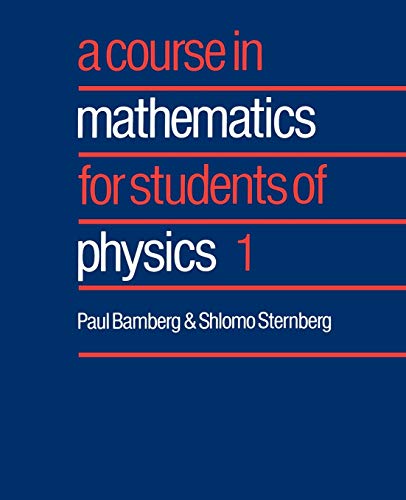
Ebook Info
- Published: 1991
- Number of pages: 424 pages
- Format: PDF
- File Size: 23.88 MB
- Authors: Paul Bamberg
Description
This text breaks new ground in presenting and applying sophisticated mathematics in an elementary setting. Aimed at physics students, it covers the theory and physical applications of linear algebra and of the calculus of several variables, particularly the exterior calculus. The exterior differential calculus is now being recognized by mathematicians and physicists as the best method of formulating the geometrical laws of physics, and the frontiers of physics have already begun to reopen fundamental questions about the geometry of space and time. Covering the basics of differential and integral calculus, the authors then apply the theory to interesting problems in optics, electronics (networks), electrostatics, wave dynamics, and finally to classical thermodynamics. The authors adopt the “spiral method” of teaching (rather than rectilinear), covering the same topic several times at increasing levels of sophistication and range of application.
User’s Reviews
Editorial Reviews: Review “A Course in Mathematics by Bamberg and Sternberg is in a class by itself….The authors have drawn on their wide teaching experience to produce a book whose tone is authoritative, whose vision is fresh, and whose whole feel is original….there is to my knowledge no comparable book, and it is hard to imagine a more inspiring one.” Times Literary Supplement”You can find about a dozen books on exterior calculus, that is, the calculus of differential forms, written for physicists. The one reviewed here is the most elementary. It is excellent, and provides a solid foundation….Not only is the mathematics clean, elegant, and modern, but the presentation is humane, especially for a mathematics text.” American Journal of Physics”This textbook (Vol. 1 & 2) is a well-written and well illustrated introduction to the mathematics of modern physics. The combination of mathematics and physical applications provides an excellent learning environment for students of physics and for scientists wishing to upgrade their education. This textbook emphasizes the geometric visualization of mathematical equations, and tries to develop in the student an intuitive feel for the mathematics. Overall, this book is a welcomed introduction to the mathematics required in modern physics.” Physics in Canada”I consider Sternberg’s book a fine addition to the existing literature and strongly recommend it to anyone with an interest in learning how to use group-theoretical methods to understand concrete physical problems.” Siam Review Book Description A textbook covering the theory and physical applications of linear algebra and the calculus of several variables.
Reviews from Amazon users which were colected at the time this book was published on the website:
⭐I’m going to mention the second volume almost exclusively. This is where the action is located. It is hard to find any equivalent treatment of circuit theory using algebraic topology. You should have some mathematics background or some patience and a stack of books on algebra and algebraic topology so you can understand what these authors write so poorly. However, while the text (vol.2) loses a star for being horribly written, it gains four stars for the amazing content. If you are patient you will see a side of circuits you have never dreamt of and then you will be led into the generalized (continuous) version which is electromagnetics.If you are looking for some really accessible and really interesting mathematics on circuits and EM buy this book (or buy it used, I bought my hardcover for 10$) You might also find it useful to consult the appendix in Frankel’s Geometry of Physics for comparison.Have fun and keep in mind that the book is written by sadists, clever and intelligent, but sadists all the way!
⭐There are a number of reviews for this series, mixed good and bad, and rather than adding another, I just want to register agreement with most of the points on both sides; on the positive end, it’s as far as I can tell unique in using electronic circuits as the primary motivation for the math, and provides a broad enough range of material that it should be fairly easy to pick up just these two volumes and be able to get a decent handle on the material.On the negative side, while I haven’t noticed the errors that were mentioned, the lack of solutions and occasional hand-wavery can leave one wondering — but that’s by no means a problem unique to this text. The standard point of comparison seems to be Frankel’s Geometry of Physics, which is an excellent text, but I’d argue that it suffers from the same problem. This series doesn’t go as deep into differential geometry as Frankel’s, but offers more breadth.
⭐The book itself is five stars. The kindle edition gets three: many equations are rendered in tiny, unreadable fonts.
⭐This book covers a lot of material and presents the underlying concepts in a particularly useful manner. Silly digressions into self-indulgent proofs are pleasingly absent.
⭐excellent
⭐Preface: “course is aimed at students with an interest in Physics who have a good grounding in one-variable Calculus” and “our pedagogical approach follows the Spiral Method, wherein we cover the same topic several times at increasing levels of sophistication and range of application.” (This is an excellent pedagogic strategy !). Let me commence with proclaiming that I love these two volumes. I proffer evidence in support of my view regards volume one:(1) We noted that answers for the exercises are not provided. Yet, there are “hints” supplied for quite a few of these exercises (see: page 54, #20; page 75, #15; page 114, #7,13,17; page 269, #8 &10). The student will locate more hints. Might I remark that many of the exercises are not too difficult (see: page 48, #5, 7 and 13; page 73, #1, 4, 5, 6 and 7; page 112, #1, 6 and 7….the list can be continued). Solutions can be verified on one’s own ! If asked to verify the inverse of a 2X2 determinant, a routine matter (via matrix multiplication) to “verify” the answer ! Solutions to problem #11, parts a through f, page 116 (differential equations) can certainly be verified on one’s own.(2) Chapter Three–Linear Differential Equations in the plane–is as lucid as one is likely to find at an elementary level.(3) Study page 128, it is easy enough to follow along to the explicit construction using the Gram-Schmidt process, this but one example of the interplay between the abstract and the concrete permeating the textbook.(4) Special Relativity, beginning Section #4.8 (pages 148-166) is an interesting account. The account encompasses twenty pages, where we learn: “twin paradox is, of course, no paradox, just an immediate corollary of the reverse triangle inequality.”(5) Chapter Five: Calculus in the Plane, Section# 5.6, pullback notation, is incredibly informative (pages 209-215).(6) Chapter Six–theorems of differential calculus: Lagrange multipliers, as lucid an exposition as any encountered !The Section #6.3, inverse function theorem, along with Newton’s algorithmic method, are given beautiful discussion.(7) Line integrals and differential forms are introduced next (beginning page 246): This is a fantastic Chapter !Note that Problem 12 a&b is one which many Physics students should already have mastered. Note: orientation, parameterization—understanding these concepts are absolutely central and essential to understanding the textbook.(8) Double integrals, next up: The chapter begins with exterior derivative, then two-forms, Once again, pages 284 and 285 render that which is abstract to that which is concrete–the mere computation of an Integral. Section # 8.7 deserves highlight, a nice discussion between differences of two-forms and densities. Green’s theorem the highlight concluding this great chapter.(9) Tenth chapter will place everything previously assimilated within the context of the axioms for vector spaces.The usual properties (commutative, associative, identity, inverse), dual spaces, quotient spaces (equivalence class)and linear transformations, concluding with adjoint transformations make this the most challenging part of the book.(10) Finally, determinants. From axioms to concrete computations, a rather satisfying conclusion to volume one.Not forgetting that the exercises for this chapter (pages 399-400) are a mix of the routine (a, b, c and d) and the innovative ( the remaining exercises !). Here, then, a unique textbook which can be profitably perused by both mathematics and physics students. Unfortunate, then, that it is not more often utilized by students and instructors.This text does offer comparisons to Burke (Applied Differential Geometry) and Bressoud (Second Year Calculus).While it has much in common with those textbooks, all three texts should be studied !The textbook is sufficiently interesting and innovative as to be heartily recommended for further enrichment.I am a proponent of the “spiral method” of teaching, thus, not completely unbiased.Highly recommended !
⭐I don’t understand why some of the reviews here are mediocre. Although I haven’t read the book to any depth, I have a knack of knowing whether a book exudes quaity by browsing briefly through it to get a general feel; the breadth of the material presented is breathtaking and at least eye-opening. Here are some reviews from the back cover…American Journal Of Physics:- Not only is the mathematics clean, elegant, and modern blah, blah, blah… This is first rate!Times Higher Education Supplement:-…There is to my knowledge no comparable book, and it is hard to imagine a more inspiring one.Remember also that there are two volumes.
⭐This almost 30 years old book is still one of the most clearly written, elegant and modern (differential forms) introductions to first year mathematics for physicists.I don’t say that too often but I almost enjoyed reading it. Highly recommended for those looking for a gentle path along the differential forms road.
Keywords
Free Download A Course in Mathematics for Students of Physics: Volume 1 in PDF format
A Course in Mathematics for Students of Physics: Volume 1 PDF Free Download
Download A Course in Mathematics for Students of Physics: Volume 1 1991 PDF Free
A Course in Mathematics for Students of Physics: Volume 1 1991 PDF Free Download
Download A Course in Mathematics for Students of Physics: Volume 1 PDF
Free Download Ebook A Course in Mathematics for Students of Physics: Volume 1