

Ebook Info
- Published: 2000
- Number of pages: 411 pages
- Format: PDF
- File Size: 2.11 MB
- Authors: Jacqueline Simpson
Description
With 1250 entries ranging from dragons to Mother Goose, May Day to Michaelmas, this enchanting dictionary unfurls the colorful history behind the holidays, customs, legends, and superstitious beliefs of England. Ever wonder why we kiss under the mistletoe at Christmas or think a rabbit’s foot brings good luck? Two folklore authorities provide reliable and often surprising answers to these and other curiosities that have shaped daily life in England for centuries. They explore the festivals and pastcelebrations of the English calendar, from St. Andrews Day and its tradition of drunkenness and cross-dressing to Twelfth Night and its king and queen cake. They also provide concise portraits of real and legendary characters that populate the public memory, including Robin Hood, The BrothersGrimm, Lady Godiva, Puck, and The Sandman. Fairies, mermaids, hobgoblins, and changelings are but a few of the supernatural forces surveyed here. However, as folklore encompasses the mundane as well as the fantastic, numerous other entries illuminate the significance of colors, numbers, flowers,animals, and household objects. Learn the curious history behind our distrust of the “black sheep,” popular credence in “wishbone” wishes, folk cures for nosebleeds and warts, and persistent old wives’ tales. In addition to ancient and medieval folklore, you will find many contemporary urbanlegends, e.g., the vanishing hitchhiker–a spooky figure seen ominously by travelers in Britain and the United States–and the Tooth Fairy. An entertaining resource, The Dictionary of English Folklore will be a fascinating companion for readers of English literature, history, cultural studies, and fantasy.
User’s Reviews
Editorial Reviews: Amazon.com Review If your hand itches, you’re about to receive money. Walking under a ladder is not just unlucky, but might mean you’ll never marry or are bound for the gallows. To get rid of mice, speak to them politely, suggesting another house they might prefer. Filled with fascinating bits of information, A Dictionary of English Folklore catalogues many of the tales and beliefs, ancient, medieval, and contemporary, in England. The term “folklore” may have been invented in 1848, but the stories and legends it encompasses reach far back into history. Their intention, say authors Jacqueline Simpson and Steve Roud, “is to provide a work of reference, not to build theories–the entries therefore emphasize established dates and facts; speculative interpretations are kept to a minimum.” Though dryly academic at times, the dictionary is a wealth of information on English folklore, of which little has been written (Scotland, Ireland, and Wales all have their own folklore and mythologies). Broader than just a collection of tales, the book includes important folklorists, holidays, numbers, plants, animals, and customs. Did you know “Goldilocks” was once “Silver-Hair” and before that an old woman? Or that folding your thumb into the palm of your hand and closing the fingers over it was believed to protect against witches? Organized in alphabetical order with cross-referencing, the entries are thorough and well-cited (including books, publication dates, and page numbers). A Dictionary of English Folklore is a great reference tool for historians and folklorists, but also for those interested in the origins of fairy tales, old wives’ tales, and superstitions. –Dana Van Nest From Library Journal Containing more than 1200 alphabetically arranged entries, this folklore dictionary spans familiar beliefs, from the earliest cultural traditions to more familiar subjects, such as Mother Goose. The authors, esteemed British folklore experts with many publications to their credit, include a broad range of oral genres, calendar customs, festivals, life-cycle customs, and supernatural and superstitious beliefs. Everyday lore is fully explored, from the Tooth Fairy and Godiva to the modern tales of wonderment such as “The Vanishing Hitchhiker.” Fairies, mermaids, hobgoblins, and changelings are examples of the supernatural forces surveyed. The historical foundations of folk cures and old wives’ tales, as well as classic legendary characters (e.g., Robin Hood) are identified and traced. Other topics include festivals, past and present, that are celebrated throughout English literature, as well as children’s games, “fakelore,” cross-dressing, mumming, and more. All are provided with dependable information and references, and the many See and See Also citations add considerably to the book’s richness as a reference source. The one drawback to this solidly researched work is its exclusively British approach, which will limit its appeal to American readers. Students and researchers, however, will find it valuable. Recommended for inclusive and extensive library collections.DRichard K. Burns, MSLS, Hatboro, PA Copyright 2000 Reed Business Information, Inc. From Booklist This scholarly dictionary begins with a broadly inclusive definition of what constitutes folklore . Briefly, the editors have chosen to include oral and performance genres of common culture, calendar customs, life-cycle customs, and supernatural and superstitious beliefs, dating from antiquity through current day. Not included are traditional foods, sports, games, fairs, or obsolete customs. There is only limited coverage of children’s lore, fairies, and plants. English has a much narrower definition: England and England only. The folklores of Ireland, Wales, Scotland, the Isle of Man, and the Channel Isles are not considered, nor are those of any of the ethnic groups that form part of English society. Researchers will find no references to banshees or Nessie but will find detailed entries concerning strictly British inventions such as boy bishops, Farthing Bundles, the Lambton worm, and Stir-Up Sunday.The 1,250 alphabetically arranged definitions range from a sentence or two to more than a page, with the focus on factual documentation as opposed to analytical interpretation. Footnotes appear at the end of each entry, referring to more than 350 academic resources detailed in the bibliography. These sources mostly date from the nineteenth and twentieth centuries (although some are as early as the fourteenth century) and include standards of folklore scholarship, unpublished doctoral treatises, reference works, and folklore periodicals.There are just eight illustrations, and the scholarly approach makes for rather dry prose. Text is arranged in a no-nonsense double-column format, with indexed terms appearing in boldface. There is no index, but see and see also references guide readers to appropriate entries. An asterisk next to a term indicates that the term is the subject of a separate entry.Although the concentration on English folklore might seem to limit this source’s research value, the bibliography alone should warrant interest in academic and specialized collections. General public and school collections might be better served by one of the broader works currently available: for example, David Pickering’s A Dictionary of Folklore [RBB My 15 00], originally published in England as the Cassell Dictionary of Folklore , or The Larousse Dictionary of World Folklore, by Alison Jones (1996). Still, this represents a unique contribution to the body of work about folklore and should be considered by academic and large public libraries. RBBCopyright © American Library Association. All rights reserved Review `splendid book’ Christopher Hawtree, Independent, 31/7/00`The book is full of absorbing information … a valuable research tool.’ TLS 29/9/00`delightful book’ Lancshire magazine 12/2000`The authors … have certainly done their homework … Packed with information the authors and publishers deserve full praise for a valuable addition to works on this fascinating subject.’ James Whetter, The Cornish Banner, Aug 2000, No.101. About the Author Dr. Jacqueline Simpson was president of the Folklore Society from 1993 to 1996, editor of Folklore from 1979 to 1993, and is currently Honorary Secretary of the Folklore Society. Her publications include Folklore of Sussex, Folklore of the Welsh Borders, and Scandinavian Folktales. Steve Roud hasbeen Honorary Librarian of the Folklore Society for the last 15 years. He is the author of Mumming Plays in Oxfordshire and has compiled the Index to the Journal Folklore 1968-1992. Read more
Reviews from Amazon users which were colected at the time this book was published on the website:
⭐There is a little bit of everything, and if you are like me you find one entry leading to the rest. I especially liked the article on Bees. You must bring them the news, and if they are really happy they will hum hymns on Christmas day. I hope someday I can make bees hum. Find out about this and many other interesting stuff from the most fascinating island in the world.
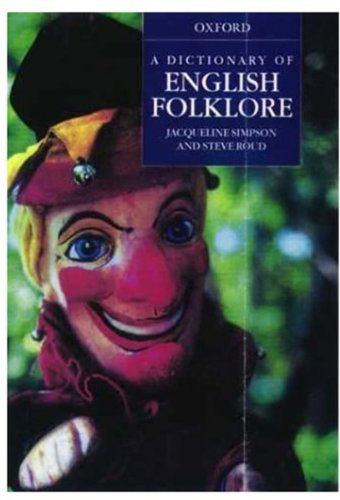
⭐I almost didn’t buy this book because the cover is aggressively awful. But, I bit the bullet and got it anyway and it is an invaluable resource. That said, I am still sitting here mulling knocking off a star for that leering Punch figure. Yikes! Who thought that was a good idea, when English folklore has so many more appealing images that could have been selected? Oh well. Maybe it will be reissued with more intelligence from the designers and editors at some point in the future.
⭐Good for library research.
⭐This book has a focus on folk beliefs and customs, but there’s plenty of space devoted to children’s games, legends, obscure festivals and the various “bugaboos” rumored to haunt the English countryside. Some folklorists are covered, but fortunately don’t take up a lot of room. This book is not as deep as some others like the 1,200~ page “Funk and Wagnall’s Standard Dictionary of Folklore, Mythology, and Legend” or the 1,000~ page (excluding index) “Facts on File Encyclopedia of World Mythology and Legend” — although that one has many articles I’d say they’re of less depth.What makes this book shine is the focus specifically on Britain and the feel of true scholarship. Also the authors fit a lot of information into well-written articles, occasionally with books of this sort it feels like the authors are filling up space with wordiness instead of facts. I also like how the author references older books, tracing the origin of certain beliefs, superstitions and practices. A good example of this is sin-eating, which he traces to a book from the 1600’s. There are ten plates in the center of the book on glossy paper, mostly of various festivals. The bibliography is extensive.Definitely a great book, a little expensive when one compares it to other books available on this topic — fortunately I found it for $1.50 at a library book sale. Couldn’t resist mentioning that!)
⭐I have read issues of the Folklore journal, and have always been allured by the true origins of folklore, rather than the fanciful relics of ancient practice theories. It’s a shame people still believe in this type of theorising whereby one explanation can be stretched to explain everything from corn dollies to the rising price of fish, but hopefully books like this might counterbalance the trend. I find the main culprits are those in the field of withcraft, paganism etc where all too many authors accept & propagate complete rubbish about the past.This book is an excellent resource of folklore, much of which I have been brought of with or come across. This book has contributed greatly to an understanding of the reasons behind so many things that seem commonplace, such as maypole dancing (which I did as a child at school!), making daisy chains, not stepping on the cracks in pavements etc.It’s one of those books which I tend to flick open, read one entry, refer to another & then find myself wanting to explore the subject further.One other attraction of this book for me is that it’s about my own country. It seems a real shame that so many people in England seem to find other countries so alluring that they completely neglect the vast heritage of their own, turning instead to the East, the Indians etc. This book is a real celebration of our country, and hopefully will bring our customs into the popular consciousness.However, this book also takes into account the fact that folklore is not dead, it carries on creating itself in the forms of urban legends, rumours etc, and that todays gossip could become tommorows legend.
⭐Get this book if you are into old english folklore, ballads, events, festivals -It may say dictionary – but it is a perfect book to just sit sown and graze in – short enough entries, great descriptions, and WOW! as far as love of Old England etall – Definately should be had by anyone who sings, writes, reads, dreams, re-enactment groups – (SCA, Renn Faires, etc)Totally Jolly and well researched! Wanted MORE!!!!Totally worth whatever you pay for it –
⭐A wonderful guide to many aspects of English culture that are these days lesser known. I strongly feel this should be on the shelves of every public library.
⭐great seller
⭐I am thoroughly enjoying this book. Lots of customs and traditions jam packed into this book. A great book for those wanting to learn a bit about various subjects. If you decide something peeks your interest you can look into other books to further your knowledge.
⭐This book is an essential tool for this subject. there were one or two subjects not covered. But is was still very much worth the money.
⭐really interesting
Keywords
Free Download A Dictionary of English Folklore in PDF format
A Dictionary of English Folklore PDF Free Download
Download A Dictionary of English Folklore 2000 PDF Free
A Dictionary of English Folklore 2000 PDF Free Download
Download A Dictionary of English Folklore PDF
Free Download Ebook A Dictionary of English Folklore