Ebook Info
- Published: 1978
- Number of pages: 196 pages
- Format: PDF
- File Size: 2.80 MB
- Authors: J. C. Burkill
Description
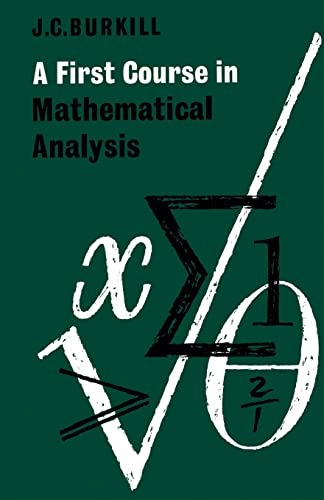
This straightforward course based on the idea of a limit is intended for students who have acquired a working knowledge of the calculus and are ready for a more systematic treatment which also brings in other limiting processes, such as the summation of infinite series and the expansion of trigonometric functions as power series. Particular attention is given to clarity of exposition and the logical development of the subject matter. A large number of examples is included, with hints for the solution of many of them.
User’s Reviews
Editorial Reviews: Review ‘Books of this quality are rare enough to be hailed enthusiastically … Essentially an introductory book for the mathematics specialist. But it is so fresh in conception and so lucid in style that it will appeal to anyone who has a general interest in mathematics.’ The Times Educational Supplement’This is an excellent book … If I were teaching a course for honours students of the type described, this book would rank high as a possible choice of text.’ Canadian Mathematical Bulletin’ … it is a pleasure to be able to welcome a book on analysis written by an author who has a sense of style and who avoids the excessive use of symbolism which can make the subject unnecessarily difficult for the student.’ Proceedings of the Edinburgh Mathematical Society Book Description This course is intended for students who have acquired a working knowledge of the calculus and are ready for a more systematic treatment.
Reviews from Amazon users which were colected at the time this book was published on the website:
⭐Absolutely stellar.I feel a little amused by the author using the word “hitherto” way too much but overall the book is very readable and the proof is clearly written, and the logical follow is easy to follow.It serves two purposes excellently aside from your assigned textbook:(A) If you just finished univariate calculus, you can immediately upgrade your knowledge by reading this book. You can also read that together with Calculus I. So you don’t need to jump from Calculus II to Rudin/Apostol, and end up with “I can do the proof but I don’t know where they come from or why we need them” at most.(B) If you are not a pure mathematician but need some knowledge in analysis. Mostly likely you don’t need compactness other than a closed interval or fields other than R or C in your own work.In short, this textbook covers the minimal information of (univariate, except for the last chapter)analysis and nothing more. The author does not even mention limsup, Cauchy convergence criteria and open sets,which is covered by the author’s other book “A second course in mathematical analysis, and keep number of theorems to a minimum.So, you do need to discover things yourself (For instance, you probably discover sandwich theorem, or maybe the notion of subsequence and its properties when you are doing some problems in chapter 2 ) This is actually a good thing: Many people want to see the skeletons first and add details later and do not want to be overwhelmed by 20+ theorems in a single chapter. Also notice that some conclusions are not in the form of theorems but just appears as plain texts along the way. Since the books is <200 pages, it's less of a problem though.Most exercises are easy. Paradoxically some of the trickiest is in Chapter 1. ⭐This book is entirely appropriate as an introduction to analysis for students already familiar with the Calculus. It is on the reading list at Cambridge and Oxford for their undergraduate analysis courses and its reputation is well established. It is not too abstruse but is exceptionally clear and straightforward. ⭐Better than expected. No scratches ⭐It is amazing that, despite the changing fads in the curriculum, this book has the quality to remain a steadfast bridge from School Mathematics on the first steps into the realm of the Maths specialist for over 40 years now.The recipe is simple: keep it short, keep it sweet, keep it simple! Mr Burkill has produced a fine little book that gently guides the new student embarking on a specialism in Maths. The author has struck a good balance between the problem solving so familiar at school and introducing the rigour of Mathematical Analysis.Familiar concepts like differentiation and integration are brought into play right after a quick refresher on numbers and then introducing the notion of limit within the framework of sequences. The delta-epsilon construct is used to great effect to give meaning to the ideas of convergence of sequences and the continuity of functions.These then lead naturally to the Differential calculus where previously learnt ideas like the rules of differentiation are placed in a rigorous setting and interesting elementary analytical results such as the Mean Value Theorem and Taylor's theorem are discussed. The chapter on Infinite series together with the elementary rules for testing for convergence is followed by a chapter on the special functions of analysis as defined in terms of series - e.g. exp, log, sin, cos, etc.The chapter on the Integral Calculus makes a natural next step utilising the ideas of an integral as a limit and of infinite series. Specific techniques such as the integral to infinity and approximation methods are placed on a rigorous footing. The final chapter introduces functions of several variables.The book has lots of worked examples within the text, which aid understanding of new material. As a bonus, there are also several end of section with notes/hints at the end of the book.Overall, this is a gentle introduction to Analysis and will help anyone who is overawed by the subject on first encounter. ⭐It is my textbook. Very good introductory book for year two university students who have some knowledge about Calculus and Linear algebra. ⭐Good book. Lacking in certain important mathematical concepts like lim sup and lim inf, but otherwise good so far. ⭐Professor Brian Kuttner's text book for first year mathematicians in 1972. There is no better recommendation! ⭐Well presented and explains well. ⭐A neat introduction to Analysis. Its size however does create its own problems. Explanations are brief and key ideas are sometimes skipped. Like many small UK maths books, it's great if you already know the material or are very clever. Otherwise students would be better off with a more expansive US textbook.
Keywords
Free Download A First Course in Mathematical Analysis 1st Edition in PDF format
A First Course in Mathematical Analysis 1st Edition PDF Free Download
Download A First Course in Mathematical Analysis 1st Edition 1978 PDF Free
A First Course in Mathematical Analysis 1st Edition 1978 PDF Free Download
Download A First Course in Mathematical Analysis 1st Edition PDF
Free Download Ebook A First Course in Mathematical Analysis 1st Edition