

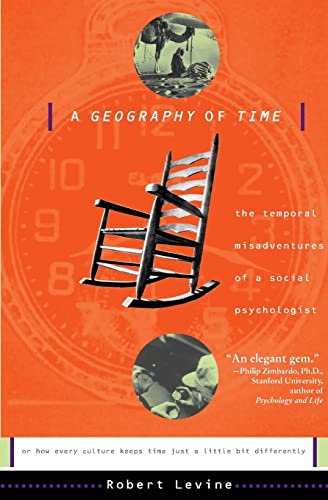
Ebook Info
- Published: 1998
- Number of pages: 280 pages
- Format: PDF
- File Size: 2.18 MB
- Authors: Robert V. Levine
Description
In this engaging and spirited book, eminent social psychologist Robert Levine asks us to explore a dimension of our experience that we take for granted—our perception of time. When we travel to a different country, or even a different city in the United States, we assume that a certain amount of cultural adjustment will be required, whether it’s getting used to new food or negotiating a foreign language, adapting to a different standard of living or another currency. In fact, what contributes most to our sense of disorientation is having to adapt to another culture’s sense of time.Levine, who has devoted his career to studying time and the pace of life, takes us on an enchanting tour of time through the ages and around the world. As he recounts his unique experiences with humor and deep insight, we travel with him to Brazil, where to be three hours late is perfectly acceptable, and to Japan, where he finds a sense of the long-term that is unheard of in the West. We visit communities in the United States and find that population size affects the pace of life—and even the pace of walking. We travel back in time to ancient Greece to examine early clocks and sundials, then move forward through the centuries to the beginnings of ”clock time” during the Industrial Revolution. We learn that there are places in the world today where people still live according to ”nature time,” the rhythm of the sun and the seasons, and ”event time,” the structuring of time around happenings(when you want to make a late appointment in Burundi, you say, ”I’ll see you when the cows come in”).Levine raises some fascinating questions. How do we use our time? Are we being ruled by the clock? What is this doing to our cities? To our relationships? To our own bodies and psyches? Are there decisions we have made without conscious choice? Alternative tempos we might prefer? Perhaps, Levine argues, our goal should be to try to live in a ”multitemporal” society, one in which we learn to move back and forth among nature time, event time, and clock time. In other words, each of us must chart our own geography of time. If we can do that, we will have achieved temporal prosperity.
User’s Reviews
Editorial Reviews: Amazon.com Review On time, out of time, time out, time is money–if our vernacular is any indication, the concept of time has certainly infiltrated American culture. Does everybody in the world share the same perception of time? In A Geography of Time, psychologist Robert Levine puts time to the test by sending teams of researchers all over the world to measure everything from the average walking speed to the time it takes to buy a stamp at the post office. Levine scatters his findings among engaging accounts of his own encounters with the various perceptions of time in different cultures. From the history of clocks to how people tell time today, A Geography of Time is jam-packed with “timely” information. From Library Journal Not limited by conventional notions of time?or “clock time,” as he calls it?Levine (psychology, California State Univ., Fresno) presents a wide-ranging work loosely organized around a social construct of time. The result is an intellectualized “places-rated” guide containing observations on where people are the most generous and talk the fastest, as well as discussions of how “time wars” are waged and deeper insights into South American, Japanese, and other cultures through their perception of time. The first part of the book covers concepts of time and the history of the techniques used to measure it. The focus then shifts to the author’s cross-cultural research on pace of life and its social implications. Time literacy, a type of multiculturalism, is advocated in the final section, which also contains advice for approaching life in “slower” cultures. Unique, wry, and readable, this well-documented book is recommended for social psychology collections and public libraries for sophisticated readers with the time to spare.?Antoinette Brinkman, Southwest Indiana Mental Health Ctr. Lib., EvansvilleCopyright 1997 Reed Business Information, Inc. From Booklist In this well-crafted treatise on the history of time, psychologist Levine does a good job of keeping the text lively. Working with potentially dry subject matter, Levine has fashioned an entertaining book that examines the history of time, timekeeping, and the various ways that time is experienced in different cultures. Using clever anecdotes and comparisons between hectic U.S. lifestyles and those of other more relaxed cultures, Levine contends that by learning to understand and accept three different perceptions of time–“clock time,” “nature time,” and “event time”–we can begin to experience a more flexible and rewarding life. Scholarly yet still informative, this book contains valuable perspectives and lessons for those caught up in and frustrated by the hectic modern lifestyle. Kathleen Hughes From Kirkus Reviews An amusing, informative account of how different cultures and subcultures have different concepts of time. Social psychologist Levine (Calif. State Univ., Fresno) loves anecdotes that illustrate a point, and he packs his report with stories about the frustrations of living in a culture where one is unfamiliar with the rules about waiting, punctuality, and time measurement. As a scientist, though, he employs objective tests to measure these temporal differences. Preceding his look at the pace of life in contemporary cultures, he gives a brief history of clock time that is full of quotable trivia (e.g., in the 1860s the US had some 70 different time zones). Among the factors that Levine says determine tempo of life are economic vitality, industrialization, population size, climate, and a cultural orientation toward individualism. Two questions command his interest: Which are the fastest and slowest cultures, and how does tempo of life affect quality of life? To find answers, he sent teams of researchers around the globe measuring walking speeds, accuracy of public clocks, and work speed, specifically the time required to purchase a postage stamp. The results are fascinating: Of 31 countries studied, Switzerland ranks as the fastest-paced, with other Western European countries and Japan close behind, the US in dead center, and Mexico the slowest. Applying slightly different criteria to US cities, he concludes that Boston is the speediest and L.A. the most relaxed. When he sets up situations designed to measure helping behavior in these same cities–giving change for a quarter, assisting a handicapped person, etc.–those with the most time do not necessarily turn out to be the most generous with it. Some stereotypes hold up: New Yorkers take last place in the civility ranking. Levine concludes with advice for the time-urgent when visiting slower-paced cultures and about taking control of one’s own pace of life. Recommended for all time-pressured type As. — Copyright 1997, Kirkus Associates, LP. All rights reserved. Review … Levine’s book is not without its charming moments. The turning point in the author’s own developing awareness of temporal issues occurred in Brazil, where he spent a year as a visiting professor … There is a nice chapter on the history of the mechanical clock… — The New York Times Book Review, Ed RegisHe’s got a funny, self-deprecating way with a travel anecdote…. This tome is well worth a chunk of your [time]. — Entertainment WeeklyThis goes beyond a travelogue or a psychology text but combines elements of both, presenting a psychologist’s travels around the world and his insights into how different cultures perceive and use time. Travel encounters are always spiced with social and cultural issues and understanding, making for lively and informative reading. — Midwest Book Review About the Author Robert Levine, Ph.D., is professor in the psychology department at California State University, Fresno, where he has also served as Department Chair and Associate Dean of the College of Science and Mathematics. He has received many awards for his teaching and research. He has been a visiting professor at Universidade Federal Fluminense in Niteroi, Brazil, at Sapporo Medical University in Japan, and at Stockholm University in Sweden. He has published articles in Psychology Today, Discover, and American Scientist and has appeared on ABC’s World News Tonight, Dateline, NBC, CNN, The Discovery Channel, and All Things Considered. He is currently President-Elect of the Western Psychological Association. Read more
Reviews from Amazon users which were colected at the time this book was published on the website:
⭐Professor Levine wrote this book as a result of a year-long sabbatical, where he was paid to do nothing more than travel the world observing how different cultures move at different paces (talk about luxury!) There are no surprises in his findings: highly industrialized societies move at a faster pace, people in Third World nations won’t necessarily turn up at an appointment time, fast-paced societies have more heart disease, slow-paced ones more compassion, and Japanese politeness demands circuitous answers to uncomfortably direct inquiries.Chapter 3 is “A Brief History of Clock Time,” and recounts a quick history of clocks and time-keeping. Early attempts (water clocks, sand dials, incense burners) tended to measure intervals rather than marking the progression of the day, although sun dials and pendulum clocks eventually filled that role.This leads naturally into chapter 4, “Living on Event Time” where pre-chronometer cultures gauge time by natural events (annual floods, the seasons, the time it takes cows to graze) rather than artificial constructs. The tension between “clock time” and “event time” is still troublesome for travelers between cultures, such as our professor here. Valid point, but hardly new.I wished Dr. Levine had researched why the year has twelve months, and why the months have the number of days that they have, why the days are divided up into 24 hours of 60 minutes each and 60 seconds. He does recount, briefly, some experiments in revolutionary France (12 months of 30 days each — with 5 “bonus days” at the end of the year — consisting of three 10-day weeks and decimal hours), and the Russian revolution (months comprised of six weeks of 5 days each) but he never really explores the consequences or motivations for such experiments.For all its lack of curiosity the book is entertaining and well-written, and would make a perfect “airplane book” on your next long flight to a different time zone.
⭐As someone whose has traveled considerably over the last 35 years, I have often found time — local time — as something of a challenge. This book provided insights into the cultural determinants of the perception of time and its uses. The authors experiences helped me to understand many of the strange, maddening, and wonderful experiences I’ve had while traveling.
⭐Though this book is old enough to order a beer, it’s still one of the most accessible research-based accounts of the role temporality plays in culture clashes. The last chapter offers practical suggestions for people interested in having the best of both worlds: the productivity of clock-driven time cultures and the ease and connectivity of event-based time cultures. Each person I talk with about the concepts in this book has a light go on over their head and story to share about a culture clash they’ve experienced that they now see as caused by different understandings, beliefs, and values around time. With so many sources of conflict in our social lives today, I’d even go so far as to say everyone should read this book.
⭐Apart from the author’s relevant study on the pace of life around the globe, the rest of the book reads as a personal memoir of entertaining stories, many of them told from a biased, western (American) point of view. Even when Levine tries to push aside his one-sided perspective, he makes comparisons that are absolutely twisted and misguided, such as the one expressed on page 111:”There is a practice in many Arab cultures whereby a young woman who is caught being intimate with a man she is not married to is sometimes murdered by her brothers. To Westerners, this is uncivilized behavior. But the brother is committed to protecting the role of an important institution-the family-in the social pattern. The temporal behavior of important Brazilians must, similarly, be understood as part of a larger pattern.”Parts of the book are still interesting, but I would prefer to read less on Levine’s travels and subjective experiences around the world, and more on objective research on the topic of time.
⭐This book was great introduction to time and culture. I found the study of Japan most interesting. The study I am most interested in is how time is used in planning and this was not covered. It seems there is a big difference between business and governments/scientists. The rule seems to be that it is difficult to convince someone when his pay is based on his not understanding it.
⭐I love this book! It is brilliantly researched and an engaging read. It is informative about time, cultures, differences, and similarities and does a brilliant job of linking facts and data with our human experience. It is the kind of book that is energizing for all the new ideas and insights available to the reader.Dr. Tracy Brower, author of Bring Work to Life by Bringing Life to Work: A Guide for Leaders and Organiztions
⭐I’ve enjoyed the book and have no complaints with it’s contents. But the digital edition was done sloppily. A lot of hyphenated words mid sentence; footnotes not working (they appear in the text but have no hyperlinks to jump back and forth); it has the same index of the printed edition, as an image and not text, containing references to the page numbers. Which are useless for the Kindle edition. Sometimes there are words in a line for which their vertical position is below or above the rest of that line.
⭐At times didactic or reductionist in its academic approach, the book overall is an interesting read on the concept of time. I especially enjoyed the historical takes on time and learning how our current constructs of time came to be.
⭐A lazily researched book full of unchallenged assumptions and generalisations about cultures. The conclusions in this book say more about the writer’s prejudices than answering the questions he poses. The most basic scientific protocols (such as double blind etc) are not adhered to so, despite some attempts at statistical analysis, the results cannot be trusted. Worst of all ‘women’s work’s’ such as childcare and housework are categorised by the author alongside hobbies and as something women do for fun. Only paid work (he makes a broad assumption is done mainly by men) is considered work and women’s time is not considered in any depth at all. This book is about 20 years old but, even then it must have been considered outdated.
⭐This book is a really good introduction to our perception of time. It would have been good however to have had a little more info on Philosopher’s who have talked about it. Overall I learned a lot though
⭐Covers unusual idiosyncrasies and habits of various cultures. Useful material for my ESL classes outside the U.S..
⭐Fascinating book, well written and easy to understand.
⭐Decent condition good price
Keywords
Free Download A Geography Of Time: The Temporal Misadventures of a Social Psychologist in PDF format
A Geography Of Time: The Temporal Misadventures of a Social Psychologist PDF Free Download
Download A Geography Of Time: The Temporal Misadventures of a Social Psychologist 1998 PDF Free
A Geography Of Time: The Temporal Misadventures of a Social Psychologist 1998 PDF Free Download
Download A Geography Of Time: The Temporal Misadventures of a Social Psychologist PDF
Free Download Ebook A Geography Of Time: The Temporal Misadventures of a Social Psychologist