Ebook Info
- Published: 2015
- Number of pages: 176 pages
- Format: PDF
- File Size: 21.11 MB
- Authors: E. F. Schumacher
Description
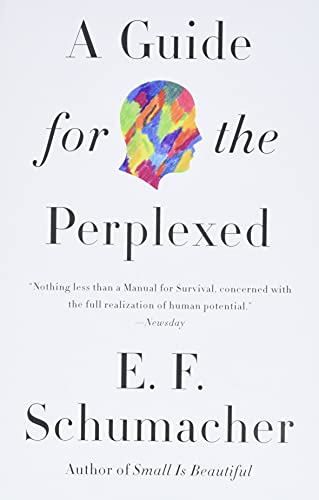
“A condensation of a vast and refreshingly unorthodox system of ideas.” — Arthur Koestler, ObserverFrom one of the most influential thinkers of the 20th century, and the author of the international bestseller Small Is Beautiful, the reissue of a timeless treatise on the meaning of living.In A Guide for the Perplexed, bestselling author E. F. Schumacher explores our relation to the world: our obligations—to other people, to the earth, to progress and technology, but most importantly to ourselves. If man can fulfill these obligations, then and only then can he enjoy a truly authentic relationship with the world—and truly know the meaning of living.Schumacher argues that we need maps: a “map of knowledge” and a “map of living.” The concern of the mapmaker is to find for everything its proper place. For things out of place tend to get lost; they become invisible and their proper places are filled by other things that should not be there at all and therefore serve to mislead.A Guide for the Perplexed teaches us to be our own map makers in following our destined path in life’s journey.
User’s Reviews
Editorial Reviews: Review “A Guide for the Perplexed deserves wide reading. It deserves in fact a Place in the college curriculum, as a text for introductory courses in philosophy….It does as much for the defense of traditional civilizational values as C.S. Lewis’s The Abolition of Man did in the last generation, and it does so on a metaphysical foundation.” — Greensboro Daily News“Nothing less than a Manual for Survival, concerned… with the full realization of human potential.” — Newsday“A condensation of a vast and refreshingly unorthodox system of ideas.” — Arthur Koestler, Observer“The most exciting philosophical book for ages.” — Daily Mail (London)“There is a rich store of wisdom and understanding, embedded in the religions of East and West, which our dangerous preoccupation with science has scanted and ignored. … People may see the blindness of only seeing in one particular way.” — Sunday Telegraph“A Guide for the Perplexed offers us a harvest of utterly sane, consoling, and life-affirming insight from one of the wisest minds of our time.” — Theodore Roszak, Los Angeles Times From the Back Cover An inspired critique of modern materialistic values and a road map for achieving one’s true, higher potential from “one of the wisest minds of our time.”*”This is what my life has been leading to,” said the maverick economist E. F. Schumacher upon completing A Guide for the Perplexed, his summation of a lifetime of wisdom. The author of the classic Small Is Beautiful, the “eco bible” (Time) named one of the Times Literary Supplement’s 100 Most Influential Books Since World War II, Schumacher charts the failings of “materialistic scientism,” the system of thought that dominates the developed world and which Schumacher charges with narrowing the horizons of human experience. Instead, he seeks to offer a new, far more expansive “map for living” that liberates our goals beyond the constraints of logic and inspires in us the faith to choose a life of higher significance. “Our ordinary mind always tries to persuade us that we are nothing but acorns,” he writes, “but that is of interest only to pigs. Our faith gives us something much better: that we can become oak trees.” About the Author Born in Germany, Dr. E. F. Schumacher (1911–1977) fled to England after the rise of Nazism and, with the help of John Maynard Keynes, taught economics at Oxford University. He is the author of Small Is Beautiful, the book that “changed the way many people think about bigness and its human cost” (New York Times). Read more
Reviews from Amazon users which were colected at the time this book was published on the website:
⭐Ever since René Descartes redirected philosophy towards a rationalist, individualist view of life (basically kickstarting the Enlightenment), people’s belief in a higher being has steadily been waning. The centuries since have seen a rise in science and determining the world around us via the scientific method, and we have come to see ourselves as the top of the food chain, the all-powerful beings in our universe. But there are some things that cannot be measured and quantified, and Schumacher’s ultimate conclusion is that there must be something spiritually higher than humanity. For how else can you truly answer the existential questions?What does it mean to be human? What is the purpose of life? Where did the initial spark of life come from? There is a distinct reason why there are so many different answers to these questions: there are a lot of people in the world, and every person has their own subjective life experiences that determine their answers. We can only do our best to share our ideas with others via communication, and while communication is good for understanding, it can never substitute for true knowing. “We ‘see’ not simply with our eyes but with a great part of our mental equipment as well,” Schumacher writes, “and since this mental equipment varies greatly from person to person, there are inevitably many things which some people can ‘see’ but which others cannot.” No two people know exactly the same things about anything.Schumacher describes Four Fields of Knowledge loosely broken down as Inner-Personal, Inner-Other, Outer-Personal, and Outer-Other: 1) What is really going on in my own inner world? This we can always know. 2) What is really going on in the inner world of other beings? This we can never know, but can only make educated guesses about based on the clues we gather. 3) What do I look like in the eyes of other beings? This again we can only make educated guesses about. 4) What do I observe in the world around me? This we can know to the extent that we have knowledge about it, but our knowledge is not the same as anyone else’s.Schumacher’s beef with Cartesian theory is based in his disbelief in rationalism. “Sense data alone do not produce insight or understanding of any kind. Ideas produce insight and understanding, and the world of ideas lies within us.” I find this to be a true statement, for two people can watch the same movie and one can love it and one can hate it. Is it a good movie or a bad movie? “The truth of ideas cannot be seen by the senses but only by that special instrument sometimes referred to as ‘the Eye of the Heart.’” Ideas, as our author alludes to, are the most powerful things we know of. When someone says that the pen is mightier than the sword, this is what they are talking about. Swords and the use of violence can force people to change, but that change is always against a tide of resistance. Ideas, on the other hand, (often demonstrated via the form of writing with pens and ink,) are fabulously more transformative and enduring. Ideas change the world.It is dangerous to try and scientifically explain phenomena that cannot be observed and quantified. Some thing are better left to subjectivity, the differences between opinions celebrated instead of condemned for one all-purpose answer. This wonder is the essence of philosophy, for as Socrates once said: “Wonder is the feeling of a philosopher, and philosophy begins with wonder.” Perhaps the human need for certainty in our answers to existential questions isn’t even the right path to travel. Is there a God? Is there not a God? Certainty in either answer closes one off from wonder and further exploration and insight. Perhaps decidedly not knowing the answer is ultimately more enlightening.
⭐Schumacher’s A Guide for the Perplexed is the author’s response to the philosophical juggernaut of materialism in the western world. In it, he exposes the intellectual and spiritual poverty of the view that man is nothing more than a naked ape with advanced computing power; that all reality and knowledge can be reduced to the objective measurement and analysis of physics and chemistry. This has been the prevailing view of scientists and intellectuals in the modern age, beginning with Descartes, and remains so today (the negative reviews here on Amazon reflect that flawed perspective). In this book, as relevant today as it was in 1977, Schumacher demonstrates the inadequacy of this philosophy, while pointing to the ancient tradition–confirmed by modern writers and mystics–that matter, life, consciousness, and self-awareness represent progressively higher Levels of Being, and that recognition of this hierarchy is essential to a true understanding of the world. He posits “four fields of knowledge”: knowledge of oneself, i.e. one’s own interior existence; knowledge of the interior existence of others beings, achieved indirectly by communication and interpretation; knowledge of how one is perceived by and exists in relation to others; and finally knowledge of the outside material world. “Materialistic scientism” focuses exclusively on the last of these fields. While the study of this material field has yielded breathtaking results in science and technology, the study of all four fields is essential for a true attainment of human progress, peace, and purpose. Those who ignore the first three fields of knowledge remain ignorant of what truly matters.The book is indeed a precious and accessible guide for those perplexed by the inconsistency between their desire to live a meaningful, self-transcending life and the materialistic scientism preached by our modern intellectual authorities.
⭐It is for those of us who don’t seem to understand why we are the way we are.
Keywords
Free Download A Guide for the Perplexed (Harper Perennial Modern Thought) in PDF format
A Guide for the Perplexed (Harper Perennial Modern Thought) PDF Free Download
Download A Guide for the Perplexed (Harper Perennial Modern Thought) 2015 PDF Free
A Guide for the Perplexed (Harper Perennial Modern Thought) 2015 PDF Free Download
Download A Guide for the Perplexed (Harper Perennial Modern Thought) PDF
Free Download Ebook A Guide for the Perplexed (Harper Perennial Modern Thought)