

Ebook Info
- Published: 2007
- Number of pages: 380 pages
- Format: PDF
- File Size: 5.74 MB
- Authors: Sidney B. Cahn
Description
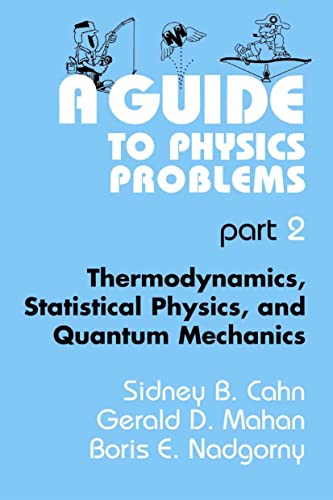
In order to equip hopeful graduate students with the knowledge necessary to pass the qualifying examination, the authors have assembled and solved standard and original problems from major American universities – Boston University, University of Chicago, University of Colorado at Boulder, Columbia, University of Maryland, University of Michigan, Michigan State, Michigan Tech, MIT, Princeton, Rutgers, Stanford, Stony Brook, University of Tennessee at Knoxville, and the University of Wisconsin at Madison – and Moscow Institute of Physics and Technology. A wide range of material is covered and comparisons are made between similar problems of different schools to provide the student with enough information to feel comfortable and confident at the exam. Guide to Physics Problems is published in two volumes: this book, Part 2, covers Thermodynamics, Statistical Mechanics and Quantum Mechanics; Part 1, covers Mechanics, Relativity and Electrodynamics.Praise for A Guide to Physics Problems: Part 2: Thermodynamics, Statistical Physics, and Quantum Mechanics:”… A Guide to Physics Problems, Part 2 not only serves an important function, but is a pleasure to read. By selecting problems from different universities and even different scientific cultures, the authors have effectively avoided a one-sided approach to physics. All the problems are good, some are very interesting, some positively intriguing, a few are crazy; but all of them stimulate the reader to think about physics, not merely to train you to pass an exam. I personally received considerable pleasure in working the problems, and I would guess that anyone who wants to be a professional physicist would experience similar enjoyment. … This book will be a great help to students and professors, as well as a source of pleasure and enjoyment.” (From Foreword by Max Dresden)”An excellent resource for graduate students in physics and, one expects, also for their teachers.” (Daniel Kleppner, Lester Wolfe Professor of Physics Emeritus, MIT)”A nice selection of problems … Thought-provoking, entertaining, and just plain fun to solve.” (Giovanni Vignale, Department of Physics and Astronomy, University of Missouri at Columbia)”Interesting indeed and enjoyable. The problems are ingenious and their solutions very informative. I would certainly recommend it to all graduate students and physicists in general … Particularly useful for teachers who would like to think about problems to present in their course.” (Joel Lebowitz, Rutgers University)”A very thoroughly assembled, interesting set of problems that covers the key areas of physics addressed by Ph.D. qualifying exams. … Will prove most useful to both faculty and students. Indeed, I plan to use this material as a source of examples and illustrations that will be worked into my lectures.” (Douglas Mills, University of California at Irvine)
User’s Reviews
Reviews from Amazon users which were colected at the time this book was published on the website:
⭐Finding a collected set of problems in thermodynamics and quantum mechanics with their solutions is a challenge. A Guide to Physics Problems Part 2 answers that challenge well, though imperfectly. Here are the book’s strengths:- The problems are varied and cover lots of ground.- There are not hundreds of problems just for the sake of having hundreds of problems. Problems are selected carefully to make sure that they don’t overlap concepts. This means you’ll do a few problems on each topic, with each problem requiring different skills and techniques. Repitition is thankfully minimized.- Problems are written clearly and succintly.- All problems seem “fair”. These are concepts I would expect to see tested on graduate level exams.But there are also weaknesses:- The solutions are not always crystal clear. At times, I found myself wondering where particular equations came from.- I found certain concepts not covered well. For example, in the quantum mechanics section, I don’t recall any problems regarding free particle states.Overall, this is a solid and useful purchase. While not perfect, it’s still one of the better resources out there for learning thermo and QM.
⭐If you’re studying for your Quals, this is the book to use. Explanations are clear, and the problems are useful.
⭐These are actual Ph.D. qualifying exam problems. Most problems are short and beautiful – and the solutions are elegant. The problems do not emphasize raw math crunching (solving a god-awful diff equation via series expansion…) – but focuses more on concepts and simple approaches to problems. If you are looking to get back to graduate school physics, chances are you will need to re-take the qualifying exams. This is the best set of books to prepare you for such an exam.For those looking for a more rounded approach to self-learning advanced physics, I had compiled a list of bookshttp://www.anujvarma.com/self-learning-booksfor-advanced-physics/
⭐I simply did the problems in this book and then passed the Caltech physics phd qualifying exam for quantum and statistical mechanics. The difference between this book and the standard Yung-kuo book for practice problems is brevity. Yung-kuo simply has too many problems, many of which are very similar, teaching no new concepts. Cahn, on the other hand, has picked a smaller but more meaningful subset of problems. There are few enough problems that you can do them all in a reasonable amount of time, but enough that you hit all the major concepts. I highly recommend it for anyone studying for physics quals, or for an undergraduate with a couple weeks of time who is about to do the GRE. I realize that the GRE doesn’t have in-depth problems, but by doing in-depth problems you master the concepts that the GRE does test on.
⭐The idea behind this book is good, and the selection of problems is okay. However, there are flaws that undermine the usefulness of many of the problems. All too often there is not enough information given in a problem to solve it, and the solution will assume values for mass, temperature, etc. (i.e. pull numbers out of nowhere).Some solutions are wrong. The first problem in the book, for example – “Sure, it’s fine to sit in a sealed chamber when an atomic bomb explodes. There’s no change in temperature because no molecules are escaping. What is this ‘potential energy’ of which you speak?”Also, a number of the problems are not as self-contained a qual questions tend to be, and rely on you having solved other problems first (which makes it difficult to pick and choose the problems you do from this book).And the pictures… are cute, but they are worse than useless. For example, look at P.4.3 and tell me that you expected them to assume the balloon was less than 2km from the Earth. It looks like it’s farther away than the Moon. Combine this picture with the lack of information given in the problem and you have no idea what density to pick. (I used the density of the interstellar medium because of the picture. They assume the density of air at the surface of the Earth!)It’s worth looking at nonetheless, but don’t buy it. It’s put together in far too sloppy a fashion.
⭐This book provides elegant physics problems (and solutions) from the preliminary doctoral exams of some prestigious universities. Very good for preparing these exams and also gaining problem solving skills in physics (not only for exams).With these problems, I also understood some concepts which were not clear before. This book can, therefore, be used as a source for applications of the corresponding subjects. I strongly recommend it.
Keywords
Free Download A Guide to Physics Problems: Part 2: Thermodynamics, Statistical Physics, and Quantum Mechanics (The Language of Science) 1997th Edition in PDF format
A Guide to Physics Problems: Part 2: Thermodynamics, Statistical Physics, and Quantum Mechanics (The Language of Science) 1997th Edition PDF Free Download
Download A Guide to Physics Problems: Part 2: Thermodynamics, Statistical Physics, and Quantum Mechanics (The Language of Science) 1997th Edition 2007 PDF Free
A Guide to Physics Problems: Part 2: Thermodynamics, Statistical Physics, and Quantum Mechanics (The Language of Science) 1997th Edition 2007 PDF Free Download
Download A Guide to Physics Problems: Part 2: Thermodynamics, Statistical Physics, and Quantum Mechanics (The Language of Science) 1997th Edition PDF
Free Download Ebook A Guide to Physics Problems: Part 2: Thermodynamics, Statistical Physics, and Quantum Mechanics (The Language of Science) 1997th Edition