

Ebook Info
- Published: 1993
- Number of pages: 262 pages
- Format: PDF
- File Size: 20.34 MB
- Authors: Stuart Bennett
Description
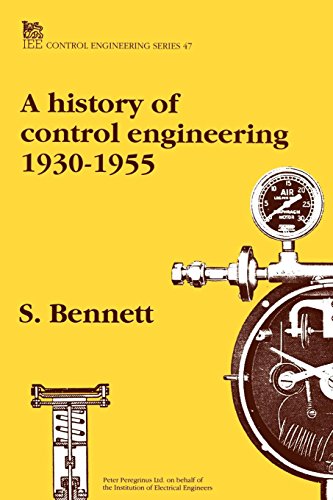
In the twenty-five years between 1930 and 1955 crucial changes in our understanding of feedback control systems occurred. The history of these developments is traced in this book.Feedback control devices were used for general industrial control, in process control, in aircraft and ships, in the telephone system and in analogue computing systems. The significant developments that occurred during the 1930s in several of these areas are analysed in detail.During the Second World War the ideas and techniques that had been developed in disparate areas were brought together to form what we now know as the classical frequency response methods of analysis and design. Work on methods for dealing with non-linear systems, sampled-data systems and stochastic systems began. The immediate post-war years saw the consolidation and dissemination of the classical methods and the addition of the root locus method for analysis and design. The final chapters cover the beginnings of so-called modern control with the introduction of state-space methods of analysis and design.As well as being of interest to engineers the book is also relevant to historians concerned with social, economic and labour history.
User’s Reviews
Editorial Reviews: About the Author Stuart Bennett is a senior lecturer in the Department of Automatic Control and Systems Engineering at the University of Sheffield. He has written extensively about the history of control engineering and about the influence of technological developments on the process industries. His other interests include computer control, real-time system design methodologies and intelligent simulation systems.
Reviews from Amazon users which were colected at the time this book was published on the website:
⭐Great book with lots of references and backup material. Author has written something that needed to be written for non-academians.
⭐”The standarisation of products, components and procedures not only made it easier to observe and control what workers were doing but also encouraged managers to consider automatic operation, for with automatic operation the uncertainty involved in human operations could be removed.” -p.1″W. Oppelt suggests more was known than was published partly because of military secrecy and partly because of an unwillingness to disclose techniques to commercial competitors.” -p.20″The ability to measure a quantity is prerequisite to controlling it, and in order to understand the way in which controllers developed we need to first examine briefly the development of measuring (recording) instruments during the early years of this century.” -p.29″Also, with several competing companies, there was a reluctance to share information or to publish more than was necessary to stimulate sales.” -p.62″It has been pointed out by Leonard Reich that one of the benefits of industrial research laboratories was (and is) their ability to bring together teams of experimentalists, theoreticians, technicians and clerical staff who together are more productive than they would be as individuals.” -p.81″The close ties and the ‘excessive application of security regulations’, Ivan Getting argued, produced a ‘closed technical society’ which could ‘easily lead to over-confidence within the group’ and to the discounting opinions, criticism and proposals of people outside the group.” -p.125″If it was found that the parameters of the performance of a human being cannot be established with any degree of certainty, ‘ a definite boundary on the performance of any given automatic control system in which a human link is used’ would be set, ‘beyond which it is futile to attempt to go.'” -p.167″In this book, although I have not tackled the difficult task of relating the technical changes brought about by the development of feedback theory and devices to social and economic change, I hope that what I have done provides a starting point that will help others with the task. It is an important task, for even though we are nearing the end of this century, we have no yet solved and do not understand many of the problems that emerged with the first use of automatic control mechanisms at the beginning of the century. As control technology and theory continues to change it is vitally important that we do begin to understand more deeply its social consequences and learn to adapt the technology to society’s needs rather than society to the technology.” -p.205
Keywords
Free Download A History of Control Engineering 1930-1955 in PDF format
A History of Control Engineering 1930-1955 PDF Free Download
Download A History of Control Engineering 1930-1955 1993 PDF Free
A History of Control Engineering 1930-1955 1993 PDF Free Download
Download A History of Control Engineering 1930-1955 PDF
Free Download Ebook A History of Control Engineering 1930-1955