

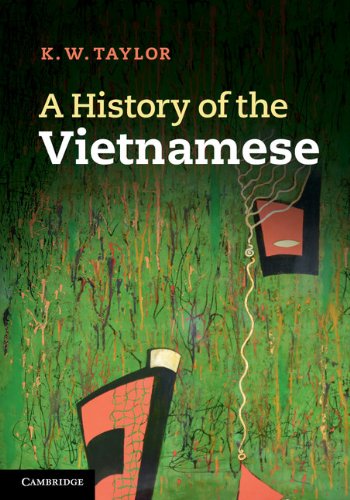
Ebook Info
- Published: 2013
- Number of pages: 716 pages
- Format: PDF
- File Size: 6.78 MB
- Authors: K. W. Taylor
Description
The history of Vietnam prior to the nineteenth century is rarely examined in any detail. In this groundbreaking work, K. W. Taylor takes up this challenge, addressing a wide array of topics from the earliest times to the present day – including language, literature, religion, and warfare – and themes – including Sino-Vietnamese relations, the interactions of the peoples of different regions within the country, and the various forms of government adopted by the Vietnamese throughout their history. A History of the Vietnamese is based on primary source materials, combining a comprehensive narrative with an analysis which endeavours to see the Vietnamese past through the eyes of those who lived it. Taylor questions long-standing stereotypes and clichés about Vietnam, drawing attention to sharp discontinuities in the Vietnamese past. Fluently written and accessible to all readers, this highly original contribution to the study of Southeast Asia is a landmark text for all students and scholars of Vietnam.
User’s Reviews
Reviews from Amazon users which were colected at the time this book was published on the website:
⭐This is an obviously well-researched book, by a lifelong scholar in the field. As I see it, his basic point is that the Vietnamese are an extension of the Chinese. While there is some separation between them, it is tenuous because Vietnam doesn’t have the geographical advantages that Japan and Korea had, of enjoying a physical barrier. For this reason, Chinese influence has been the predominant external factor throughout the entire history of Vietnam.I hate to contradict a 30 year professor of Vietnamese history, but I believe that his judgments regarding the Vietnam War are plainly incorrect. I believe these judgments are largely derived from his combat experience in Vietnam. He does recognize that President Diem was murdered on orders of our head of state, but he doesn’t seem shocked or disturbed by this. It seems par for the course. He clearly believes that if only the military had been given a free hand we could have driven North Vietnam to its knees. He also states in his final sentence that Vietnam was “wounded by a faithless ally in 1975”. This sounds very much like “we could have won if only we hadn’t given up.”Taylor is capable of acknowledging the political (though not economic) realities in the United States which made it impossible for us to win against an enemy as dedicated as the North Vietnamese, but he does not seem to truly understand them. Perhaps this is due to the timing of his deployment in Vietnam, which appears to have been in the latter half of our involvement in that war.According to Wikipedia: “Between March 1965 and November 1968, aircraft of the U.S. Air Force had flown 153,784 attack sorties against North Vietnam, while the Navy and Marine Corps had added another 152,399. On 31 December 1967, the Department of Defense announced that 864,000 tons of American bombs had been dropped on North Vietnam during Rolling Thunder, compared with 653,000 tons dropped during the entire Korean War and 503,000 tons in the Pacific theater during the Second World War.” Taylor does not discuss this tremendous use of ordinance on Vietnam, nor does he discuss the reasons why the US lost this war.I have extensive knowledge of the period 1962 through 1965 concerning Vietnam, so I will use that as my litmus test for K. W. Taylor’s discussion of the subject. I was pleased to see that Taylor mentioned the bombing of Diem’s “presidential palace” in 1962, an often ignored Early Warning Sign that perhaps the leader of our ally wasn’t the most beloved leader ever. I was pleased to see he acknowledged direct US instigation of the overthrow and murder of Diem. What I wasn’t pleased to see was his discussion of the period that followed the coup which began the “revolving door” of coup after coup that took place in this period. Taylor does admit the existence of a few coups, but fails to say that there were roughly a dozen. It is at this point that I wonder if his personal experience of the War may have influenced his opinions enough to impact the objectivity of his discussion. Certainly the remainder of his narrative bristle with phrases remarkably similar to those being handed out to the American public: the North Vietnamese were about to break, we were tying our military’s hands behind its back, LBJ didn’t have the will to win; even McNamara emerges as some kind of “latter day peacenik”!The strange thing is, that his own personal feeling that we could have (and should have?) won the war, contradicts his overall conclusion that after all, Vietnam is an extension of China and can do nothing without a clear signal from China that it’s okay to do it. If that is the basic nature of Vietnam, how does he expect that the US could have won the Vietnam War, without incurring war with China? After all, we had the example of the Chinese reaction to MacArthur’s triumphs in Korea.It is telling that this author scarcely discusses US involvement in the war at all, and even then only in the most limited way. Taylor apparently does not see any moral dimension to our actions during the Vietnam War. It was as if talking about the American dominance of this country was an Elephant in the room. Once we murdered the legitimate President of our own ally, South Vietnam ceased to be a real ally and became instead an occupied country forced to serve America’s interests.Perhaps this was in our best interest, or seemed in our best interest at the time. Perhaps all is fair in love and war. Perhaps national interest is the only thing that matters. But can we really afford to think that way, in a nuclear world? Are we really willing to roll the dice with the continued existence of humanity as our stake?
⭐I bought this Keith Taylor’s excellent book on the History of the Vietnamese, because I love his earlier book The Birth of Viet Nam very much.Professor Keith Taylor approached this history of the Vietnamese with a new and fresh optic very much different from the way Western & French and traditional Vietnamese historians wrote on the same topic.Taylor emphasized the role the Chinese immigrants and their descendants played during the first 6 centuries AD, after the first war of Independence of Viet Nam leaded by the Trung sisters in 43 AD, a fact that was not elaborated at its just value by previous historians.He discussed of the matrilocal – and probably matriarchal also – aspect of Viet Society during these earlier centuries, which explains why the first anti Chinese wars were leaded by female leaders like the Trung sisters in the First century and the Lady Trieu in the 3rd century AD.Taylor shows us that one of the causes of the decline of the Ly dynasty, beside the weak personalities of the Ly kings, was the fact that maternal family played a predominance role in the government for many years.Ho Quy Ly – Le Quy Ly by his previous name – the man who overthrew the last king of the Tran dynasty in the last years of the XIV century was seen as a ruthless but very efficient state man who tried very hard – but unsuccessfully – to reform the Vietnamese society in the beginning of the XV century. Ho Quy Ly was splendid in his conquests of southern regions of Viet Nam but ran into troubles by the early and over-aggressive hegemonic policy of the Ming emperor.Probably the political landscape of Vietnamese XV century would be very much different if Ho Quy Ly had a few more years to consolidate his new government before the Chinese Ming invaded Viet Nam. His plan to convert coins money into paper money was a good one but required much more time to implement.I believe that Taylor’s view was influenced partly by the excellent researches of his old friend from the U of Michigan John Whitmore who wrote his doctorate thesis on Ho Quy Ly.I believe this is a very good history book on Viet Nam.I feel bad that Taylor does not give us any footnote to help us locate the proper reference on many of his points of view on historical facts. The very long bibliography at the end of the book is overwhelming but a difficult maze to navigate.It is excellent that Taylor is good in reading and interpreting the chữ Nôm – an old logographic script of the old Vietnamese language – which enabled him to decipher the many scriptures carved in stone steles dating from the first millennium in Viet Nam. This gives us a different view of History when compared side by side with the official Chinese history books.I will advise anybody interested in the History of Viet Nam to buy this excellent bookNguyen Thuong Vu M.D.
⭐As a Vietnamese American, Ph.D in Science, who retired as a Cancer Researcher at several US Research Institutes and Universities, I spent my professional life looking at very complex problems such as the abnormal biology of cancer cells. Vietnam’s History is my non bread winning activity occupying most of my non-cancer related mental activity.Dr Keth Taylor ‘s book A History of the Vietnamese was a first book on the subject that provided, certainly to me, a coherent rationale explaining the two millennium evolutionary process ending with an entity known as the country of Vietnam inhabited by the Vietnamese of today.Dr Taylor’s theory was the creation of post 1975 Vietnam, a country spanning over 2000 km long with 90 millions inhabitants was almost accidental depending on the action of a few leaders who motivated the very heterogeneous populations of different ethnicity, language, culture, beliefs and religions. Vietnam was One only for a very brief time of her existence less than 10% .I strongly recommend this book to all people who want to understand in depth a very complex people and a very complex country.
⭐I feel happy to have bought this book, as it is nearly brand new and the price is sensible. It is very helpful for my research. Thank you very much.
⭐I anticipate really enjoying this new approach to my favourite subject
⭐This readable book provides a flight over history of Vietnamese with a lot of hasty conclusions. The author use “Vietnamese” instead of Vietnam probably because in his view point the Vietnamese People never got a country (?) The most interesting point of this book is history events indexed by author with an extensible annex. So the readers can search and read then make their own conclusion. With rich document sources on western sides and a good understanding of western politic author details well the connected events. But he lacks painfully primary sources from URSS, North Vietnam… to go further and deeply in any analysis. Another issue is the lack of understanding the Asian culture especially in relationships between China and Vietnam. One example, the author stated at the end of the book that China and Vietnam have mainly peaceful relation through history or in reality it’s a permanent and painful conflict. Even when he can agree on the outcomes of 1968 Tet offensive he could not get rid of his bias view of the Operation Linebacker II…If the readers can put aside all conclusions and personal view of the author, this book is quite interesting to read to have an understanding of chaotic history of Vietnam.The last point: it seems to me that the author tried to undo the Myth of Vietnamese on their survival history but his efforts are based on unconsciously (?) exterior view points thus the only things he found are disarray elements. In fact the myth is no myth at all. Just the people and their culture.
⭐This is the only book on Vietnam that places in the “Vietnam War” within the context of a larger Vietnamese history rather than a global Americancentric perspective. For this alone the book is worth its price.
⭐K.W.Taylor offers a very thorough and concise but still comprehensive overview of the Vietnamese in the last 4000 years. For me as a trained economic historian and investigative journalist, this book offers just the right amount of background information for a independent research on your own. Thanks a lot.
Keywords
Free Download A History of the Vietnamese (Cambridge Concise Histories) in PDF format
A History of the Vietnamese (Cambridge Concise Histories) PDF Free Download
Download A History of the Vietnamese (Cambridge Concise Histories) 2013 PDF Free
A History of the Vietnamese (Cambridge Concise Histories) 2013 PDF Free Download
Download A History of the Vietnamese (Cambridge Concise Histories) PDF
Free Download Ebook A History of the Vietnamese (Cambridge Concise Histories)