Ebook Info
- Published: 2017
- Number of pages: 208 pages
- Format: PDF
- File Size: 8.65 MB
- Authors: Leonard M. Blumenthal
Description
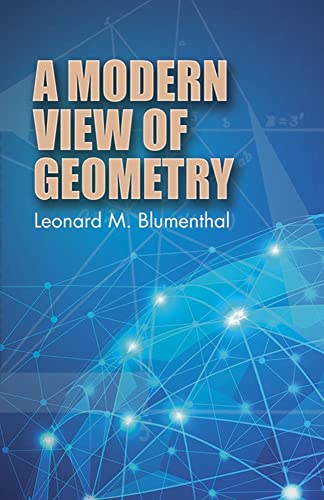
On the required reading list for all thoughtful students who wish to see mathematics from the ‘higher standpoint.’ — American Mathematical MonthlyElegant and original, this exposition explores the foundations and development of both Euclidean and non-Euclidean geometry, particularly the postulational geometry of planes. Emphasis is placed upon the coordination of affine and projective planes as well as the basic unity of algebra and geometry.Geared toward undergraduate and graduate students, the treatment begins with a brief but engaging sketch of the historical background of Euclidean geometry and an elementary summary of set theory and propositional calculus. Subsequent chapters explore coordinates in an affine plane, including those with Desargues and Pappus properties, and coordinatizing projective planes. The final two chapters contain detailed developments of simple sets of postulates for the Euclidean and non-Euclidean planes.
User’s Reviews
Editorial Reviews: About the Author Leonard M. Blumenthal (1901–84) was Professor of Mathematics at the University of Missouri. In addition to this volume, he wrote Theory and Applications of Distance Geometry.
Reviews from Amazon users which were colected at the time this book was published on the website:
⭐Love it
⭐Far away and long ago, I read this little big book. I borrowed it from a public library, with the hope to learn plane projective geometry. I’m still amazed I could understand almost everything there in one month. Years later I bought it. The first three chapters are addressed to anybody able to read, write and think, with little or null background in mathematics. The book starts with a glimpse on Euclid’s fifth postulate and its history. Then it gives an overview of elementary logic and says what an axiomatic theory is. In chapter three, Hilbert axioms for the euclidean plane geometry are presented. Here, the less trained reader could consider a trip thru Euclid’s Elements
⭐before going further. If you have some mathematical education and keep faithful to Blumenthal, you face the affine plane and the problem of introducing cordinates (chapter four); to do so, Blumenthal uses a quite singular tool: Marshall Hall’s concept of planar ternary ring (see the revered Hall’s work
⭐to confirm). I was shocked when I knew finite geometries were possible. The book shows that the plane admits the Desargues configuration if and only if coordinates form a (maybe non commutative) field of “numbers”, while the plane admits Pappus configuration if and only if the field is commutative (G. Hessenberg’s theorem). Next, an axiomatic definition of projective plane is presented (curiously, we don’t find here the name of Staudt, the author of the first purely projective foundation of projective geometry, published in his book “Geometrie der Lage”, Nüremberg, 1847). More on coordinates and configurations on a projective plane is discussed in chapter six. At the end, there is a nice report on the elliptic plane, which is nothing but the real projective plane with a suitable metric (by the way, as a topological space, Möbius discovered that it is a non-orientable surface). Its differences with respect to the euclidean plane and with respect to the Poincaré half plane model of hyperbolic plane geometry are briefly presented. I regret that there is no bibliography, although many mathematitians are cited. What I appreciated most of this little book (in addition to its rich content) is the fact that it is both a model of mathematical reasoning and a very pleasant reading. Later, I had to study E. Artin’s dry book
⭐, where a simpler approach is used to introduce coordinates, and where the link between the projective geometry and the underlying linear algebra properties is quite well established, (with the so called “Fundamental Theorem of Projective Geometry”, which essentially says that if coordinates are good enough, then evey transformation sending lines into lines arise from a (semi)-linear map of a vector space underlying the projective space, a property discovered by R. Baer, which is not mentioned by Blumenthal). To be modern is nowadays much less important than it was in 1960. I don’t know if the title of Blumenthal’s work is still realistic. After Hilbert, between 1900 and 1970, many mathematicians felt forced to write their own books on the “foundations” of (projective) geometry. Among them, Coxeter’s books are enjoyable, for example
⭐. Modern may be not, but Elie Cartan’s
⭐(“Leçons sur la Géométrie Projective complexe”, Gauthier-Villars, Paris, 1950) deserves the highest attention.
⭐This book provides a great intro to non-standard geometries by creating different axiomatic systems and finding models of them. It then constructs and analyzes operators (addition, multiplication, and the like) on the plane. It devotes a good section to discussing the Desargues and Pappus properties and their fundamentality in most geometries. A good treatise of projective geometry follows, and the book ends with a quick skim of metric geometries and non-euclidean geometries. This is not a good book if you are planning to study Hyperbolic, Spherical or Elliptical geometry, nor does it do a fair treatment of the effects of a metric on a geometry, but it does provide a short, comprehensive intro to axiomatic coordinate geometry.
⭐Good book on the foundations of geometry from a modern-ish perspective. Contains discussions on postulational systems, connection between theorems of elementary geometry and algebraic properties, and equivalance of modern (metric) axioms of geometries to original postulates.
⭐A good introduction to Modern Geometry. Be warned though, this is a rather slim volume and feels more like a monograph than a text book.
Keywords
Free Download A Modern View of Geometry (Dover Books on Mathematics) in PDF format
A Modern View of Geometry (Dover Books on Mathematics) PDF Free Download
Download A Modern View of Geometry (Dover Books on Mathematics) 2017 PDF Free
A Modern View of Geometry (Dover Books on Mathematics) 2017 PDF Free Download
Download A Modern View of Geometry (Dover Books on Mathematics) PDF
Free Download Ebook A Modern View of Geometry (Dover Books on Mathematics)