

Ebook Info
- Published: 2014
- Number of pages: 161 pages
- Format: PDF
- File Size: 3.62 MB
- Authors: Daniel Rosenthal
Description
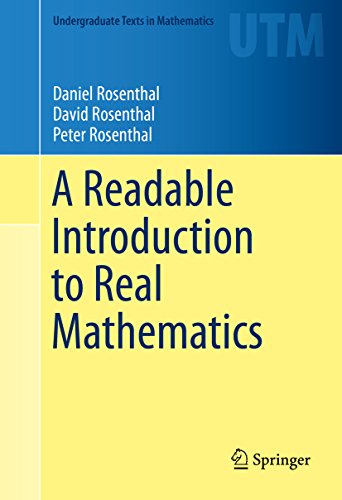
Designed for an undergraduate course or for independent study, this text presents sophisticated mathematical ideas in an elementary and friendly fashion. The fundamental purpose of this book is to engage the reader and to teach a real understanding of mathematical thinking while conveying the beauty and elegance of mathematics. The text focuses on teaching the understanding of mathematical proofs. The material covered has applications both to mathematics and to other subjects. The book contains a large number of exercises of varying difficulty, designed to help reinforce basic concepts and to motivate and challenge the reader. The sole prerequisite for understanding the text is basic high school algebra; some trigonometry is needed for Chapters 9 and 12. Topics covered include: mathematical induction – modular arithmetic – the fundamental theorem of arithmetic – Fermat’s little theorem – RSA encryption – the Euclidean algorithm -rational and irrational numbers – complex numbers – cardinality – Euclidean plane geometry – constructability (including a proof that an angle of 60 degrees cannot be trisected with a straightedge and compass). This textbook is suitable for a wide variety of courses and for a broad range of students in the fields of education, liberal arts, physical sciences and mathematics. Students at the senior high school level who like mathematics will also be able to further their understanding of mathematical thinking by reading this book.
User’s Reviews
Reviews from Amazon users which were colected at the time this book was published on the website:
⭐Great and fun intro!
⭐This text attempts to give undergraduate students an understanding of proofs in mathematics, using topics in number theory and Euclidean geometry. It is written from course notes for a one semester course at the University of Toronto, required for math majors or minors who do not take a proof-based calculus course. I have used this book three times as a TA for such an introductory proofs course. Every time I’ve found new mistakes and had to console frustrated students.Undergraduate math specialists will be disappointed by gaps in proofs and the dearth of definitions, but at least may be able to fill them in from outside knowledge or sources. They will be misled by historical errors (from the creations of public key cryptography to non-Euclidean geometries) and downright ridiculous statements (p. 106: “We invite you to try to prove that those mathematicians are wrong by proving (or disproving) the Continuum Hypothesis.”) Non-specialists or high school students will simply be confused and done a disservice by the breadth. There is little instruction on writing proofs, none on problem solving strategies, and many uncommon notations are used. Calculus is not required, but concepts usually covered in a calculus course (trigonometric functions, polynomials, and general properties of functions) are required.If you took math courses long ago and want a refresher on geometry or number theory, there are better books with fewer errors. Read Euclid’s “Elements”, or find a used copy of Robbins’s “Beginning Number Theory.” If you are a math student looking for an introduction to proofs, find Zeitz’s “Art and Craft of Problem Solving” or Krantz’s “Techniques of Problem Solving.” If you are required to buy this book, make a complaint and find one of the other books above to help in your course.
⭐I have been using this book (and its preceding notes) for my teaching at the University of Toronto over the past 15 years. I tell my students that this book exposes them to some of the highlights of the undergraduate math curriculum without much of the pain.The scope is quite broad, collecting together topics seldom discussed in other courses. The selection of topics emphasizes aesthetic consideration in service of developing mathematical appreciation. The book presents an elegant selection of topics, proofs, and examples. It modernizes and simplifies classical treatments such as “What is Mathematics?” by Courant and Robbins, keeping the mathematical intuition alive while providing the necessary rigorous justification.The organization of topics creates a natural flow and progresses in a way that reinforces the interconnectivity of ideas. For example, chapter 6 on RSA cryptography demonstrates nicely how preceding discussions on primes, modular arithmetic, and Fermat’s little theorem come together in the context of a particular application. In Chapter 10 many of the examples about cardinality re-examine mathematical objects developed earlier.One of my favourite aspects of the text is the authors’ clear and concise use of language to help readers at different levels of maturity parse mathematical logic and grasp more difficult concepts. My students enjoyed reading the book and working out the variety of problems at the end of each chapter, which builds gradually from the easy to the more challenging.I look forward to the upcoming second edition which, as I understand, will update the first edition and include two new chapters.
⭐disclosure- Daniel Rosenthal was my student when I taught primary school! He was a gifted teacher when he was six years old and is still teaching me things- this is a very good book for someone like me who got off to a bad math start as a child and is still recovering!
⭐Good Book.
⭐
⭐
⭐
Keywords
Free Download A Readable Introduction to Real Mathematics (Undergraduate Texts in Mathematics) 2014th Edition in PDF format
A Readable Introduction to Real Mathematics (Undergraduate Texts in Mathematics) 2014th Edition PDF Free Download
Download A Readable Introduction to Real Mathematics (Undergraduate Texts in Mathematics) 2014th Edition 2014 PDF Free
A Readable Introduction to Real Mathematics (Undergraduate Texts in Mathematics) 2014th Edition 2014 PDF Free Download
Download A Readable Introduction to Real Mathematics (Undergraduate Texts in Mathematics) 2014th Edition PDF
Free Download Ebook A Readable Introduction to Real Mathematics (Undergraduate Texts in Mathematics) 2014th Edition