

Ebook Info
- Published:
- Number of pages:
- Format: PDF
- File Size: 2.41 MB
- Authors: Willy Peter Reese
Description
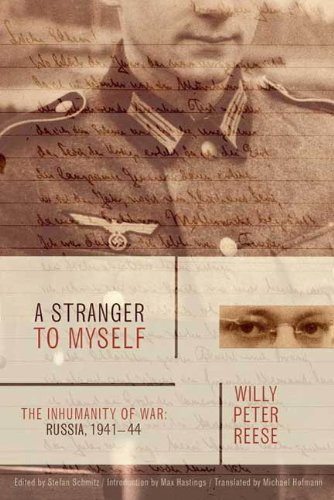
A Stranger to Myself: The Inhumanity of War, Russia 1941-44 is the haunting memoir of a young German soldier on the Russian front during World War II. Willy Peter Reese was only twenty years old when he found himself marching through Russia with orders to take no prisoners. Three years later he was dead. Bearing witness to–and participating in–the atrocities of war, Reese recorded his reflections in his diary, leaving behind an intelligent, touching, and illuminating perspective on life on the eastern front. He documented the carnage perpetrated by both sides, the destruction which was exacerbated by the young soldiers’ hunger, frostbite, exhaustion, and their daily struggle to survive. And he wrestled with his own sins, with the realization that what he and his fellow soldiers had done to civilians and enemies alike was unforgivable, with his growing awareness of the Nazi policies toward Jews, and with his deep disillusionment with himself and his fellow men.An international sensation, A Stranger to Myself is an unforgettable account of men at war.
User’s Reviews
Reviews from Amazon users which were colected at the time this book was published on the website:
⭐Of all the countless memiors written by German veterans of the Eastern Front, A STRANGER TO MYSELF is the most unique I’ve yet read. It distinguishes itself from the “field gray flood” of nonfiction books on the Russian campaign in two very distinct ways: first, the author, Willy Peter Reese, did not live to see his scattered notes, many scribbled by the light of a cigarette, get published; he was killed in action in Russia in 1944. Second, Reese was not writing a mere litany of combat experiences and behind-the-lines hijinks but rather a deeply introspective, quasi-metaphysical self-portrait of a thoughtful young man in the midst of a war he neither agreed with nor understood.Willy Reese seems to have been a rather tortured soul well before he was drafted into Hitler’s army – he had a tendency to brooding and seems to have been somewhat anguished about the meaning of life, not to mention oversensitive to its vulgarity and cruelty. The military service did not sit well with him, and he nursed a deep disgust for the Nazis and their cult of anti-intellectualism and brutality. By the time he got to Russia he seems to have given up on the human race, which made what he saw and experienced there all the more horrifying for him.Roughly 32 million people died on the Eastern Front between 1941 – 1944, the majority of them Russian civilians, and Reese himself survived long enough to see enough carnage for 1,000 lifetimes. He expected war to be horrible; what he did not expect was that he himself would willingly perpetrate some of this horror, and learn to do so with a smile on his face. Such was his transformation, from vaguely pacifistic poet to stone-faced hunter of his own species, that he came to feel that he had changed into someone that he did not know – a stranger to himself. Trapped between who he had been and who he was becoming, his only release (“spiritual morphine”) came in writing down his experiences, notes which, after his death in combat, his mother would later organize into this book.American war literature tends to be very straightforward, and so it’s no surprise a lot of people feel that Reese was a pretentious pseudo-intellectual trying to impress his audience with his vocabulary and intellect. After all, many of the book’s passages are taken up with philosophical contemplations of the meaning of existence, the human soul, the relationship of man to nature, and the cycle of life and death. And Reese is the sort who doesn’t step over a rock, he picks it up and contemplates its place in the Scheme of Things, sometimes with a seriousness that may seem silly to a (further) Westerner. This will be very annoying to a lot of readers who want their “war” books heavy on the “war” and light on the half-mystical philosophizing, but what readers and critics must understand is that Reese was merely a product of his times and of his country. German education heavily stressed philosophy, history, mythology, and classic literature, and Germans as a rule have a very deep connection to nature. This tends to effect their writing, and it deeply effected Reese’s. You can love it or hate it (or something in between), but you shouldn’t view it as affected – it was quite genuine.A STRANGER TO MYSELF is not without its gripping moments. Like one of his influences, Ernst Jünger, Reese often digresses into turgid rambling, but just like Jünger, these tedious passages almost always give way to beautifully written and vivid descriptions – when Reese describes the horrible fury of the Russian winters, the plagues of lice, the stench of decomposing corpses, the terrible exhaustion and thirst of a long march in the Ukrainian sun, the pathos of a dead soldier “whose rigored hands refused to yield his rifle”, you feel these things as certainly as if you were experiencing them yourself.A STRANGER TO MYSELF is an important book, one which approaches an unbelievably savage conflict from the perspective of a man who was quite aware of what the war was doing to him, but powerless to stop it. And that theme of powerlessness, of being swept along the currents of Fate by forces he did not understand, is part of what makes the book such a poignant and necessary read. The Eastern Front was a hell that only one in four of the German soldiers who served in lived to talk about, and while Reese did not survive, his voice rings very loud indeed.
⭐The story of this soldier really shows how terrible WW2 was for everyone, including the soldiers and people of the Eastern Front. Reese does not hold back on details of war and destruction during this time, and covers what he thinks and feels throughout battles and marching. He even admits throughout the book the terrible things he has done himself, and it’s interesting to see that defeat in a person of losing innocence to becoming a soulless soldier as he describes it. The main thing I didn’t like about the book is the rambling sometimes in sections that sometimes feel repetitive or random. They are all not bad, but sometimes they say the same thing as before and doesn’t add anything to the story. I know he wrote all this in diaries and manuscripts at a whim, but sometimes they do repeat themselves and it gets tedious. Regardless, the story is dark, very open on details, and gives you a picture of the life of a soldier in the Eastern Front. Very cool but sad read.
⭐I stumbled on this book why visiting some sites about Stalingrad. It was mentioned by a couple posters so I decided to give it a read. I was not disappointed.This is not a book looking for hard facts about places and people. It’s the writings of a man coming to terms with war and how it changed him.There is a great deal where the author goes into vivid descriptions about feelings, memories, and impressions of his surroundings. This could annoy some people.Do not look for detailed descriptions of tactics and strategy.What makes this book interesting is the contrast of hope and despair. The prose that starts a chapter changes to despair over time. There are ample descriptions of soldiers abusing people, looting, and drinking. Reese tells of his own actions and in the end drinks heavily. He even decided to get himself killed or wounded by standing up from a trench.There is no propaganda in the book. He does not preach the glory of Hitler. Yet, he also doesn’t mention other things such as the holocaust. There is even a reference to a friend in Auschwitz.Towards the end of the book I got the impression he decided to die in Russia. There isn’t anything obvious to state this idea. It’s just how it read to me.There are photos in the book ranging from his early days, joining the army and even a Red Cross report telling where it is thought that Reese died.It is a good thing this book was published. The mother held his writings till she died. One aspect that is useful is that it goes contrary to a belief that the German army was clean in it’s actions in Russia. I have read more then a few comments from people that argue the Germans were noble while the Russians were savage.Probably the most prophetic comment was the end of the book:”The war went on. Once more I went out there. I loved life.”
⭐This book is absolutely extraordinary. The literary talent of Willy Peter Reese is incredible and this story is all the more tragic when you realize that he was killed in the war. For starters, Reese’s introspection and his honest descriptions of what goes on around him are absolutely vital to the narrative of the Eastern Front, some reviewers are taken aback by Reese’s more literary approach to his experiences. This is silly, this is one of the best memoirs of WW2 and the title says it all. There isn’t much else to say, if you can only buy one book about a German soldier in WW2, this is it. The reading is hard for those who aren’t as adept at reading poetry and symbolic writing, but read it, this book is simply amazing, as someone who has read more than my fair share of Eastern Front memoirs, this book left me amazed.As a side note, if you want to watch a physical representation of Reese’s character arc, watch the series “Unse Mutter, Unser Vater” and pay particular attention to the character of Friedhelm.
⭐This is almost a poetic journey through 3 years of war as experienced by a young man. Instead of long passages of action, tanks destroyed, hand to hand conflict endured, a personal tally of those killed wracked up, we have a sensitive yet fatalistic vision of an unfolding ‘adventure’. Adventure is a word Reese uses often, the sense that he yearns for the camaraderie, the dislocation, the horror of day to day war, and can never relax during those passages of leave when he knows that reality lies waiting for him upon his return.Reese communicates this living landscape eloquently. Many of the passages are beautifully written. The shame is that he was unable to write more and on other subjects divorced from war. Of all the memoirs I have read recently, this is possibly the best, and certainly possesses the best prose style.
⭐This book needs to be read slowly – some may not like the “poetic flights”, but i honestly think it an extremely valuable contribution to autobiographical accounts of the Eastern Front.
⭐A book that tells the story in his own words of a German infantry man on the Eastern Front. His observations are worth reading for they help explain why so many ordinary Germans fought for the evil that was Hitler. But so many of his comments can apply to any war.
⭐Not for me, Willy did let you know what it’s was like, the horror of war, the freezing conditions,but for me he waxed lyrical just too much
⭐This was a Christmas present for my husband. He has a real interest in reading German accounts of WW2 and this book apparently does not disappoint. Nothing has been lost in translation and he says it makes for a fascinating read. He’s read it already!
Keywords
Free Download A Stranger to Myself: The Inhumanity of War: Russia, 1941-1944 in PDF format
A Stranger to Myself: The Inhumanity of War: Russia, 1941-1944 PDF Free Download
Download A Stranger to Myself: The Inhumanity of War: Russia, 1941-1944 PDF Free
A Stranger to Myself: The Inhumanity of War: Russia, 1941-1944 PDF Free Download
Download A Stranger to Myself: The Inhumanity of War: Russia, 1941-1944 PDF
Free Download Ebook A Stranger to Myself: The Inhumanity of War: Russia, 1941-1944