

Ebook Info
- Published: 1987
- Number of pages: 174 pages
- Format: PDF
- File Size: 16.26 MB
- Authors: Johan G. F. Belinfante
Description
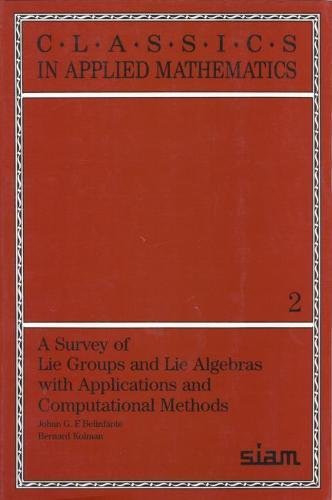
Introduces the concepts and methods of the Lie theory in a form accessible to the nonspecialist by keeping mathematical prerequisites to a minimum. Although the authors have concentrated on presenting results while omitting most of the proofs, they have compensated for these omissions by including many references to the original literature. Their treatment is directed toward the reader seeking a broad view of the subject rather than elaborate information about technical details. Illustrations of various points of the Lie theory itself are found throughout the book in material on applications. In this reprint edition, the authors have resisted the temptation of including additional topics. Except for correcting a few minor misprints, the character of the book, especially its focus on classical representation theory and its computational aspects, has not been changed.
User’s Reviews
Editorial Reviews: Review …makes interesting reading … presented simply and clearly, and almost everyone will find something new… — Mathematical Reviews, Vol. #53, 1977, Wayne J. Holman, III
Reviews from Amazon users which were colected at the time this book was published on the website:
⭐I like this book so much that I don’t mind mixing metaphors to say so. If you’ve ever been frustrated by books about Lie theory that make you wade through hundreds of pages and weeks of exercises to get to an explanation of Lie groups and how they connect to Lie algebras, Dynkin diagrams, etc. you’ll find this book a tremendous help and relief. This is an outstanding introduction to pretty much all the highlights of Lie theory in less than 150 pages of text. It’s good preparation for a math book like Fulton & Harris on representation theory, as well as for physics books like Georgi or Kahn on applications to particle physics.The authors are at pains to give you the big-picture context for pretty much everything they describe. That said, the descriptions of some constructive techniques (Chap. 3) might be a little too condensed for convenient application. E.g., the discussion of Young tableaux in Sec. 3.16 is relatively perfunctory and not relied on in subsequent sections; but at least you can get a rough idea of why people resort to them. The point of view throughout is highly algebraic: manifolds are briefly described early on and then for the most part forgotten. The book is squarely in the math-for-physicists genre, so don’t get mad at it for not being punctiliously rigorous. It lacks exercises, theorems and proofs, and has a far higher ratio of words to symbols than is usual for a book on this topic. It also has fewer illustrations than I usually like to see in a math book, but is redeemed by the clear narrative style of the exposition (which nonetheless requires a lot of concentration). Applications from physics are discussed every now and then, e.g. angular momentum, Kepler problem, charge algebras, hadrons. The text is pretty self-contained: compact Lie groups and the fundamental homomorphism theorem were the main concepts I noticed to have been slipped in without prior explanation, but these lapses were low-impact. Nonetheless, you probably should have enough of a passing acquaintance with abstract algebra and with applications of Lie groups to recognize a bit of the jargon, and to be curious enough to read this book through.A lot of the material is hard to find elsewhere. What especially excited me about the book was that it helped me to see Clebsch-Gordan coefficients in a completely new light. That may sound geeky, but it always bothered me how quantum mechanics books introduce CGCs in an ad hoc way when discussing angular momentum, esp. because computing them looks like a tedious pain and they seem only to make angular momentum more confusing. This book, though, helps you to appreciate that CGCs pop up all the time when analyzing Lie algebras (and are related to Clebsch-Gordan series, which in turn relate to those magical-seeming decompositions of tensor products into direct sums of spaces) — so they have a much deeper and more beautiful significance than you’ll learn about even from a graduate level QM book like Ballentine or Messiah. (Though this book doesn’t mention the point, both Clebsch and Gordan were contemporaries of Lie, and long dead by the time modern QM was born.) Another very neat discussion is about the connection between special functions (Bessel, Legendre, Hermite, etc.) and Lie groups/algebras — this also helps you to appreciate Lie’s historical motivation for developing the groups, viz. to simplify the solution of differential equations. The only other place where I found a discussion of this topic is in a series of exercises buried a few hundred pages into Gilmore’s 1974 textbook (now in Dover).Since the book is from 1972, it has many quaint references to “electronic computing machines,” such as UNIVAC and IBM360. The treatment of some material isn’t the most modern, but there are probably many hints of useful earlier methods that can be picked up by those wiser than I. The bibliography includes over 250 references, and the index is thorough. And BTW, I read the book in its original hardcover printing, on heavy paper that’s still as pristine white as it was when bound nearly 40 years ago. How likely is it that today’s electronic media will be as legible 40 years from now? A terrific overview of this topic — I wish I’d found it several decades ago.
⭐Book arrived as advertised and on time.
⭐
Keywords
Free Download A Survey of Lie Groups and Lie Algebra with Applications and Computational Methods (Classics in Applied Mathematics, Series Number 2) in PDF format
A Survey of Lie Groups and Lie Algebra with Applications and Computational Methods (Classics in Applied Mathematics, Series Number 2) PDF Free Download
Download A Survey of Lie Groups and Lie Algebra with Applications and Computational Methods (Classics in Applied Mathematics, Series Number 2) 1987 PDF Free
A Survey of Lie Groups and Lie Algebra with Applications and Computational Methods (Classics in Applied Mathematics, Series Number 2) 1987 PDF Free Download
Download A Survey of Lie Groups and Lie Algebra with Applications and Computational Methods (Classics in Applied Mathematics, Series Number 2) PDF
Free Download Ebook A Survey of Lie Groups and Lie Algebra with Applications and Computational Methods (Classics in Applied Mathematics, Series Number 2)