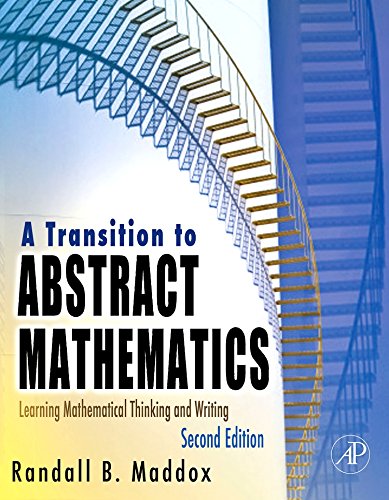
Ebook Info
- Published: 2008
- Number of pages: 384 pages
- Format: PDF
- File Size: 1.80 MB
- Authors: Randall Maddox
Description
Constructing concise and correct proofs is one of the most challenging aspects of learning to work with advanced mathematics. Meeting this challenge is a defining moment for those considering a career in mathematics or related fields. A Transition to Abstract Mathematics teaches readers to construct proofs and communicate with the precision necessary for working with abstraction. It is based on two premises: composing clear and accurate mathematical arguments is critical in abstract mathematics, and that this skill requires development and support. Abstraction is the destination, not the starting point.Maddox methodically builds toward a thorough understanding of the proof process, demonstrating and encouraging mathematical thinking along the way. Skillful use of analogy clarifies abstract ideas. Clearly presented methods of mathematical precision provide an understanding of the nature of mathematics and its defining structure. After mastering the art of the proof process, the reader may pursue two independent paths. The latter parts are purposefully designed to rest on the foundation of the first, and climb quickly into analysis or algebra. Maddox addresses fundamental principles in these two areas, so that readers can apply their mathematical thinking and writing skills to these new concepts. From this exposure, readers experience the beauty of the mathematical landscape and further develop their ability to work with abstract ideas.
User’s Reviews
Editorial Reviews: Review This second edition assists engineering and physical science students on fundamental proof techniques and learning to think and write mathematics
Reviews from Amazon users which were colected at the time this book was published on the website:
⭐I used this textbook the first time I taught an intro to proof course at a rigorous, liberal arts college. There were approximately 20 students in the class; most were sophomores who had completed linear algebra and/or multivariable calculus. I chose this book because it had been used by the previous two instructors of the course. They weren’t crazy about it, but the bookstore carried used copies and I was in a pinch time-wise.The major flaw in this book is in the “How We Write Proofs” section. It’s 4 pages long. Those four pages cover all proof techniques except for induction. The examples and exercises in this section just give (or ask for) the first and last sentences of a proof by contradiction, or a proof by contrapositive, etc. There is not a single start-to-finish proof. There is no mention of the combination of techniques within one proof. There is no example of an if and only if. There is no mention of how to create/”market” a counterexample. There are no exercises on how to READ a proof–both correct and incorrect proofs.In addition, the book is just poorly formatted. It is very hard to find a specific definition or exercise in the text. The number system of definitions vs. theorems vs. exercises is ridiculous. While this is a common student complaint in many courses, I have to say it rings true here: what’s done in detail in the reference is SIGNIFICANTLY easier than the assignments–to the point where the reference is unhelpful.What this book has going for it are ideas for extra topics–assuming your course is structured in such a way where that’s a possibility. Pages 163 to 345 include everything from a point set topology meets real analysis attack of the Heine Borel Theorem, to epsilon-delta proofs on limits and uniform continuity, to basics of groups and rings. Granted, there is no way that in less than 200 pages this is going to be high-quality–there’s way too much material. But it still gives nice ideas for extra topics.After my experience with Maddox, I chose not to use a textbook at ALL–it was that bad. It’s better to have no textbook than to have a completely worthless textbook. The students concurred–every single course evaluation mentioned how unhelpful and awful the book was.
⭐Very easy to follow, the author did a good job with his book. I used the text for self study – and didn’t have any major problems. Putting the time in to lay the foundation is very rewarding – it was an investment to get more out of my other texts on Graph theory, combinatorics.
⭐A Transition to Abstract Mathematics is more than a book on proof techniques. It also provides a good overview of and introduction to many important ideas in subsequent courses. The book is divided into three major parts. Part I covers the basics of higher mathematics and proof techniques, including symbolic logic, elementary set theory, relations, functions and other basics. The second part covers the basics of analysis and the third algebra. The book is designed for students with some mathematical background, such as calculus as is typically taught in the US. Such students often find the transition from problems oriented problems to writing proofs difficult. Thus, students with limited exposure to rigorous mathematical proof will find this book very useful. Students who have had proof-oriented calculus (often taught as honors calculus) may find it repetitive, but most students will find something of value here in preparing them for higher level courses. The book assumes students will study more advanced mathematics subsequently, so the analysis and algebra sections provide a rigorous overview of these subject, not a complete treatment. The book is easy to read and follow, and suitable for self-study, although this would be improved with an appendix of solutions. If you already have a good understanding of proof techniques and some feel for analysis and algebra, you should probably go straight to analysis or algebra. But if you are not comfortable with proving basic results, you would benefit from this approach before tackling advanced undergraduate courses or texts in mathematics.
⭐The book is a good introduction to abstract mathematical thinking which is so fundamental to advanced mathematics. It taught me a lot.The biggest disadvantage is that the book does not contain answers to the exercises (only some worked-out examples). So it’s not a very good tool for self-study or practice, because you can hardly gain any feedback on your progress or learn from your mistakes.There are also a few proofreading errors (e.g. on pg 25 Exercise 1.2.19 (b) where there is a mistake in the formulation of the conditional statements).But the ultimate undoing is, as said, that a good book such as this does not contain answers to the exercises. That actually made me switch to another book, in order to get more feedback on what I was doing.
⭐This book is very basic undergraduate text but nevertheless very helpful. The notation is not the happiest as some of the equations contain footnotes so that variables look squared or cubed, presumably this was not intended. However, I would recommend this to undergraduate students as it is a soft transition to real analysis and it has some nice explanations.
Keywords
Free Download A Transition to Abstract Mathematics: Learning Mathematical Thinking and Writing 2nd Edition in PDF format
A Transition to Abstract Mathematics: Learning Mathematical Thinking and Writing 2nd Edition PDF Free Download
Download A Transition to Abstract Mathematics: Learning Mathematical Thinking and Writing 2nd Edition 2008 PDF Free
A Transition to Abstract Mathematics: Learning Mathematical Thinking and Writing 2nd Edition 2008 PDF Free Download
Download A Transition to Abstract Mathematics: Learning Mathematical Thinking and Writing 2nd Edition PDF
Free Download Ebook A Transition to Abstract Mathematics: Learning Mathematical Thinking and Writing 2nd Edition