

Ebook Info
- Published: 2007
- Number of pages: 416 pages
- Format: PDF
- File Size: 6.31 MB
- Authors: Vasily Grossman
Description
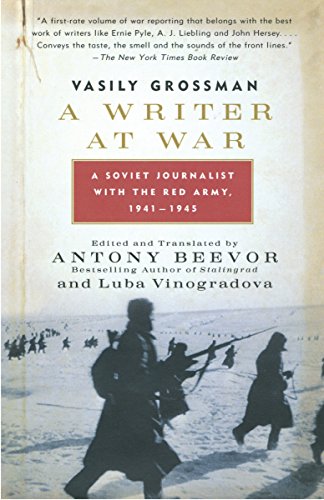
When the Germans invaded Russia in 1941, Vasily Grossman became a special correspondent for the Red Star, the Soviet Army’s newspaper, and reported from the frontlines of the war. A Writer at War depicts in vivid detail the crushing conditions on the Eastern Front, and the lives and deaths of soldiers and civilians alike. Witnessing some of the most savage fighting of the war, Grossman saw firsthand the repeated early defeats of the Red Army, the brutal street fighting in Stalingrad, the Battle of Kursk (the largest tank engagement in history), the defense of Moscow, the battles in Ukraine, the atrocities at Treblinka, and much more. Antony Beevor and Luba Vinogradova have taken Grossman’s raw notebooks, and fashioned them into a gripping narrative providing one of the most even-handed descriptions –at once unflinching and sensitive — we have ever had of what Grossman called “the ruthless truth of war.”
User’s Reviews
Editorial Reviews: Review “A first-rate volume of war reporting that belongs with the best work of writers like Ernie Pyle, A. J. Liebling and John Hersey. . . . Convey[s] the taste, the smell and the sounds of the front lines.”—The New York Times Book Review“Overwhelmingly powerful. [Grossman’s] combination of passion and detail, of patriotic fervor and journalistic objectivity, makes A Writer at War one of the greatest documents of World War II.”—The New York Sun“Gripping…[has] the immediacy of eyewitness observation, but also the novelist’s sensitivity to the men and women whose lives and deaths he was recording.”—The Boston Globe “Excellent…Grossman, like Isaac Babel twenty years before him, lifts war correspondence to new heights.”—Literary Review About the Author VASILY GROSSMAN was born in 1905. In 1941 he became a war reporter for the Red Army newspaper Red Star and came to be regarded as a legendary war hero. Life and Fate, his masterpiece, was considered a threat to the totalitarian regime, and Grossman was told that there was no chance of the novel being published for another 200 years. Grossman died in 1964. ANTONY BEEVOR’s books include Stalingrad and The Fall of Berlin 1945, which has been translated into 25 languages. DR. LUBA VINOGRADOVA is a researcher, translator, and freelance journalist. She has worked with Antony Beevor on his three most recent books. Excerpt. © Reprinted by permission. All rights reserved. ONEBaptism of FireHitler’s invasion of the Soviet Union began in the early hours of 22 June 1941. Stalin, refusing to believe that he could be tricked, had rejected more than eighty warnings. Although the Soviet dictator did not collapse until later, he was so disorientated on discovering the truth that the announcement on the wireless at midday was made by his foreign minister, Vyacheslav Molotov, in a wooden voice. The people of the Soviet Union proved rather more robust than their leaders. They queued to volunteer for the front.Vasily Grossman, bespectacled, overweight and leaning on a walking stick, was dejected when the recruiting station turned him down. He should not have been surprised, considering his unimpressive physical state. Grossman was only in his mid-thirties, yet the girls in the next-door apartment called him `uncle’.Over the next few weeks he tried to get any form of employment he could which was connected with the war. The Soviet authorities, meanwhile, gave little accurate information on what was happening at the front. Nothing was said of the German forces, more than three million strong, dividing the Red Army with armoured thrusts, then capturing hundreds of thousands of prisoners in encirclements. Only the names of towns mentioned in official bulletins revealed how rapidly the enemy was advancing.Grossman had put off urging his mother to abandon the town of Berdichev in the Ukraine. His second wife, Olga Mikhailovna Guber, convinced him that they had no room for her. Then, before Grossman realised fully what was happening, the German Sixth Army seized Berdichev on 7 July. The enemy had advanced over 350 kilometres in just over two weeks. Grossman’s failure to save his mother burdened him for the rest of his life, even after he discovered that she had refused to leave because there was nobody else to look after a niece. Grossman was also extremely concerned about the fate of Ekaterina, or Katya, his daughter by his first wife. He did not know that she had been sent away from Berdichev for the summer.Desperate to be of some help to the war effort, Grossman badgered the Main Political Department of the Red Army, known by the acronym GLAVPUR, even though he was not a member of the Communist Party. His future editor, David Ortenberg, a commissar with the rank of general, recounted later how he came to work for Krasnaya Zvezda, the newspaper of the Soviet armed forces which was far more attentively read during the war than any other paper.I remember how Grossman turned up for the first time at the editorial office. This was in late July. I had dropped in at the Main Political Department and heard that Vasily Grossman had been asking them to send him to the front. All that I knew about this writer was that he had written the novel Stepan Kolchugin about the Donbass.`Vasily Grossman?’ I said. `I’ve never met him, but I know Stepan Kolchugin. Please send him to Krasnaya Zvezda.’`Yes, but he has never served in the army. He knows nothing about it. Would he fit in at Krasnaya Zvezda?’`That’s all right,’ I said, trying to persuade them. `He knows about people’s souls.’I did not leave them in peace until the People’s Commissar signed the order to conscript Vasily Grossman into the Red Army and appoint him to our newspaper. There was one problem. He was given the rank of private, or, as Ilya Ehrenburg liked to joke about both himself and Grossman, `untrained private’. It was impossible to give him an officer’s rank or that of a commissar because he was not a Party member. It was equally impossible to make him wear a private’s uniform, as he would have had to spend half his time saluting his seniors. All that we could do was to give him the rank of quartermaster. Some of our writers, such as Lev Slavin, Boris Lapin and even, for some time, Konstantin Simonov, were in the same situation. Their green tabs used to cause them a lot of trouble, as the same tabs were worn by medics, and they were always being mistaken for them. Anyway, on 28 July 1941 I signed the order: `Quartermaster of the second rank Vasily Grossman is appointed a special correspondent of Krasnaya Zvezda with a salary of 1,200 roubles per month.’The next day Grossman reported at the editorial office. He told me that although this appointment was unexpected, he was happy about it. He returned a few days later fully equipped and in an officer’s uniform. [His tunic was all wrinkled, his spectacles kept sliding down his nose, and his pistol hung on his unfastened belt like an axe.]`I am ready to depart for the front today,’ he said.`Today?’ I asked. `But can you fire that thing?’ I pointed to the pistol hanging at his side.`No.’`And a rifle?’`No, I can’t, either.’`So how can I allow you to go to the front? Anything can happen there. No, you will have to live at the editorial office for a couple of weeks.’Colonel Ivan Khitrov, our tactical expert and a former army officer, became Grossman’s coach. He would take him to one of the shooting ranges of the Moscow garrison and teach him how to shoot.On 5 August, Ortenberg allowed Grossman to set off for the front. He arranged for him to be accompanied by Pavel Troyanovsky, a correspondent of great experience, and Oleg Knorring, a photographer. Grossman described their departure in some detail.We are leaving for the Central Front. Political Officer Troyanovsky, camera reporter Knorring, and I are going to Gomel. Troyanovsky, with his thin dark face and big nose, has received the medal `For Achievements in Battle’. He has seen a lot although he isn’t old, in fact he is some ten years younger than me. I had at first thought that Troyanovsky was a real soldier, a born fighter, but it turned out that he had started his career in journalism not long ago as a correspondent of Pionerskaya Pravda [the Communist Youth Movement newspaper]. I was told that Knorring is a good photo-journalist. He is tall, a year younger than me. I am older than the other two, but alongside them I am a mere baby in matters of war. They take a perfectly justified pleasure in regaling me with the forthcoming horrors.We leave tomorrow by train. We will travel in a `soft’ railway carriage all the way to Bryansk, and from there by whatever transport God sends our way. We were briefed before our departure by Brigade Commissar Ortenberg. He told us that an advance was about to take place. Our first meeting was at GLAVPUR. Ortenberg had a conversation with me and finally told me that he thought I was an author of children’s books. This was a big surprise for me, I had no idea that I had written any books for children. When we were saying goodbye I said to him: `Goodbye, Comrade Boev.’ He burst out laughing. `I am not Boev, I am Ortenberg.’ Well, I paid him back. I had mistaken him for the chief of the publications department of GLAVPUR.I have been drinking all day, just as a recruit should. Papa turned up, as well as Kugel, Vadya, Zhenya and Veronichka. Veronichka was looking at me with very sad eyes, as if I were Gastello. I was very touched. The whole family sang songs and had sad conversations. The atmosphere was melancholy and concentrated. I lay alone that night, thinking. I had a lot of things, as well as people, to think about.The day of our departure is a lovely one, it’s hot and rainy. Sunshine and rain alternate suddenly. Pavements and sidewalks are wet. Sometimes they shine and sometimes are slate grey. The air is filled with hot, stifling moisture. A beautiful girl, Marusya, has come to see Troyanovsky off. She works at the editorial offices [of Krasnaya Zvezda], but apparently she is seeing him off on her own initiative, not at the editor’s request. Knorring and I are tactful. We avoid looking in their direction.Then the three of us [go to the platform]. I have so many memories of the Bryansky railway station. It’s the station I arrived at when I first came to Moscow. Perhaps my departure from it today is my last. We drink lemonade and eat disgusting cakes in the cafeteria.Our train pulls out of the station. All the names of stations along the line are familiar. I passed them so many times as a student, going back to Mama, to Berdichev, for my holidays. For the first time in a long while I can catch up on sleep in this `soft’ compartment, after all the air raids on Moscow.[After reaching Bryansk] we spend a night at the railway station. Every corner is filled with Red Army soldiers. Many of them are badly dressed, in rags. They have already been `there’. Abkhazians look the worst. Many of them are barefoot.We have to sit up all night. German aircraft appear above the station, the sky is humming, there are searchlights everywhere. We all rush to some wasteland as far as possible from the station. Fortunately, the Germans don’t bomb us here, they only frighten us. In the morning we listen to a broadcast from Moscow. It is a press conference given by Lozovsky [the head of the Soviet Information Bureau]. Sound was bad, we were listening hungrily. He used a lot of proverbs as usual, but they didn’t make our hearts feel any lighter.We go to the freight station to look for a train. They put us on a hospital train going to Unecha [midway between Bryansk and Gomel]. We board the train, but then suddenly there is panic. Everyone starts running, and firing. It turns out that a German aircraft is machine-gunning the railway station. I myself was caught up in this considerable commotion.After Unecha, we travelled in a freight car. The weather was wonderful, but my travel companions said this was bad, and I realised this myself. There were black holes and craters from bombs everywhere along the railway. One could see trees broken by explosions. In the fields there were thousands of peasants, men and women, digging anti-tank ditches.We watch the sky nervously and decided to jump off the train if the worst came to the worst. It was moving quite slowly. The moment we arrived in Novozybkov there was an air raid. A bomb fell by the station forecourt. This train wasn’t going any further. We lay on the green grass, waiting and enjoying the warmth and grass around us, but we still kept glancing up at the sky. What if a German [aircraft] turned up all of a sudden?We jump to our feet in the middle of the night. There is a hospital train going to Gomel. We take hold of the handrails when the train is already moving. We hang on the steps, knock at the door, pleading with them to let us at least on to the platform of the freight car. Suddenly a woman looks out and shouts: `Jump off this second! It is forbidden to travel on hospital trains!’ The woman is a doctor whose calling is to relieve people’s suffering. `Excuse us, but the train is moving at full speed, how are we to jump off?’ There are five of us holding on to the handrails, we are all officers and all we are asking for is to be allowed to stand on the covered platform. She starts kicking us with her great boot, silently and with extraordinary force. She punches us on the hands with her fist, trying to make us let go of the handrails. Things are looking bad: if one lets go, that would be the end. Fortunately, it dawns on us that we aren’t on a Moscow tram, and switch from the defensive to the attack. A few seconds later, the covered platform is ours, and the bitch with the rank of doctor is screaming in a frightened way and disappears very quickly. This is our first taste of fighting.We arrive in Gomel. The train stops very far from the railway station, so we have a painful walk along the track in the dark. One has to crawl under the carriages to cross railways. I bang my forehead on them and stumble; my damned suitcase turns out to be extremely heavy.Finally we reach the station building. It is completely destroyed. We utter `Ahs’ and `Ohs’ looking at the ruins. A railway worker who is passing reassures us by saying that the station had been demolished just before the invasion in order to build a bigger and better one.Gomel! What sadness there is in this quiet green town, in these sweet public gardens, in its old people sitting on the benches, in sweet girls walking along the streets. Children are playing in the piles of sand brought here to extinguish incendiary bombs … Any minute a huge cloud may cover the sun, a storm may whip up sand and dust, and whirl them about. The Germans are less than fifty kilometres away.Gomel welcomes us with an air-raid warning. Locals say that the custom here is to sound the alarm when there are no German aircraft around and, on the contrary, to sound the all-clear as soon as bombing starts.Bombing of Gomel. A cow, howling bombs, fire, women … The strong smell of perfume – from a pharmacy hit in the bombardment – blocked out the stench of burning, just for a moment.The picture of burning Gomel in the eyes of a wounded cow.The colours of smoke. Typesetters had to set their newspaper by the light of burning buildings.We stay the night with a tyro journalist. His articles aren’t going to join a Golden Treasury of Literature. I’ve seen them in the Front newspaper. They are complete rubbish, with stories such as `Ivan Pupkin has killed five Germans with a spoon’.We went to meet the editor, regimental commissar Nosov, who kept us waiting for a good two hours. We had to sit in a dark corridor, and when finally we saw this tsar-like person and spoke with him for a couple minutes, I realised that this comrade was, to put it mildly, not particularly bright and that his conversation wasn’t worth even a two-minute wait.The headquarters of the Central Front was the first port of call for Grossman, Troyanovsky and Knorring. The Central Front, commanded by General Andrei Yeremenko, had been set up hurriedly following the collapse of the Western Front at the end of June. The Western Front’s unfortunate commander, General D.G. Pavlov, was made the chief scapegoat for Stalin’s refusal to prepare for war. In characteristic Stalinist fashion, Pavlov, the commander of Soviet tank forces during the Spanish Civil War, was accused of treason and executed. Read more
Reviews from Amazon users which were colected at the time this book was published on the website:
⭐If you’re like me, a senior citizen who remembers WWII from the nightly radio news broadcasts and the Movietone footage at every movie theater, you only know about a small segment of WWII.The American journalists and photographers and cameramen (and women) followed American soldiers, sailors and airmen. And so that’s the war we learned about from our radios and our visits to movie theaters … oh, and in addition to Movietone news we also got a steady stream of WWII movies. (My friends and I went to see every one, I believe. And we also read all the popular books about battles that were written during and after the war.)Among the war books I read later in life was the memorable account of the Battle of Stalingrad, where Hitler’s armies first were soundly defeated … by the Russian winter and the Soviet forces. The author of “Stalingrad” is Antony Beevor. It is British writer Beevor and his Latvian collaborator, Luba Vinogradova, whom we have to thank for the excellent editing, annotating and translating of “A Writer at War.”The writer in the title was Vasily Grossman, born in the Ukraine in 1905, trained as a scientist at the University of Moscow, but then making his living as a published writer of fiction prior to the Nazi invasion of the USSR in June of 1941. After being rejected as a volunteer for the Red Army, Grossman applied, and was accepted, as a war correspondent for the Red Army’s newspaper, “Krasnaya Zvezda” (“Red Star”). Grossman’s book, which was published in 2005, is a collection of reports that appeared in that newspaper, as well as pieces that had been deemed by the Soviet commissars as too honest/controversial for the newspaper, as well as writings from his notebooks and from letters to family and friends.The compilation of these extensive samples from Grossman’s writings provide the reader a first-hand account of most of the major battles between German and Russian forces from the steppes of central Asia to the fall of Berlin.But the book is much more than an account of battles. It’s an account of a country at war. Moreover, it’s an account of a huge swath of landscape – Russian, Ukrainian, Polish and German – torn up by tank treads and truck tires and soldier’s boots, soaked in blood from both the population and the combatants. (On the Soviet side the combatants included Ukrainian, Siberian and Polish troops and partisans; the Nazis had Italian, Romanian and Ukrainian allies and partisans.)The writing is straightforward, and the horrors of war between desperate adversaries is not sugar coated. Grossman spent more time with the troops than any of the other army journalists and was trusted by the officers and the enlisted men. The death of combatants, prisoners, and civilians is reported. The destruction of cities and the pillaging of villages is reported. Suicides by those who saw no purpose in continuing to live is reported.The most difficult sections to read are the sections relating to the round-up of Jewish populations – mostly in Ukraine and Poland – and the subsequent killing of most of those who had been rounded up. Although these reports were not permitted to be published in the Army newspaper, they were later published in other venues, and Grossman was invited to testify at the Nuremberg trials as to what he had seen and learned. He did go and bear witness to the atrocities, which … as I said … are not easy to read.Grossman was apparently unique among Russian war correspondents. He was an avid socialist, but he wasn’t a communist party member, nor was he an apologist for Stalinism with its gulags and purges and killings. He did not try to please the authorities with his reports from the front. Nevertheless, Stalin was aware of his writing and wanted him to continue to be published because his reports were often more honest than the reports he was getting from his generals.In addition to his war reporting, Grossman published a number of novels and plays. The works translated into English thus far are this book about the war, “Forever Flowing” (a fictionalized account of life in Stalinist Russia and not published until 1970, after Stalin was dead), and “Life and Fate,” which could not be published until 1980. This book, which has been compared to “War and Peace” in its scope and in its variety of clearly drawn characters, fictionalizes the life and times of Grossman and his colleagues and friends and family during the war years. There are no journalists in this fictionalized biography. Aside from the military men, the other main characters are scientists and wives of scientists. Grossman got his degree from the University of Moscow in the sciences.I had read “Life and Fate” prior to reading “A Writer at War.” I would suggest that anyone wanting to sample Grossman start with the latter book, since it’s a more immediate account of what he and his colleagues – and especially the country and the population – lived through during the war years.
⭐I started this book with misgivings. The introduction informed me it was the unpublished notes of Grossman’s war correspondence, rather than the stories themselves. I’ve been a reporter, and let’s just say my unpublished notes will never win a National Book Award. I also gathered that “Life and Fate”, rather than this, was Grossman’s masterwork, so perhaps I should have gone directly to it.I was completely and thankfully wrong. Edited by noted historian Anthony Beevor, an expert on Stalingrad, and collaborator Luba Vinogradova, the book expertly sets vignettes from Grossman’s notes into ample background material putting it all in context.Grossman’s reportage sweeps from the stunning fall of the western Soviet Union following Germany’s invasion in June 1941, to the epic battle of Stalingrad in 1942 and early 1943, to the reconquest of Soviet lands, the taking of Berlin, and war’s end.Grossman distinguishes himself both by his willingness to expose himself to combat and his ability to get everyone to open up to him, from peasant soldiers to tight-lipped generals. This was no mean feat for a Jewish intellectual whom many Russians despised just for who he was.You see an entire nation shell-shocked by war. They’ve fought so long they can’t remember what peace is like. They’ve lived so long in the mud they can’t remember what it’s like to be clean or warm or dry. They don’t care about getting paid because there’s nothing to buy at the front. They have seen so much death; millions of people take it for granted they won’t survive the war, and many are right. They die fighting with a uniquely Slavic romanticism otherwise vanished from the modern world, and despite the violence behind them – just at Stalingrad, thousands of Red Army soldiers were executed by their own commissars.We see the heroism of countless soldiers thrown into the meatgrinder of Stalingrad, on the banks of the Volga, where Stalin finally realizes he’s got no more ground to give and must stop the Nazis now.Powerful too, and more unique, are later chapters where Grossman covers the Red Army’s rollback to the west, where he learns what actually happened to more than a million Jews living there – including his hometown of Berdichev, where his mother was murdered.He writes the first take on the Holocaust wherever he goes from 1943 to 1945. He was the first reporter into much of the annihilated Jewish Pale in the Ukraine and Byelorussia; the first into Treblinka and Majdanek. But the Communists stunningly censored any reference to the Holocaust’s victims as Jews. Stalin wanted them seen merely as Soviets, and the Ukrainian complicity covered up to ease the Ukraine’s postwar reabsorption.At Treblinka, the Nazis, having spent almost two years mass murdering the Jews of Poland and neighboring areas, then spent more than six months disinterring 800,000 bodies from mass graves to destroy the evidence – starting, Grossman learns, precisely when Stalingrad fell to the Russians and the Germans realized the war was lost. They burned those corpses in bonfires that, day and night, could be seen 25 miles away. Grossman describes this in grisly detail.Inmates rebelled and destroyed the camp in the summer of 1943 and the Germans subsequently destroyed it, trying to disguise the site as a farm – one where, however, countless bits of human bone and scraps of clothing and documents and household goods were littered throughout the soil. These attested to the truth of what Grossman was told by a handful of survivors who emerge at liberation from nearby forests. Grossman’s retelling of what happened to victims from the moment they emerged from the trains to their walk naked down a sandy path to the gas chambers, shocks even those of us now familiar with the subject. Think how much stronger this would have read when the world was first hearing about it. History and time have added detail, but not essence, to what Grossman, first on the scene, has to say about it.
⭐Vasily Grossman (1905-1964) is now best known in the West as the author of a pair of novels, ‘Stalingrad’ and ‘Life and Fate’, that together amount to a 20th century ‘War and Peace’. Some other of his writings, fiction and non-fiction, have also been translated and published in English in recent years, most notably ‘The Road’ (2010).Intellectually honest, Grossman never subscribed to the Stalin cult, and it may be that as a Jew he was in danger of the Gulag or worse as Stalin ramped-up a campaign of anti-Semitism in the last months of his (Stalin’s) life. But during the years of the Soviet Union’s involvement in the Second World War, Grossman enjoyed celebrity status as a Front Line correspondent for the Red Army newspaper, ‘Krasnaya Zvezda‘ (‘Red Star’). Produced in Moscow, the newspaper circulated widely amongst civilians as well as the armed forces.Of the 1417 days of war (just less than four years), Grossman spent more than a thousand days at the front. He began in Belarus in August 1941, withdrew with the troops as they were forced back most of the way to Moscow; transferred to Stalingrad a couple of days after air raids began there in late August 1942, remaining for most of the time until Generalfeldmarschall Paulus surrendered in January 1943; and then travelled with the Red Army all the way back across Russia and Ukraine to Poland, and ultimately Berlin and victory in May 1945.His reports drew on the notes that he wrote at the earliest opportunity following an encounter with soldiers in action, commanding officers or civilians. This book is based on his surviving notebooks, a scattering of published articles and some extracts from personal letters, notably to his wife and his father. Antony Beevor and Luba Vinogradova have added some commentary, potted biographies of Generals and others, and notes on weaponry and regimental history. They also have some personal recollections from Grossman’s daughter, Yekaterina, and it is perhaps she to whom they are indebted for the photographs dotted throughout the book of Grossman in various places from Gomel (Belarus) to Stalingrad to Berlin.The book is useful as a short history of the Great Patriotic War – each of Beevor’s ‘Stalingrad’ (1998) and ‘Berlin: The downfall’ (2002) would take at least as long to read – but is best when Grossman recounts his observations directly to us, as in:‘At war, I have seen only two kinds of reaction to the things happening around one; either extreme optimism, or complete gloom. Transition from one to the other is quick and sudden, and easy. There is nothing in-between. No one lives with the thought that the war is going to be long, that only hard work, month after month, could lead to victory. Even those who say so don’t believe it. There are only two feelings: the first one – the enemy is defeated; the other one – the enemy cannot be defeated.’and:‘… a Russian man … may live in sin, but he dies like a saint. At the front – a purity of thought and soul, a kind of monastic austerity.‘The rear lives by different laws and it would never be able to merge morally with the front. Its law is life, and the struggle for survival. We Russians don’t know how to live like saints, we only know how to die like saints.’When the Red Army reached Poznań (Poland), Grossman wrote:‘We’ve stopped feeding our men. The food isn’t tasty enough for them any longer. Transport drivers are driving around in carriages, playing accordions, like in Makhno’s army.’The reference to Makhno, an anarchist who led his own ‘Black’ army in the Russian Civil War period, is particularly apt.On arrival in Germany, the Soviet troops were deeply puzzled as to why anyone from there would be at all interested in anything the Soviet Union had to offer. The neat houses, set in flower gardens, served by paved roads, and well-supplied, even then, with consumer goods and food, seemed to them to be paradise.Except in central Berlin:‘This was where we saw the [bombing] work done by the Americans and English. Hell!’Included in this book are Grossman’s ‘The Hell of Treblinka’, his piecing-together of the operations of that death camp, used as evidence at the Nuremburg Trials, and letters that he wrote ‘to’ his no-longer-living mother in 1950 and 1961. She was one of 12,000 Jews murdered by the Nazis in Berdychiv, Ukraine, in October 1941. For a long time Grossman feared that was the case – something that features frequently in letters to his father, who remained safe in Moscow – but he was not able to confirm it until Berdychiv was re-taken by the Red Army in January 1944.
⭐This battlefront account of human beings at war through first hand experience is a tour de force right up there with Michael Herr’s Dispatches and Svetlana Alexievich’s Boys in Zinc.Vasily Grossman was a Soviet journalist as wedded to the truth as he was to communism. During the years of Stalin both these beliefs put him in considerable danger.His front line reporting of the ordinary soldiers’ lives and deaths, pivoting around the siege of Stalingrad, is emotionally intense. Its tenderness and honesty endeared him to the men and women dealing with circumstances for which the term “hell” is wholly inadequate. His popularity saved him from Stalin’s vile destruction of those whose loyalty was remotely different from his analysis.Grossman slid between Scylla of Stalin and the Charbydis of instant death for four long years. It was an amazing feat. The Russian soldiers live again through his reports, sad, grim, funny and touching.
⭐This is such a superb collection of wartime observations, interviews and analyses of the sweeping panorama of war. Grossman was the voice of the Eastern Front. A ‘heroic’ writer for the Soviet War machine and a man of sensitivity, humanity and compassion. He takes us through the unrelenting horror of Stalingrad with an eye for small details, a view of the ordinary man always foremost in his mind, and with a moving patriotic love and compassion for his suffering comrades. The Russian wears white in war. Is expiated for his past sins with suffering. The Russian knows how to die in war, where he struggles to live in peacetime. We are taken through other battles- Kursk with a detailed eye for military movements in their contemporary and historical contexts. Grossman understands profoundly the historical importance of the experience he is going through. We reach Berdichev and the horror of genocide against the Jews which is worsted by his experience of Treblinka. Here is writing which is extraordinarily poignant for its simplicity, its candid observation and the internal anger that is so well disciplined and marshaled by his analytical writers mind that swells like a rising tide.The book is a window into a world of so much horror and suffering, that is at times poetic, profoundly insightful and unrelentingly honest. Poignant moments are so many. The taking of Berlin is a tragic end where his compassion and humanity maintains its dignified head. Grossman feels and conveys human suffering so simply and yet so movingly and powerfully internalising so much pain, that his writing is an elegy to the gracefulness of suffering.Beevor provides much vital explanatory material between references, since much of the observations can range from one line observations, to character portraits to interviews, that the reader can get lost in the material occasionally, and i think in the first 100 pages in particular. However this book really takes off from Stalingrad and becomes a masterpiece of journalism that educates and harrows as it does hold the reader tight to it, till the end. A brilliant and crucial piece of work to understanding the monumental horrors of war in the Eastern front, and to understand the warped monstrosities of the holocaust which murdered culture, history and thousands of years of professional skills and artisanship.
⭐I read about the ‘Eastern Front’ of WWII: When Germany sucked Russia into a dreadful maelstrom of ‘Total War’. Living in that “Maelstrom” is explained here. Grossman had poor eyesight (although he practiced with pistol and became very good!), and was denied entry to the Red Army; so he became a ‘combat correspondent,’ for Red Star (The Red Army newspaper, at the time). He saw and watched hell on earth. A book about love, commitment, and guilt. Genius.Read this book; and then read ‘Life and Fate’. You will not look back.
⭐To be honest I’ve just started to read this, but I find her blinkered promotion of ‘Western values’ very limited and ill-informed. She states that all the problems of the Russian Revolution of arose from Lenin and barely mentions the invasion of Russia by Western countries. Her writing style is also rather turgid – apparently Grossman mentions gefilte fish in Life and Fate and this is somehow a sign of his cultural Jewishness. She does Grossman a great disservice.
Keywords
Free Download A Writer at War: A Soviet Journalist with the Red Army, 1941-1945 in PDF format
A Writer at War: A Soviet Journalist with the Red Army, 1941-1945 PDF Free Download
Download A Writer at War: A Soviet Journalist with the Red Army, 1941-1945 2007 PDF Free
A Writer at War: A Soviet Journalist with the Red Army, 1941-1945 2007 PDF Free Download
Download A Writer at War: A Soviet Journalist with the Red Army, 1941-1945 PDF
Free Download Ebook A Writer at War: A Soviet Journalist with the Red Army, 1941-1945