

Ebook Info
- Published: 2013
- Number of pages: 524 pages
- Format: PDF
- File Size: 5.21 MB
- Authors: Peter Alexander Meyers
Description
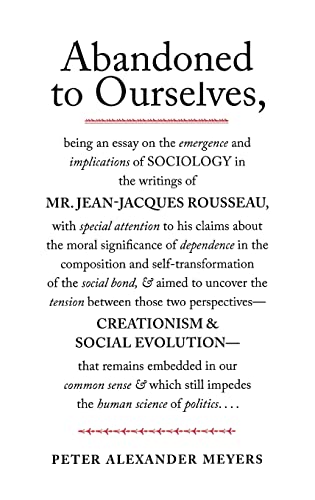
In this extraordinary work, Peter Alexander Meyers shows how the centerpiece of the Enlightenment—society as the symbol of collective human life and as the fundamental domain of human practice—was primarily composed and animated by its most ambivalent figure: Jean-Jacques Rousseau. Displaying this new society as an evolving field of interdependence, Abandoned to Ourselves traces the emergence and moral significance of dependence itself within Rousseau’s encounters with a variety of discourses of order, including theology, natural philosophy, and music. Underpinning this whole scene we discover a modernizing conception of the human Will, one that runs far deeper than Rousseau’s most famous trope, the “general Will.” As Abandoned to Ourselves weaves together historical acuity with theoretical insight, readers will find here elements for a reconstructed sociology inclusive of things and persons and, as a consequence, a new foundation for contemporary political theory.
User’s Reviews
Editorial Reviews: About the Author Peter Alexander Meyers is professor of American studies at the Université Paris III―Sorbonne Nouvelle, and a recurring visitor in the departments of Politics, Philosophy, History, and Sociology at Princeton University. Excerpt. © Reprinted by permission. All rights reserved. Abandoned to OurselvesBy PETER ALEXANDER MEYERSYale UNIVERSITY PRESSCopyright © 2013 Peter Alexander MeyersAll rights reserved.ISBN: 978-0-300-17205-8ContentsDetailed Contents………………………………………………….xiAcknowledgments……………………………………………………xvNote on Sources and Uses of Words……………………………………xviiForeword………………………………………………………….xixPART I “SOCIETY” AS THE ETHICAL STARTING POINT FOR POLITICAL INQUIRY…….1PART II THE MORAL RELEVANCE OF DEPENDENCE…………………………….69PART III NATURE AND THE MORAL FRAME OF SOCIETY………………………..155PART IV MORALITY IN THE ORDER OF THE WILL…………………………….225Afterword: A Preliminary Typology of Complex Dependence………………..382Notes…………………………………………………………….389Works Cited……………………………………………………….471Index…………………………………………………………….497 CHAPTER 1″Le Tout Est Bien?”From its origins in the Scottish Enlightenment through developments inFrance and Germany, the “classical” tradition of social theory adopted Jean-JacquesRousseau as one of its figureheads. It was, no doubt, a love-hate relationship.But Rousseau made apparent for many a new and general object for inquiry:society.The ideas Rousseau began to publish around the 1750s came as a sort of revelationand a prod for his own and then for successive generations of thinkers. Itis exactly correct to say that “the Enlightenment invented society as symbolicrepresentation of collective human existence and instituted it as the essentialdomain of human practice” as long as we add that the enduring “conceptual gridwithin which the discussion of the social” operated—along axes like needs/Will,contract/constraint, nature/artifice, religion/society—was primarily composedand animated by Rousseau.Over the subsequent two centuries, the sense that society is an autonomousforce in our experience gained traction. The first reason for this was empirical.Practices—big and small, momentary and sustained, local and extensive—ofwhich society is said to be composed expanded exponentially and reacheddeeper into everyday life. A growing number of effects that touch the lives ofmost human beings could no longer convincingly be traced back to specific persons,to nature, or to God. The sustained influence of Rousseau’s writings derivesfrom the way he attributed significance to such changes in our “life-world” andthe meaning they have for us.Rousseau is known today primarily as a provocative theorist of two majortopics of modern political thinking: liberty and equality. Both of these topics,and Rousseau’s contribution to them, have been debated in depth and at length.While it is not my central purpose here to enter these debates, it is worth recallingthat Rousseau saw human freedom as essentially a collective, rather thanan individual, problem. That is, he revived an ancient political conception ofhuman being. However, he accomplished this revival within an emerging climateof modern individualism which—one has good reason to suppose—shouldhave been fatal to the ancient view. This required substantial innovation, some ofwhich we shall consider below.The topic of human freedom frames many of Rousseau’s most important innovations.I want to begin by focusing on one of these. It is, I believe, the point fromwhich Rousseau’s influence on subsequent social thought most clearly arises.In a world intractably full of evil, Rousseau asked “Where does evil comefrom and how can we moderate its effects?” This question of theodicy had beenowned almost exclusively by theologians since Plato. In an especially strikingmanner, Rousseau brought it to the center of an ethically-charged inquiry intopolitics and attributed new significance to it. For, unlike the vast majority of hisEuropean predecessors who entered upon this terrain, Rousseau did not directlyadopt the theological topography of Saint Augustine. The Biblical story of the”original sin,” of the Fall and its consequences, shaped Rousseau’s anthropologicalnarrative in complex new ways. As he attempted to identify the source ofevil and the resources for its resolution, the primary distinction that had structuredmuch of Christian thought—distinguishing between a “city of God” and a”city of Man”—receded into the background.The word “evil”—which I will use to translate the less specifically chargedFrench word mal or (plural) maux—tends to evoke a narrowly theological register.The discursive context in which Rousseau was entangled inevitably amplifiesthis effect. Yet, as we shall see, it is precisely in the zone of uncertaintybetween the theological and the secular, between the relation of a Protestantconscience to God and the social relationships entertained among persons, thatRousseau operates. This ambiguity is a vehicle for his innovations, and we shouldbe acutely aware of it from the beginning.Rousseau’s Émile, ou De l’éducation (1762) will be the primary terrain for explorationin what follows. Open its first pages and find this striking phrase:Everything is good leaving the hands of the author of things: everything degeneratesin the hands of Man.Translation here veils something important in the French, which goes this way:Tout est bien, sortant des mains de l’auteur des choses: tout dégénére entre lesmains de l’homme. (OC IV.245)This is without doubt a play on one of the most famous lines from one of themost famous poems of the generation of Rousseau’s own youth. Challengingtheological skepticism, Alexander Pope published in his Essay on Man (1733)the provocative claim that All nature is but art, unknown to thee All chance, direction, which thou canst not see; All discord, harmony, not understood; All partial evil, universal good: And, spite of pride, in erring reason’s spite, One truth is clear, Whatever is, is right.This final line reappeared in French three years later in the widely read translationof Etienne Silhouette as “Cette vérité est évidente: que tout ce qui est, estbien.” In this eccentric formula a Panglossian vision of Providence was sustainedin the French philosophical discourse of Rousseau’s time. It seems inevitable,therefore, that Pope’s commonplace would suffer collateral damage whenthe author of the Discours sur l’origine et les fondemens de l’inégalité parmi leshommes (1755) laid literary siege to “everything that is [tout ce qui est].” Rousseauunderstood perfectly how the question of theodicy would resurface at the verycenter of his social critique.When Rousseau was attacked the next year in the Mercure de France by hisfellow Genevan Charles Bonnet, he provided what may be the pithiest summaryof the accomplishment of his prize-winning Discours sur … l’inégalité and heplaced it in just this socio-theological perspective: “Faced with the enumerationof the evils which befall mankind and which I claim to be the work of theirvery own hands, you assure me, Leibniz and you, that everything is good [tout estbien], and that therefore Providence is justified” (OC II.232).Barely months later the infamous earthquake of 1756 laid Lisbon low andshook the faith of believers across Europe. Voltaire shouted down the “the deludedphilosophers who cry out ‘all is well’ [tout est bien]” in a Poème sur le désastrede Lisbonne. Rousseau took this as an opportunity to state again the viewhe opposed, but opposed in a manner distinct from Voltaire: “Pope and Leibniztell me ‘Man, hold steady; the evils that strike you are a necessary effect of yournature, and of the constitution of this universe. If the eternal Being didn’t dobetter, it’s because he couldn’t do better.'” This paraphrase reflects Rousseau’sreticence—more from authorial pride than from intellectual humility—to proposeunadorned commonplaces to the greatest literary figure of his age. WithBonnet he had no such compunction, to whom he simply writes that “accordingto Leibniz and Pope, everything that is, is good [tout ce qui est, est bien].” Rousseau’seloquence is regrouped in the next phrase, where he adds that “it is neitherto Leibniz nor to Pope that I have to respond …” This is the gesture of a schoolmaster,at once exposing and exploiting tout ce qui est, est bien as a commonplace.All the while, of course, he continues the debate with Leibniz and Pope.It is striking that Rousseau believed, or wanted his reader to believe, that thesetwo authors spoke to him with a single voice. This was exactly the voice that Rousseaumocked as he set out to write the pointed beginning of the final version ofÉmile. One must be careful, he chides Voltaire further, to distinguish between”mal particulier” and “mal général.”… instead of “everything is good,” it could perhaps be better to say: “the wholeis good,” or “everything is good for the whole.”Just behind this metonymic reduction lie Rousseau’s primary efforts to isolatethe individual—he will evoke the metaphor of Nature for this—and identify thesocial—he will invoke the metaphors of contractus and pactum for this. Alreadythe image Rousseau opposes to Pope and Voltaire has, like all topics of part-and-whole,a spatial quality. He extends this image by displaying the significance ofthe maxim tout ce qui est, est bien as a function of time as well. This conjunctionof time and space is what will join a vision of order and society to the questionof theodicy. Yes, Rousseau tells us, perhaps it can be said that up to the momentwhen things leave the hands of God “tout est bien.” At that decisive threshold,however, the condition of our existence, our world, begins to degenerate. It becomesutterly human.CHAPTER 2″The Island of the Human Race”This is where the study of the development of humanity begins. Across theportal of his book Rousseau, as if in emulation of Dante, plasters a declarationalerting readers that they enter here a new and uncharted domain where ourhuman lives have “left the hands of the author of things” (OC IV.245). In thisrealm—société—evil is our “own creation.” It is something we have made and wemust own. It cannot be laid at the doorstep of God or Nature, or of the “Laws ofNature and of Nature’s God.”Nor, Rousseau insists, does evil arise in the individual as such. It is, rather, aproduct distinctively social, a quality that appears only in the “homme social” andhis condition (“état”). “The island of the human race is the earth” (OC IV.429)and, like Robinson Crusoe on his island, we must collectively make our way withwhat is at hand. We must become “sovereign of the world like Robinson on hisisland” (OC III.354).What sense does it make to represent the study of society with the most famoustrope of modern individualism? I think Rousseau is both blunt and subtleon this point.Later in Émile, Rousseau will tell us “I hate books,” but that the first readingfor the child in his educational program should be Daniel Defoe’s fantasticallyfamous book. It is, as Charles Dickens noted, a kind of science, and, as HaroldBloom suggests, “a book that cannot fail with children.” And, indeed, in Rousseau’sscheme “the child’s entire library will consist of Robinson Crusoe alone forquite some time.”It is obvious that everyone who encounters the ink-and-paper Defoe will beunlike Crusoe, who is “on his island, alone, deprived of the assistance of his kindand of the instruments of all the arts or crafts, yet looking after his subsistence, hisown preservation, and even obtaining a kind of well-being” (OC IV.455). WithDefoe in hand, the reader brings before his or her own imagination “the desertisland that serves first and foremost as comparison.” While this isolation is notthe condition of human beings in society and, obviously, it must be nothing likethe situation of the young Émile,… it is with respect to this condition that he must assess all others. The mostcertain manner to raise oneself above prejudices and to order one’s judgementsconcerning the real relations amongst things is to put oneself in the place of anisolated man, and to judge everything as that man himself must judge, particularlyattentive to his own utility.Precisely because the “island” represents a condition having little or nothing todo with our real social existence, it can, placed conceptually within a frameworkof radical contrasts, provide a measure by which to evaluate life in society.Establishing this distance between “island” and “society,” and suggesting itsanalytic utility, Rousseau brings forward a second and extraordinarily subtle deploymentof Defoe’s figure. To write that “the island of the human race is theearth [la terre]” is to locate as unitary and entire the object Rousseau proposes tostudy—mankind in society. This is “le tout” he recommends to Voltaire, with andagainst Pope. It is an object both figurative and, like an island, utterly material, forsomething literal in all metaphors must bring to life what is fantastic about them.What is la terre? Notes Rousseau made for a “Course in Geography” propose”description of the earth” in ways both familiar and surprising: there is a “cosmographique”side to his description that deals with physical features, but also a”historique” side that considers “government, forces, religion, and mores [le gouvernement,les forces, la réligion, et les moeurs].” The “terrestial globe” is distinctfrom the “celestial” but must be studied “in relation to the heavens” (OCV.535). The hint of old theodicy is present, but Rousseau also places mankindsquarely on the island of the earth, and his approach, here through géographie,literally writing-the-world, is like a sailor to an uncharted place. He follows—inimage and in text—the only unequivocal sign that heaven provides: the stars.Thus, the fragmentary “Course in Geography” is punctuated by “the names ofthe constellations and planets set in Latin verse.” Just after this moment of hesitation,an ephemeral chapter “Of the Sphere” [“De la sphére”] opens. Then thecourse trails off.Rousseau’s caesura again echoes Dante, as “we come out to traverse apace thevast expanse of the heavens.” Even if the earth, in its celestial surroundings, “isonly a point [n’est qu’un point],” it is also a “theater of disputes, and of the ambitionof mankind.”Rousseau pushes on. He tries his hand at a Traité de sphére [“Treatise of theSphere”], adopting an old theological genre primarily associated with Johannesde Sacrobosco, whose book De Sphaera from the year 1230 passed through 295print editions before the end of the seventeenth century and gave birth to alarge number of imitations. One version by Nicolas Malezieulx (Paris, 1679)under the title Nouveau Traite de la sphere states on its first page the traditionalpurpose of such books: “Taken literally, the word Sphere means ‘a ball,’ but herewe understand by ‘Sphere’ a figure composed of several circles, which serves toexplain the movement of stars, the sun, the moon & other planets, and whichrepresents the order and situation of the principal parts of the universe.” InRousseau’s hands, however, the Sphére is brought down to earth. His treatmentis inflected in a way that resonates with another hugely successful contemporarywork, Buffon’s discourse on the Histoire et théorie de la terre from 1749, where”it is not a question of the figure of the earth, nor its movement, nor the exteriorrelations it can have with the other parts of the universe; it is its interior constitution,its form and matter, that we propose to investigate.” In a clear rejectionof the tradition of Sacrobosco, the earth alone becomes the object in Rousseau’sTraité de sphére. However, his study of la terre is also radically different from hisfriend Buffon’s. It is configured, astonishingly, as a general method for learningto think and act, for the study of plural men in diverse times and places, and “inthe contrasts,” he adds, “we will learn to extricate man from his mask.”This is how Rousseau makes the island of mankind reappear in a very differentlight. He interrupts our desire to interpret it as a sign of nature, a topos of theprimitive or timeless. Nor is isolation, here, solitude, that unhappy life of constrainedcommunication which Rousseau, however much he lived it, certainlydid not want or recommend to the rest of humanity. And if the island amplifiesthe image of a “state of nature” as contrasting critical hypothesis to our socialestate, it also pushes in the opposite direction. It depicts absolutely clear boundariesaround the human enterprise; it envisions, in the language of De Sphaera,a “circle” with no beyond. And “Man is king of the earth.”Within that sphere, distinct spatial possibilities and material conditions comeinto focus. Only the “island of the human race” can tell us all we must and all wecan know about the composition of relations among ourselves, of société. As if tounderscore the point, Rousseau suggests that it is “at least very plausible that societyand languages were born on islands” (OC III.169). Such are the elements,the only elements, from which to conceive the civitas terrena, the ancient cité,or the modern république. (Continues…)Excerpted from Abandoned to Ourselves by PETER ALEXANDER MEYERS. Copyright © 2013 Peter Alexander Meyers. Excerpted by permission of Yale UNIVERSITY PRESS. All rights reserved. No part of this excerpt may be reproduced or reprinted without permission in writing from the publisher.Excerpts are provided by Dial-A-Book Inc. solely for the personal use of visitors to this web site.
Reviews from Amazon users which were colected at the time this book was published on the website:
⭐The writing is clear and brisk. Every page bristles with insights and ideas and questions. It is just the kind of book I like: intelligent but not dry –the suspense comes from the book’s thoughtful structure, setting up the writings of Rousseau as highly influential, worthy of study. yet…ultimately wrongheaded. Fascinating.
⭐Pretty thin Gruel. I get the attempt; but found the author’s arguments to be an endless series non-sequiturs. His concept of the implication of societal bonds is almost diametrically at odds with Rousseau assertions concerning the tendency for social contact to trend towards enslavement of the individual. I was hoping for real insight into the mind of Rousseau and his work but instead discovered the work to be a morass of prolix and sociological jargon whose intent seem to be to hijack Rousseau in the service of the Meyer’s nonsensical bleatings. Very Disappointing.
⭐
Keywords
Free Download Abandoned to Ourselves: Being an Essay on the Emergence and Implications of Sociology in the Writings of Mr. Jean-Jacques Rousseau… in PDF format
Abandoned to Ourselves: Being an Essay on the Emergence and Implications of Sociology in the Writings of Mr. Jean-Jacques Rousseau… PDF Free Download
Download Abandoned to Ourselves: Being an Essay on the Emergence and Implications of Sociology in the Writings of Mr. Jean-Jacques Rousseau… 2013 PDF Free
Abandoned to Ourselves: Being an Essay on the Emergence and Implications of Sociology in the Writings of Mr. Jean-Jacques Rousseau… 2013 PDF Free Download
Download Abandoned to Ourselves: Being an Essay on the Emergence and Implications of Sociology in the Writings of Mr. Jean-Jacques Rousseau… PDF
Free Download Ebook Abandoned to Ourselves: Being an Essay on the Emergence and Implications of Sociology in the Writings of Mr. Jean-Jacques Rousseau…