

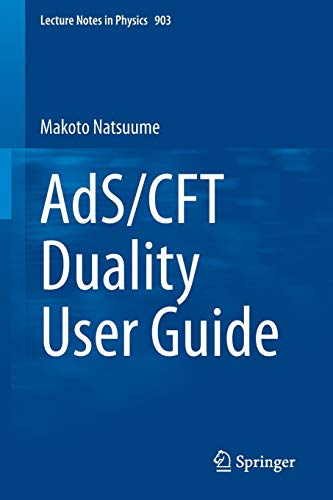
Ebook Info
- Published: 2015
- Number of pages: 305 pages
- Format: PDF
- File Size: 5.09 MB
- Authors: Makoto Natsuume
Description
This book describes applications of the AdS/CFT duality to the “real world.” The AdS/CFT duality is an idea that originated from string theory and is a powerful tool for analyzing strongly-coupled gauge theories using classical gravitational theories. In recent years, it has been shown that one prediction of AdS/CFT is indeed close to the experimental result of the real quark–gluon plasma. Since then, the AdS/CFT duality has been applied to various fields of physics; examples are QCD, nuclear physics, condensed-matter physics, and nonequilibrium physics. The aim of this book is to provide background materials such as string theory, black holes, nuclear physics, condensed-matter physics, and nonequilibrium physics as well as key applications of the AdS/CFT duality in a single volume. The emphasis throughout the book is on a pedagogical and intuitive approach focusing on the underlying physical concepts. It also includes step-by-step computations for important results, which are useful for beginners. This book will be a valuable reference work for graduate students and researchers in particle physics, general relativity, nuclear physics, nonequilibrium physics, and condensed-matter physics.
User’s Reviews
Editorial Reviews: Review “The book describes applications of the AdS/CFT duality for beginning graduate students in particle physics and for researchers in the other fields. … The book has been written with great pedagogical talent, and care, is easy for reading and invites the reader to follow the author through the labyrinths of physics. The most impressive in the book is the width of subject areas covered by the author. This make the book useful for physicists working in any area.” (Alex B. Gaina, zbMATH 1350.83001, 2017) From the Back Cover This book describes applications of the AdS/CFT duality to the “real world.” The AdS/CFT duality is an idea that originated from string theory and is a powerful tool for analyzing strongly-coupled gauge theories using classical gravitational theories. In recent years, it has been shown that one prediction of AdS/CFT is indeed close to the experimental result of the real quark–gluon plasma. Since then, the AdS/CFT duality has been applied to various fields of physics; examples are QCD, nuclear physics, condensed-matter physics, and nonequilibrium physics. The aim of this book is to provide background materials such as string theory, black holes, nuclear physics, condensed-matter physics, and nonequilibrium physics as well as key applications of the AdS/CFT duality in a single volume. The emphasis throughout the book is on a pedagogical and intuitive approach focusing on the underlying physical concepts. It also includes step-by-step computations for important results, which are useful for beginners. This book will be a valuable reference work for graduate students and researchers in particle physics, general relativity, nuclear physics, nonequilibrium physics, and condensed-matter physics. About the Author Dr.Makoto Natsuume Theory Center Institute of Particle and Nuclear Studies KEK, High Energy Accelerator Research Organization Tsukuba, Ibaraki, 305-0801 Japan Phone: +81-29-864-5396, FAX: +81-29-864-5755 Read more
Reviews from Amazon users which were colected at the time this book was published on the website:
⭐Any technique for getting non-trivial results in non-perturbative quantum field theory will be sure to attract the attention of theoreticians, and even more so if empirical evidence to substantiate these results is found. The AdS/CFT correspondence, which began as a conjecture almost ten years ago, has found significant applications not only in quantum field theory, but also in fluid dynamics and condensed matter physics as well. Some of the euphoria in these applications has subsided, such as in applications as heavy ion physics because of the lack of agreement in experiment, but in condensed matter some new conceptual frameworks have been devised based on AdS/CFT. Some of these frameworks have been heavily criticized by well-known practitioners, but it looks as though AdS/CFT will have a presence in condensed matter physics at least for a few years to come.This book gives the possible newcomer to the subject a general background in AdS/CFT, without going into some of the heavy mathematical results that are needed to discuss the “string-theory side” of AdS/CFT duality. Sometimes the grammar is jagged because the book is the result of a translation, but as a whole the book is readable in spite of this. The idea that one can analyze strongly-coupled problems in gauge theory by mapping them to problems in a particular curved spacetime has to rank as one of the most beautiful ideas in theoretical physics. One must be careful however in being seduced by this beauty, lest the proposed strategy results in a theory bubble, instead of one that (eventually) gives meaningful experimental results.Readers who are familiar with general relativity and black hole thermodynamics can skip the first two chapters, and jump right into the next one that discusses quantum chromodynamics and heavy ion physics. The author points out the problems in the using the imaginary-time formalism to do lattice simulations, but does not discuss it in detail. The large-N approximation, which is the real substance behind AdS/CFT duality, is discussed in fair detail. When learning the subject it is crucial to remember that this approximation be viewed as the justification and power in doing calculations in AdS/CFT. In this chapter the vacuum amplitudes of large-N gauge theories are derived by summing over the topologies of two-dimensional surfaces, connecting therefore with the theory of closed strings.With this in mind the author gives an argument for the equality of the partition functions of large-N gauge theories and (classical, four-dimensional) gravitational gauge theory in the next chapter. The fact that this was done in four dimensions forces the author to reconcile with the idea that string theory needs higher dimensions for its consistent quantization. Some plausibility arguments are given, but a general justification is lacking.A natural question to ask for those familiar with the research in non-perturbative quantum field is to what extent AdS/CFT is related to the Schwinger-Dyson equations, which for decades now have been viewed as providing the answer to non-perturbative quantum field theory. There has been some research on this question in the literature, but the author does not address this question or this literature in the book unfortunately.
⭐This is one of the most clear and useful texts on AdS/CFT I’ve found so far. It is also very practical and indeed teaches how to perform actual calculations. This aspect is quite rare to find in theoretical physics books.
⭐Everything OK !
⭐Having used the book for self-study and having done every computation, I can only say that it lives up to every thing it claims to be. The English is at times a bit Japanese, but I really enjoyed working in that book.
⭐A general book. Both useful for condensed matter and high energy physics.
Keywords
Free Download AdS/CFT Duality User Guide (Lecture Notes in Physics, 903) 2015th Edition in PDF format
AdS/CFT Duality User Guide (Lecture Notes in Physics, 903) 2015th Edition PDF Free Download
Download AdS/CFT Duality User Guide (Lecture Notes in Physics, 903) 2015th Edition 2015 PDF Free
AdS/CFT Duality User Guide (Lecture Notes in Physics, 903) 2015th Edition 2015 PDF Free Download
Download AdS/CFT Duality User Guide (Lecture Notes in Physics, 903) 2015th Edition PDF
Free Download Ebook AdS/CFT Duality User Guide (Lecture Notes in Physics, 903) 2015th Edition