

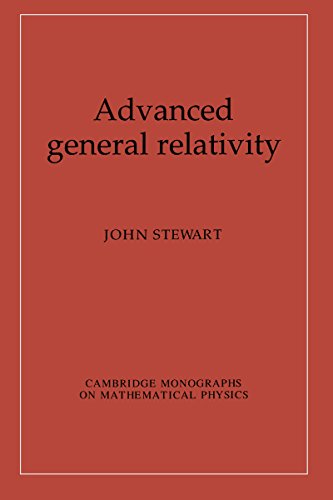
Ebook Info
- Published: 1993
- Number of pages: 240 pages
- Format: PDF
- File Size: 5.64 MB
- Authors: John Stewart
Description
This is a modern self-contained introduction to key topics in advanced general relativity. The opening chapter reviews the subject, with strong emphasis on the geometric structures underlying the theory. The next chapter discusses 2-component spinor theory, its usefulness for describing zero-mass fields, its practical application via Newman-Penrose formalism, together with examples and applications. The subsequent chapter is an account of the asymptotic theory far from a strong gravitational source, describing the mathematical theory by which measurements of the far-field and gravitational radiation emanating from a source can be used to describe the source itself. The final chapter describes the natural characteristic initial value problem, first in general terms, and then with particular emphasis for relativity, concluding with its relation to Arnold’s singularity theory. Exercises are included.
User’s Reviews
Reviews from Amazon users which were colected at the time this book was published on the website:
⭐Relativity, either special or general, has a reputation for being a little difficult and counter-intuitive. Being titled “Advanced,” it might seem as if this is the last book a person should approach. Well, it isn’t. A main difficulty in learning general relativity is the need to do differential geometry. Really, it amounts to updating the rules of calculus to account for the fact that a domain space might not necessarily be ordinary, “flat” Euclidean space. In that context, extra work is required if the derivatives we take are to be geometrically (and therefore physically) meaningful and not just some rubbish, meaningless measurement. This book develops the necessary mathematical machinery as efficiently and clearly as possible. So, it is really a book to read earlier in your relativity explorations and not later. Perhaps Woodhouse is the best beginning (both books, the Special and the General). Then, I think, this is a good follow up. Given that beginning, there’s no reason not to finish up by reading Wald as well as Misner, Thorne, and Wheeler. Once you’ve done that, you’ve got a good start, I think.This book is very valuable for its concise and clear introduction to the mathematical underpinnings. It is very useful for its insight into important special topics. This one is clearly a book you’ll be excited to read. You’ll want to read it, and when you’re done—you’ll want to re-read it. It’s that good.
⭐The book is horribly written. The author does not define things prior to using them. Very confusing! Same concepts explained in other books are much easier to understand.
⭐Although it seems to be a general relativity book, this is actually an excellent book for learning advanced mathematics. The sections on differential geometry and spinor analysis rival any of the dedicated textbooks on these subjects. This is also the only book to give a clear and concise introduction to tetrads and the Newman-Penrose formalism of general relativity.This book is a must for any serious physicist.
⭐It seems to me that there are far too many in number, and far too few in quality, books on on general relativity.John Stewart, rather than waste time on the hordes of cute little cartoon models apt for a tourist rather than physicist, gets straight to the heart of the matter and presents amazingly powerful results (on differential geometry/ Spinors/ Asymptopia/Initial Value Problem). He doesn’t skip any steps in his proofs and doesn’t try to appeal to science fiction intuition.As someone who hasn’t encountered spinors before reading this book, I’m grateful for the helpful appendi on the matter. Unfortuneately however I’ve found in different books the notation for spinors can vary wildly. The result is that I must refigure out all the basic properties to understand the notation. My complaint is that Stewart doesn’t seem* (perhaps it’s my ignorance) to use the most common notation, but on the other hand, he also provides the most easily used and referenced appendix.In summary, if reading most of that relativity tripe make you a tourist, Stewart makes you a citizen.
⭐Graduate students and others interested in GR would benefit immensely from reading and working through the equations of this book. This is a must read for those interested in black hole perturbation theory and asymptotic structure of spacetime.
Keywords
Free Download Advanced General Relativity (Cambridge Monographs on Mathematical Physics) in PDF format
Advanced General Relativity (Cambridge Monographs on Mathematical Physics) PDF Free Download
Download Advanced General Relativity (Cambridge Monographs on Mathematical Physics) 1993 PDF Free
Advanced General Relativity (Cambridge Monographs on Mathematical Physics) 1993 PDF Free Download
Download Advanced General Relativity (Cambridge Monographs on Mathematical Physics) PDF
Free Download Ebook Advanced General Relativity (Cambridge Monographs on Mathematical Physics)