

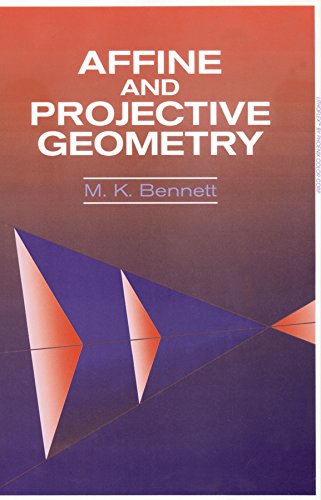
Ebook Info
- Published: 1995
- Number of pages: 248 pages
- Format: PDF
- File Size: 3.51 MB
- Authors: M. K. Bennett
Description
An important new perspective on AFFINE AND PROJECTIVEGEOMETRY This innovative book treats math majors and math education studentsto a fresh look at affine and projective geometry from algebraic,synthetic, and lattice theoretic points of view. Affine and Projective Geometry comes complete with ninetyillustrations, and numerous examples and exercises, coveringmaterial for two semesters of upper-level undergraduatemathematics. The first part of the book deals with the correlationbetween synthetic geometry and linear algebra. In the second part,geometry is used to introduce lattice theory, and the bookculminates with the fundamental theorem of projectivegeometry. While emphasizing affine geometry and its basis in Euclideanconcepts, the book: * Builds an appreciation of the geometric nature of linear algebra * Expands students’ understanding of abstract algebra with itsnontraditional, geometry-driven approach * Demonstrates how one branch of mathematics can be used to provetheorems in another * Provides opportunities for further investigation of mathematicsby various means, including historical references at the ends ofchapters Throughout, the text explores geometry’s correlation to algebra inways that are meant to foster inquiry and develop mathematicalinsights whether or not one has a background in algebra. Theinsight offered is particularly important for prospective secondaryteachers who must major in the subject they teach to fulfill thelicensing requirements of many states. Affine and ProjectiveGeometry’s broad scope and its communicative tone make it an idealchoice for all students and professionals who would like to furthertheir understanding of things mathematical.
User’s Reviews
Editorial Reviews: From the Publisher Combines three different approaches to affine and projective geometry–algebraic, synthetic and lattice theoretic. By emphasizing these three perspectives, the author demonstrates how areas of mathematics overlap–in this case, algebra and geometry. Provides a complete, detailed and self-contained description of the coordinatization of (Desarguesian) affine and projective space and a thorough discussion of the lattices of these spaces’ flats. Concludes with the Fundamental Theorem of Projective Geometry relating synthetic collineations, lattice and vector space isomorphisms. Includes numerous examples and exercises which enable students to develop their skills. From the Inside Flap An important new perspective on AFFINE AND PROJECTIVE GEOMETRY This innovative book treats math majors and math education students to a fresh look at affine and projective geometry from algebraic, synthetic, and lattice theoretic points of view.Affine and Projective Geometry comes complete with ninety illustrations, and numerous examples and exercises, covering material for two semesters of upper-level undergraduate mathematics. The first part of the book deals with the correlation between synthetic geometry and linear algebra. In the second part, geometry is used to introduce lattice theory, and the book culminates with the fundamental theorem of projective geometry.While emphasizing affine geometry and its basis in Euclidean concepts, the book:Builds an appreciation of the geometric nature of linear algebraExpands students’ understanding of abstract algebra with its nontraditional, geometry-driven approachDemonstrates how one branch of mathematics can be used to prove theorems in anotherProvides opportunities for further investigation of mathematics by various means, including historical references at the ends of chaptersThroughout, the text explores geometry’s correlation to algebra in ways that are meant to foster inquiry and develop mathematical insights whether or not one has a background in algebra. The insight offered is particularly important for prospective secondary teachers who must major in the subject they teach to fulfill the licensing requirements of many states. Affine and Projective Geometry’s broad scope and its communicative tone make it an ideal choice for all students and professionals who would like to further their understanding of things mathematical. From the Back Cover An important new perspective on AFFINE AND PROJECTIVE GEOMETRY This innovative book treats math majors and math education students to a fresh look at affine and projective geometry from algebraic, synthetic, and lattice theoretic points of view.Affine and Projective Geometry comes complete with ninety illustrations, and numerous examples and exercises, covering material for two semesters of upper-level undergraduate mathematics. The first part of the book deals with the correlation between synthetic geometry and linear algebra. In the second part, geometry is used to introduce lattice theory, and the book culminates with the fundamental theorem of projective geometry.While emphasizing affine geometry and its basis in Euclidean concepts, the book:Builds an appreciation of the geometric nature of linear algebraExpands students’ understanding of abstract algebra with its nontraditional, geometry-driven approachDemonstrates how one branch of mathematics can be used to prove theorems in anotherProvides opportunities for further investigation of mathematics by various means, including historical references at the ends of chaptersThroughout, the text explores geometry’s correlation to algebra in ways that are meant to foster inquiry and develop mathematical insights whether or not one has a background in algebra. The insight offered is particularly important for prospective secondary teachers who must major in the subject they teach to fulfill the licensing requirements of many states. Affine and Projective Geometry’s broad scope and its communicative tone make it an ideal choice for all students and professionals who would like to further their understanding of things mathematical. About the Author M. K. BENNETT is Professor of Mathematics at the University of Massachusetts, Amherst, where she earned her PhD in 1966. She was a John Wesley Young Postdoctoral Research Fellow at Dartmouth College, has authored numerous research articles on lattice theory, geometry, and quantum logics and has lectured on her work around the globe. Read more
Reviews from Amazon users which were colected at the time this book was published on the website:
⭐Ever wonder, while studying plane projective geometry, what the heck Desargues’s Theorem is good for? Aside from a slick explanation of tri-linear polars with respect to a triangle, what’s the payoff? It seems like a such curiosity piece. Why’s it given such a prominent place?Bennett’s book “Affine and Projective Geometry” certainly clears that up! Desargues is the crucial ingredient for coordinatizing both affine and projective spaces of dimension >= 2.Projectively, Desarges’s Theorem states, roughly, that given two coplanar triangles ABC and A’B’C’, if the lines AA’, BB’, CC’ joining corresponding vertices are concurrent (have a common point), then pairs of corresponding sides AB, A’B’, and BC, B’C’, and CA, C’A’, meet at collinear points.Bennett shows step-by-step that in an affine space in which an affine form of Desargues’s Theorem holds, the space can be given the structure of a vector space over a division ring. (A division ring is like a field, except that multiplication may not be commutative.) Vector addition is by the usual parallelogram law. Scalar multiplication comes from a construction reminiscent of a theorem of Thales (parallel projection). The development is careful, elementary, and necessarily geometric (i.e. “synthetic”); obviously coordinate methods are out until we show that the space can be coordinatized!(The affine version of Desargues needed to coordinatize an affine space is this. If ABC, A’B’C’ are two coplanar triangles, and AA’, BB’, CC’ are concurrent at a (finite) point, then if two pairs of corresponding sides are parallel, the third pair is as well.)Bennett does the same thing for projective spaces in which Desargues holds, demonstrating that any such space is isomorphic to P(V) (i.e. the 1-dimensional linear subspaces of V) for some vector space V over a division ring.An exciting observation is that in affine or projective spaces of dimension >= 3, Desargues’s Theorem automatically holds! Hence only planes can present obstacles to coordinatization, with the ones in which Desargues holds cooperating nicely.One might wonder when the aforementioned division ring of scalars is actually a FIELD (i.e. multiplication is commutative). Bennett proves that this occurs if and only if Pappus’s Theorem holds, giving us front-row seats for something that David Hilbert considered an exciting discovery.Bennett appears to be a combinatorialist, judging from the attention she gives to finite planes. A majority of the exercises are uninspiring (to me) opportunities to work with particular finite planes.Nonetheless, the THEORETICAL development has almost nothing to do with the finite case, and makes for fascinating reading. In addition to coordinatization, Bennett shows how any affine space can be extended to a projective space, and that all projective spaces arise in this way. She also proves fundamental theorems on maps of Desarguesian affine spaces and projective spaces (they come from semi-linear transformations), and a lovely geometric characterization of the maps arising from LINEAR (as opposed to semi-linear) transformations. Finally, she proves that a familiar feature of a projective space P(V) (if the projective dimension is n, then n+2 points in general position determine a projective automorphism) is not to be taken too lightly; it holds when and only when V’s division ring of scalars is a field (i.e. Pappus holds).I can heartily recommend this book to anyone who wants to understand the connection between synthetic treatments of projective geometry, and those that start out ASSUMING that we’re working with P(V) for some vector space V. (The latter is completely general, if we allow that the multiplication of scalars may not be commutative, and dim V >= 4.)Postscript: Bennett’s axiomatization of affine space is slightly defective. We need to add the axioms that lines contain at least two points, and planes contain at least three points not all of which are collinear.
⭐
⭐
Keywords
Free Download Affine and Projective Geometry 1st Edition in PDF format
Affine and Projective Geometry 1st Edition PDF Free Download
Download Affine and Projective Geometry 1st Edition 1995 PDF Free
Affine and Projective Geometry 1st Edition 1995 PDF Free Download
Download Affine and Projective Geometry 1st Edition PDF
Free Download Ebook Affine and Projective Geometry 1st Edition