Ebook Info
- Published: 2004
- Number of pages: 432 pages
- Format: PDF
- File Size: 4.42 MB
- Authors: Anita Burdman Feferman
Description
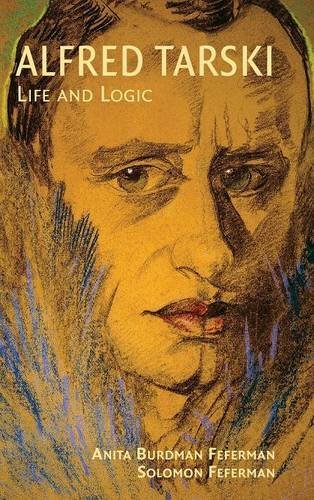
Alfred Tarski, one of the greatest logicians of all time, is widely thought of as ‘the man who defined truth’. His work on the concepts of truth and logical consequence are cornerstones of modern logic, influencing developments in mathematics, philosophy, linguistics, and computer science. Tarski was a charismatic teacher and zealous promoter of his view of logic as the foundation of all rational thought, a bon vivant and a womanizer, who played the ‘great man’ to the hilt. A fortuitous trip to the United States at the outbreak of World War II saved his life and turned his career around, even while it separated him from his family for years. From the cafés of Warsaw and Vienna to the mountains and deserts of California, this first full-length biography places Tarski in the social, intellectual, and historical context of his times and presents a frank, vivid picture of a personally and professionally passionate man – interlaced with an account of his major scientific achievements.
User’s Reviews
Reviews from Amazon users which were colected at the time this book was published on the website:
⭐I found this biography to be immensely engrossing, both from a human interest perspective and from the historical vantage point provided of the development of logic, first in Tarksi’s native Poland and then in the United States, primarily in Berkeley, where Tarski built up the world’s leading logic department. Tarski was a tour-de-force in terms of his intellect, drive and of course his legendary womanizing. There was just enough mathematics interspersed into the story to satisfy someone such as myself who is relatively well versed in mathematical foundations. I now have the book on Undecidable Theories by Tarski, Mostowski and Robinson on my desk as well as a book on Cylindrical Algebras that I am about to pour into. I did not follow he Fefermans’ account of this latter subject as well as I might have liked and it is not a subject that is much discussed nowadays. I am now working with one of Tarski’s academic grandchildren (Ron Fagin, a student of Robert Vaught’s) so getting a peak into the vibrant Berkeley of yesteryear that Fagin and Vaught were a part of has been an incredible treat.
⭐Let me state unequivocally that I want to pour gushing lavish praise on this sublime biography. The Fefermans have crafted a wonderfully warm and inspirational account of Alfred Traski, his life and loves. Many biographies of great intellects remain trapped in awe of their subjects, hesitant about exploring their foibles at length and treating divergencies from the norm as eccentricities. This book is an admirable contrast to the standard hagiographical style. Be under no illusion here, you will read about Tarski’s contributions to logic, but perhaps more interestingly you will explore the complex emotional and psychological world of Tarksi. His separation from his wife and children during WWII. His struggle to cope with impecuniary. Sexual proclivities. Shifting friendships. His step away from Judaism. The loyalty and antipathies he inspired. His humanity. The picture painted is complex and subtle.In short this is one of the finest and most rewarding biographies I have ever read. When you read this book, bear in mind the debt owed to its authors. It is unlikely a book as fine as this will come around again in the near future.
⭐To be honest, I started reading this book with some suspicion. In the first place, I was neither a fan of Tarski nor of S.Feferman. Though I did regard Tarski as one of the intellectual giants in the 20th century, I still frowned at the book’s opening description of him as one of the “greatest” logicians of all time – on a par with my own hero Godel. My feeling towards S.Feferman was similarly ambivalent. In spite of his substantial contribution as the editor-in-chief of Godel’s Collected Works and the universal praise he has received for that project, its end-result (the project was abandoned for running out of supports in 2005) is seriously lacking. For one thing, after almost 30 years’ work the huge bulk of Godel’s Nachlass in Gabelsberger (an almost extinct German shorthand) has been left unpublished (although approximately half of it has already been transcribed). It seems that more emphasis had been given by the editors and their colleague commentators on INTERPRETING Godel rather than making the inaccessible original material available to the wider public. I have always doubted the wisdom of Feferman’s chief-editorship on this and other issuesNevertheless, Feferman turns out to be a much more successful co-biographer of Tarski than an editor of Godel. The Tarski book goes far beyond my expectation. I simply couldn’t put it down and went without sleeps for several nights until my eyes could no longer tolerate my indulgence. The reading has made Tarski an immensely more interesting figure to me – almost as interesting and intriguing as the enigmatic Godel. This aftermath is something which I could never have anticipated in my wildest dreams beforehand.Since I agree with much of the praises from the Amazon Editorial and Customer Reviews of the book, I don’t think it desirable to re-enumerate the book’s various merits which others have already done. Needless to say, the book is not perfect and leaves much that is desired unaccounted. For one thing, although the book does present an interesting picture of the development of logic in the last century, it is presented from the Fefermans’ highly personalized viewpoint and very one-sided. For example, from the book the reader will only get a very uninformed idea of the development of set theory which happens to be both Tarski’s lifelong “hobby” and a source of intellectual uneasiness since he had a certain (though ambivalent perhaps, for he sometimes spoke in a Platonist tone) nominalist temperament while set theory is prima facie concerned with highly transfinite objects and often pursued by pronounced “realists” like Cantor, Zermelo, Godel (who was in effect described insane when Tarski declared himself as “the greatest living sane logician” ) et al. It is arguable that similar tension should also occur in Model Theory where Tarski reigned. But there is no discussion on this issue. It will also be interesting to know how Tarski reacted towards the epoch-making invention of forcing by P.Cohen in 1963, when the former was still an active researcher. The Fefermans say almost nothing on this either, although S.Feferman himself was one of the earliest developers of forcing immediately after Cohen. My own conjecture is that, like Godel, Tarski did not take forcing to be FUNDAMENTAL. Godel almost had a proof of the independence of the axiom of choice in the 1940s, but he abandoned the project partly because he did not want to encourage other logicians to plunge into a pursuit of independence proofs instead of trying to discover and develop new, further TRUE axioms of mathematics. Presumably the nominalist (by lips?) Tarski will perceive the issue very differently from the Platonist Godel. Yet the book gives us little clues about such and various other issues.Paradoxically, it is precisely from the frankly personalized and unsystematic viewpoints of the Fefermans and other intimates of Tarski that we find much that is valuable. Moreover, unlike the Godel case, the authors did not forget to let the protagonist to present himself. And in spite of its moderate length and lack of comprehensiveness the book does manage to weave abundant insights into their captivating story of this intriguing man who is, given all his unconventional acts and deeds notwithstanding, first and foremost “powered by his ideas” (as Peter Hoffman puts it) with an extraordinary self-confidence throughout his life. It is amidst this web of insights that we are granted some of those very rare glimpses into the mind of a genius that so few biographers have been able to reveal.
⭐well written, new information, incitefu
⭐
Keywords
Free Download Alfred Tarski: Life and Logic 1st Edition in PDF format
Alfred Tarski: Life and Logic 1st Edition PDF Free Download
Download Alfred Tarski: Life and Logic 1st Edition 2004 PDF Free
Alfred Tarski: Life and Logic 1st Edition 2004 PDF Free Download
Download Alfred Tarski: Life and Logic 1st Edition PDF
Free Download Ebook Alfred Tarski: Life and Logic 1st Edition