

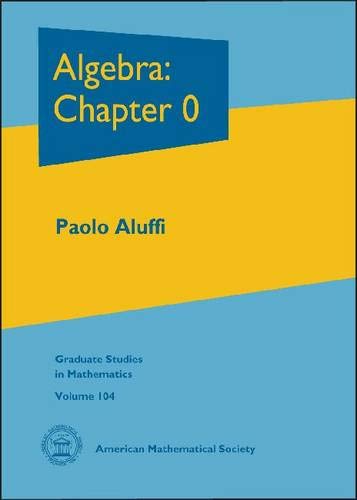
Ebook Info
- Published: 2009
- Number of pages: 728 pages
- Format: PDF
- File Size: 21.35 MB
- Authors: Paolo Aluffi
Description
Algebra: Chapter 0 is a self-contained introduction to the main topics of algebra, suitable for a first sequence on the subject at the beginning graduate or upper undergraduate level. The primary distinguishing feature of the book, compared to standard textbooks in algebra, is the early introduction of categories, used as a unifying theme in the presentation of the main topics. A second feature consists of an emphasis on homological algebra: basic notions on complexes are presented as soon as modules have been introduced, and an extensive last chapter on homological algebra can form the basis for a follow-up introductory course on the subject. Approximately 1,000 exercises both provide adequate practice to consolidate the understanding of the main body of the text and offer the opportunity to explore many other topics, including applications to number theory and algebraic geometry. This will allow instructors to adapt the textbook to their specific choice of topics and provide the independent reader with a richer exposure to algebra. Many exercises include substantial hints, and navigation of the topics is facilitated by an extensive index and by hundreds of cross-references.
User’s Reviews
Editorial Reviews: Review This self-contained introduction is suitable for a first sequence at the beginning graduate or upper undergraduate level. A distinguishing feature of the book is the early introduction of categories, used as a unifying theme. —- SciTech Book News
Reviews from Amazon users which were colected at the time this book was published on the website:
⭐In my experience, Algebra is the discipline that has the least variety in its textbook choices in all the major fields of upper-level undergraduate to graduate mathematics.For a long (but, hopefully, illustrative) for instance, a semester of analysis of a single real variable through the Riemann integral delivered through a healthy course of Rudin or Abbott can be followed by its legacy heirs in “advanced calculus” with Callahan, Pugh (which can be used for an excellent first half, as well!), the long-forgotten Bressoud “Second Year Calculus” text for those wishing to mix ad-cal material more with the sciences or for crowds with more the needs of a Lay-style text for the first semester, Munkres for the tougher crowd (whether topology or analysis on manifolds – why not both?), Ghorpade for an excellent application-focused follow-up, or even Johnston (or Rudin Sr. for graduates) for those wanting to go straight for the Kool-Aid and learn Lebesgue integration. Nearly any course works for a fun capstone that prepares you for your career (or career in grad school, as the case may be). Heck, even Complex Analysis and any one of the droves of courses whose book intros claim “all you need to know is the calculus and linear algebra you learned in second grade to begin!”This is not so with Algebra, and I wish I knew of what it was like before Lang’s (oft unfairly) maligned pages shook the shelves of Algebra books (both literally and figuratively) and defined all that went after, with Herstein – I think – leading the way with undergraduate algebra (Herstein is opposite of Hungerford: his gradute volumes were better than his undergraduate ones). Pick up a Birkhoff and Mac Lane and compare it to Lang’s capable yet dictionarian text, or Dummit and Foote with all its dryness, and then take it with you for something better to read as you go through your grad course – Jacobson’s two volumes, both on Dover, would aslo work as companions. Pinter, which everyone should own and which tops teaching the subject over any ither volume (modulo course level), doesn’t even stand apart as offering a different take. We have had nothing.Until Aluffi.Allufi has done to Algebra what Linear Algebra Done Right did to Linear Algebra: it took an important idea that shows up in typical texts in some extreme way and then recasts the idea in some equally extreme way, changing the tone of the whole subject in so doing. But, unlike Axler’s great text, Aluffi’s Algebra: Chapter 0 has the honor of a true unique take. Curing Dummit and Footte’s appendicitis by taking it to the very front of the text (Chapter 0, he very well could have called it), the entire tone and pace of the book grows as you watch category theory’s tools develop it to a status of near-omnipresence.The style is direct, but not Hungerford (graduate Hungerford) direct: it explains what it needs to explain, does it well, and does something almost no algebra book does: this book often gives straightforward reasons why results are important, both to areas from elsewhere in the text to completely outside of abstract algebra, and even gives hints – correct, as it turned out for me! – as to what appears on qualifying exams (e.g. the discussion preceding Claim 2.16 on page 201). The Linear Algebra chapters are fantastic – they aren’t just “pretend it says vector spaces where it says free modules and cross your fingers” kinds of sections that follow the inevitable letter-pushing introduction. Category Theory, which has been growing with you the whole way, jumps in here in an important way, and though this is exactly where I currently am in my perusal of the book, I am quietly confident that the discussion on multilinear algebra and tensor products will go far better than it did under D&F. Nonetheless, I still have my copy of Grinfield and Bachman on hand to ground the discussion into reality (or at least some sense of it).The book then concludes with Homological Algebra, and given the author’s style I’d be surprised if the old joke with Lang’s Algebra is missing, the one where Lang’s corresponding part has -as a real question – instructions for the reader to rent a book on homological algebra and then to prove every theorem and sove every exercise in the book. Since category theory has had such a role in this book, I have no doubt that the topic will find its resting place (in the context of this book, at least) in the grounds of homological algebra, and I’m excited to read this topic for the first time once I get there shortly.The book is a delight, and to my original question as to whether it should be “the new D&F” (Dummitt and Foote) only time will tell – having already taken algebra, my view is skewed, but imagining myself as a younger man facing graduate algebra for the first time, my answer tends toward “I hope so.”
⭐As a text for a first graduate course in algebra, this is definitely one of the better ones I have come across. I do have some complaints with it though. The format of this book is pretty standard; though I appreciate that each section is broken down into 3-4 page subsections (long sections are a pet-peeve of mine). Aluffi will often have a few paragraphs in between propositions which keeps the tone conversational. But content is never glossed over in these intermittent sections (which often happens in Lang). The content in this book is definitely nothing special. In fact it covers the same material as Dummit and Foote (minus representation theory) but through the viewpoint of category theory instead of set theory. However, Aluffi does a significantly better job than Dummit and Foote in the latter sections (linear algebra, field theory, and homological algebra). The exercises in this text are decent. If anything they are too easy; most of the problems can be done with little thought so long as one understands the sections. My only other grievance is with some of the definitions. The way Aluffi defines some concepts is just weird. For example, he defines linear independence by a mapping from the indexing set into a module instead of the familiar (and equivalent mind you) condition on the scalars in a summation that equals 0.Now that I’ve talked about the bad parts, allow me to talk about the positives. The proofs in this book are superb. Often authors will hand-wave proofs and will sacrifice clarity to justify introducing more content (Lang and Hungerford do this quite often). The logic in every proposition, theorem, lemma, and corollary flows effortlessly and is very easy to read. As I stated earlier, the tone is conversational, making this book fun to read. Aluffi will throw in his personal comments or a joke from time to time, which I have seldom seen in other texts. Finally, this book is extremely dedicated to category theory. There are other graduate texts that profess to teach algebra from the view of category theory, but they hardly ever connect categories with the content. Even in field theory Aluffi manages to connect to category theory, which is a topic pretty far removed from categories. Overall, this book is fantastic. I highly recommend it to any beginning graduate student or advanced undergraduate.
⭐Starts almost at the very beginning, and ends … Well, I’ll just say that I’m probably not going to manage the sequel, “Algebra: Chapter 1”. A delight to read, reread, check, think about.
⭐great book
Keywords
Free Download Algebra: Chapter 0 (Graduate Studies in Mathematics) in PDF format
Algebra: Chapter 0 (Graduate Studies in Mathematics) PDF Free Download
Download Algebra: Chapter 0 (Graduate Studies in Mathematics) 2009 PDF Free
Algebra: Chapter 0 (Graduate Studies in Mathematics) 2009 PDF Free Download
Download Algebra: Chapter 0 (Graduate Studies in Mathematics) PDF
Free Download Ebook Algebra: Chapter 0 (Graduate Studies in Mathematics)