

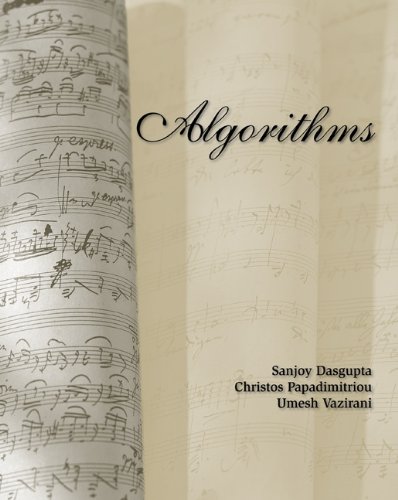
Ebook Info
- Published: 2011
- Number of pages: 336 pages
- Format: PDF
- File Size: 4.47 MB
- Authors: Sanjoy Dasgupta
Description
This text explains the fundamentals of algorithms in a story line that makes the material enjoyable and easy to digest. Emphasis is placed on understanding the crisp mathematical idea behind each algorithm, in a manner that is intuitive and rigorous without being unduly formal. An alternative to the comprehensive algorithm texts in the market, Dasgupta strength is that the math follows the algorithms. In addition to the text, DasGupta also offers a Solutions Manual, which is available on the Online Learning Center.
User’s Reviews
Reviews from Amazon users which were colected at the time this book was published on the website:
⭐This was the primary textbook for my Georgia Tech OMSCS class, CS6515: Intro to Graduate Algorithms.Strong points:* Very affordable, for a textbook* Extremely concise: all chapters are short so it’s easy to read the entire relevant chapter while the class covers the corresponding material* Eloquent & pleasant to read, considering the technical mathematical subject* Rigorous, creative, numerous problems at the end of every chapter* Excellent coverage of underrepresented topics like dynamic programming & flow networksWeak points:* No official problem solutions. This is disappointing because the exercises are packed with excellent additional content & applications. Crowdsourced solutions simply aren’t sufficient.* Inconsistent rigor. While Dynamic Programming is well-covered, Graphs & Trees arguably need more than 1 chapter to cover the full breadth of variability. I’d argue that Algorithms by Sedgewick et al. has more comprehensive exploration of these topics.* Mediocre quality. The pages are somewhat thin & crease easily. The printing is offset on pages, almost to the point of cropping the page numbers. I suppose this is the tradeoff for the price.* No programming solutions. This can be problematic for interview preparation, so you’ll need to supplement with additional textbooks or websites like LeetCode.* No updates. They only released 1 major revision of the textbook, 15 years ago. The errata on Dasgupta’s website hasn’t been updated in 14 years. The material hasn’t changed, but I’m sure there are many opportunities to improve the execution with minimal effort. I fear this book will slowly become irrelevant due to neglect.The textbook was created in the context of undergraduate teaching at UC San Diego & Berkeley, so it’s not surprising that the best use-case is alongside a formal class. The lack of solutions & code samples damages the self-study potential. That said, this is a crowded subject with many established texts (CLRS for reference material, Sedgewick for data structures, dozens of coding interview books & websites) so in some ways this book fills an important and useful niche.With that understanding, I still cannot give a perfect rating because the lack of any official solutions is really inconvenient and puts the responsibility on the professor to help students learn from the exercises. I think the context of online solutions has changed dramatically since 2006 and I wish this book evolved with that reality.
⭐The editing of Algorithms is quite poor. I suspect someone with little mathematical ability edited it. About one third of the mathematical formulas are wrong due to typos. The author’s errata page has not been updated in 10 years. If you get this book, check each formula against the Wikipedia entry for the algorithm in question. It will save you lots of time trying to make erroneous formulas work. Are the rest of McGraw Hill’s Higher Education series like this?
⭐Used this for a grad school algos class. This textbook is short, packed full of info, and wastes no words in getting you to understand the concepts. There are plenty of good examples, and the text itself is probably one of the most readable textbooks I’ve ever encountered. Most example problems have solutions posted on YouTube or various blogs. It’s one of only a handful in my life where I can claim I did actually utilize the entire textbook. Pair it with something like the Algorithm Design Manual and you’ve got everything you need to succeed.
⭐I have just this past year finished a Masters of IT. Considering that my professional reference library has some rather out-of-date books, I decided to refresh the library with a view to polishing up a number of topics studied and not studied whilst ‘seeking gainful employment.’ Now, while for my purpose this work is a bit disappointing, it looks to be an excellent textbook for first year computer science students …Why do I so conclude? Let’s distinguish between so called computer science students doing more nuts and bolts and technical studies who typically learn Java then C++ and sometimes take an assembler subject, and information systems students who typically learn Java and then systems analysis and design and database and sometimes never even take a low level programming subject. The former would in my opinion be well served by this work; the latter might find the mathematical content perhaps a bit challenging.That said, the first year computer science student should realise that algorithms is a deep subject that leads in many surprising directions deep into many fields of mathematics, and that one could spend years studying just the history of algorithms … Therefore, this is a reference work to be dipped into to find the content that is needed by the task at hand. The use of the table of contents and index to find such content as is relevant to the task at hand is required. But, during the break before second year read this work cover to cover, as there is so much knowledge to absorb as one learns to appreciate the many and varied algorithms available to solve various problems and begin to acquire judgment as to what kind of algorithm would suit a particular problem situation with its time and space and cost constraints … including the cost if required to code it up and carefully and properly test it!An educational textbook well suited to that purpose; but not recommended for the professional reference library market.
⭐It came wrapped well enough to not get water damage, and it is basically brand new.
⭐Honestly, this book is largely overlooked, maybe because it is not a beginner’s book.Very concise and rich content.If you have been studied for like half year or one year, this book will instantly summarise what you’ve learnt in a simple but expressive way.Highly recommend. Even if you are a beginner, don’t forget it and you will need it one day.
⭐Great book for understanding some of the most interesting and popular algorithms in CS. definately helpful for students in relevamt fields.
⭐top quality product, good price and recommended
⭐Although the volume is smaller than other classical books on algorithm but covers plenty of relevant topics in algorithm with in depth treatment. The way of explanations and proofing are very much enjoyable. The chapter exercises ranges from simple things to much complicated ones, which can further enhance you understanding of the topics!
⭐This is an amazing book. However, the quality of paper and printing is really bad. Many pages are joined and some are wrinkled. Unacceptable quality and the only publisher is McGraw-Hill. Got a replacement copy and even that as bad as the first one. Better to go to a physical store and check before buying.
Keywords
Free Download Algorithms 1st Edition in PDF format
Algorithms 1st Edition PDF Free Download
Download Algorithms 1st Edition 2011 PDF Free
Algorithms 1st Edition 2011 PDF Free Download
Download Algorithms 1st Edition PDF
Free Download Ebook Algorithms 1st Edition