Ebook Info
- Published: 2002
- Number of pages: 432 pages
- Format: PDF
- File Size: 35.94 MB
- Authors: Noam Chomsky
Description
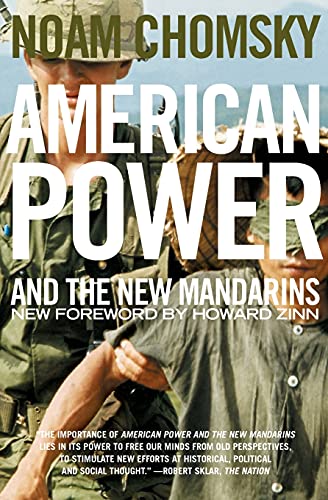
American Power and the New Mandarins is Noam Chomsky’s first political book, widely considered to be among the most cogent and powerful statements against the American war in Vietnam. Long out of print, this collection of early, seminal essays helped to establish Chomsky as a leading critic of United States foreign policy. These pages mount a scathing critique of the contradictions of the war, and an indictment of the mainstream, liberal intellectuals―the “new mandarins”―who furnished what Chomsky argued was the necessary ideological cover for the horrors visited on the Vietnamese people.As America’s foreign entanglements deepen by the month, Chomsky’s lucid analysis is a sobering reminder of the perils of imperial diplomacy. With a new foreword by Howard Zinn, author of A People’s History of the United States, American Power and the New Mandarins is a renewed call for independent analysis of America’s role in the world.
User’s Reviews
Editorial Reviews: From Publishers Weekly Whether assessing U.S. policy in the Middle East (Fateful Triangle) or analyzing the events of September 11 (9-11), linguist, intellectual giant and moral authority Chomsky has made a brilliant career out of telling his fellow Americans things they didn’t want to hear. And it all began with this collection of provocative essays (first published by Pantheon in 1969), each advancing a cogent, rigorous argument for why we shouldn’t have been in Vietnam. In his opening piece, Objectivity and Liberal Scholarship, Chomsky establishes the premise that U.S. presence in Southeast Asia was little more than updated imperialism; that theory informs much of the writing that follows. In The Logic of Withdrawal, Chomsky methodically debunks the accepted reasons for U.S. intervention in a foreign civil war, and in On Resistance, he restates his case even more bluntly, writing that no one has appointed us judge and executioner for Vietnam or anywhere else. If it merely recalled the heady debates of a generation past, this volume would have been well worth reprinting. But at this moment in history, as America teeters on the brink of another war, Chomsky’s ruminations about our role on the world stage take on renewed relevance. Copyright 2002 Reed Business Information, Inc. About the Author Noam Chomsky is the Institute Professor and a professor of linguistics, emeritus, at the Massachusetts Institute of Technology. A world-renowned linguist and political activist, he is the author of numerous books, including On Language: Chomsky’s Classic Works Language and Responsibility and Reflections on Language; Understanding Power: The Indispensable Chomsky, edited by Peter R. Mitchell and John Schoeffel; American Power and the New Mandarins; For Reasons of State; Problems of Knowledge and Freedom; Objectivity and Liberal Scholarship; Towards a New Cold War: U.S. Foreign Policy from Vietnam to Reagan; The Essential Chomsky, edited by Anthony Arnove; and On Anarchism, and a co-author (with Ira Katznelson, R.C. Lewontin, David Montgomery, Laura Nader, Richard Ohmann, Ray Siever, Immanuel Wallerstein, and Howard Zinn) of The Cold War and the University: Toward an Intellectual History of the Postwar Years and (with Michel Foucault) of The Chomsky-Foucault Debate, all published by The New Press. He lives in Lexington, Massachusetts.
Reviews from Amazon users which were colected at the time this book was published on the website:
⭐Excellent book. A must read for the serious Noam Chomsky enthusiast. Sheds light on the real American Power and politics.
⭐the order which i received has very much met and indeed exceeded expectations! the copy was in very good condition
⭐Chomsky’s first political book, _American Power_ is a devastating critique for the U.S. foray into Southeast Asia, which Chomsky considers to be little more than modified imperialism. The book starts somewhat slowly, first with an extended essay focusing largely on the Spanish Civil War, which though interesting, seems like a strange place to begin the discussion. The second essay focuses on the decision of drop nuclear weapons during World War II, and the absence of “war guilt” in the U.S. over that action. The second essay, like the first, is interesting, though not seemingly directly related to Chomsky’s Vietnam critique. The remainder of work focuses quite squarely on Vietnam, and offers the sort of moral outrage that Chomsky contends was conspicuously lacking from the liberal academics of the time. The entire underpinning of Chomsky’s premise has to do with the morality of U.S. action, rather than the pragmatism that he chides others for basing their positions on.The book is quite powerful in many of its conclusions. A few criticisms: there is extensive use of irony throughout the work, occasionally to the point of excess; while Chomsky eviscerates a half dozen of the “liberal intelligensia”, it’s difficult for me, as someone who was not alive to witness the war, to know if these voices typify the liberal objections to the war, or if Chomsky has cherry-picked these individuals (obviously Schlesinger was a major voice, but I’m not familiar with the others); if you don’t have some conception of the forces behind the Spanish Civil War, the first essay will be somewhat confusing. It was for me, anyway.Altogether though, particularly in light the U.S. invasion of Iraq, many of Chomsky’s ideas have taken on a new urgency. The comparision between Vietnam and Iraq will come very naturally as you read _American Power_. It is well worth our time to make this comparison. Chomsky’s thesis is as valid now as it was in 1969.
⭐American Power and the New Mandarins is, on the surface, about the Vietnam War. And its value to the modern reader (who is too young to remember the Vietnam era) includes learning more about the Vietnam War and the domestic resistance to it. But I think the timeless value of this book is the dissection of ideology and how the modern-day technical intelligentsia (social scientists, political scientists, engineers, etc) have come into political power and manipulate public (and their own) thought through doublethink (not exactly Chomsky’s phrasing). Chomsky dissects the “liberal scholarship” that supports jingoist fantasies that echo the worst of the fascists, and calls them as “moderate.” It’s easy to see the right-wing as raging madmen who just want war. But the liberals pose as reasonable and simply come up with rationalizations for behaving the same way as the right. How Chomsky shows this is the real value of this book, and there are entire passages where “Vietnam” can be replaced with “Middle East.”Also included is the beautiful essay, “The Responsibility of Intellectuals.”
⭐Noam Chomsky’s first political work is a first-rate collection of essays critiquing the U.S. war of aggression in Vietnam. Chomsky is more concerned here with the ideological defenses for the war than with the moral implications of the war itself, which are totally transparent at this late date. There are a wide variety of topics discussed in this broad volume, from the origins of the Pacific War to Arthur Schlesinger’s liberal apologetics for U.S. imperialism. Chomsky’s famous essay ‘Objectivity and Liberal Scholarship’ is a meandering account of the liberal intelligentsia’s understanding of the Spanish Civil War. In it, Chomsky falls into the pitfalls of ultra-leftism, with low quality critiques of Bolshevism and Leninism. He relies on Rosa Luxemburg’s fine criticisms of Lenin without examining Luxemburg’s own political context in the German SDP, or her own explicit support for forming a revolutionary ‘vanguard.’ However, there are some fine passages in ‘American Power and the New Mandarins,’ such as ‘The Logic of Withdrawal’ or Chomsky’s own personal reflections on the demonstrations at the Pentagon. This book will surely remain one of the better examinations of the criminal war in Vietnam for years to come.
⭐During the Vietnam war the United States used its enormous military power to try to install in South Vietnam a minority government of U.S. choice, with its military operations based on the knowledge that the people there were the enemy. This country killed millions and left Vietnam (and the rest of Indochina) devastated. A Wall Street Journal report in 1997 estimated that perhaps 500,000 children in Vietnam suffer from serious birth defects resulting from the U.S. use of chemical weapons there. Seems fairly reasonable to protest against this, surely?… This was and is a groundbreaking book, and ….
⭐I recently reread Chomsky’s classic. It’s very enlightening to see the parallels as well as the differences between the role America’s “intelligencia” played during the Vietnam War and the role they are playing now with just another war “won”.
⭐American Power and the New Mandarins’, Chomsky’s first political book, is an excellent forerunner for the eye-opening works that were to come. His intellect is piercing, and his knowledge seemingly knows no bounds.At least two things where slightly disappointing, however. Like most of Chomsky’s books, this is not a ‘book’, so much as it is a collection of essays upon similar themes, and thus his points about the role of the intellectual in the governmental regime is subject to a degree of repetition that may potentially irk the more discerning reader.Secondly, I was mildly disappointed in the fact that Chomsky at no point in this book elucidates the full range of reasons for his fundamental opposition to the Vietnam War – he takes his opposition to the war to be self-explanatory, and then proceeds to carve out his niche subject (the role of the aforementioned ‘New Mandarins’).In summary, minor qualms aside, this is a book that is just as relevant – perhaps even more relevant – to the 21st century than it was to the 1960s, given the growing power of the ‘technocrat’ in Western politics, especially within the field of economics and political ‘science’. Thoroughly recommendable to anyone with an interest in this subject.
⭐この方の本を,読んで裏切られたことがない。知識人は,テロに無関心でいいのか。アメリカこそ正義押し付けているのでは,ないか。アマゾンからのDMで読んだのだが,読んだ日にどうしてこんなに事件起きるの。アメリカで閣僚二人首切られたでしょう。話が,それたが,この人の本読むと,自分が、つくずくバカであるとかんじられる。単なる武力行使論者必読。
⭐
Keywords
Free Download American Power and the New Mandarins: Historical and Political Essays in PDF format
American Power and the New Mandarins: Historical and Political Essays PDF Free Download
Download American Power and the New Mandarins: Historical and Political Essays 2002 PDF Free
American Power and the New Mandarins: Historical and Political Essays 2002 PDF Free Download
Download American Power and the New Mandarins: Historical and Political Essays PDF
Free Download Ebook American Power and the New Mandarins: Historical and Political Essays