

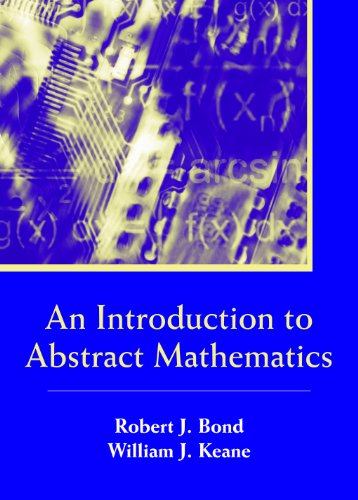
Ebook Info
- Published: 2007
- Number of pages: 323 pages
- Format: PDF
- File Size: 14.30 MB
- Authors: Robert J. Bond
Description
Bond and Keane explicate the elements of logical, mathematical argument to elucidate the meaning and importance of mathematical rigor. With definitions of concepts at their disposal, students learn the rules of logical inference, read and understand proofs of theorems, and write their own proofs—all while becoming familiar with the grammar of mathematics and its style. In addition, they will develop an appreciation of the different methods of proof (contradiction, induction), the value of a proof, and the beauty of an elegant argument. The authors emphasize that mathematics is an ongoing, vibrant discipline—its long, fascinating history continually intersects with territory still uncharted and questions still in need of answers. The authors’ extensive background in teaching mathematics shines through in this balanced, explicit, and engaging text, designed as a primer for higher-level mathematics courses. They elegantly demonstrate process and application and recognize the byproducts of both the achievements and the missteps of past thinkers. Chapters 1–5 introduce the fundamentals of abstract mathematics and chapters 6–8 apply the ideas and techniques, placing the earlier material in a real context. Readers’ interest is continually piqued by the use of clear explanations, practical examples, discussion and discovery exercises, and historical comments.
User’s Reviews
Reviews from Amazon users which were colected at the time this book was published on the website:
⭐I do think students would be better suited reading this book after going through the calc sequence, linear algebra, and possibly discrete mathematics. The authors broke down the material quite well, but I do wish more of the questions at the end of the chapter had solutions in the back of the book or a way to easily access the material online. I hope other readers have as much fun as I do when going through the material.
⭐Besides the mediocre review, I’ve so far have enjoyed the book in its simplistic nature. To be fair, the book attempts to explore a broad range of basic mathematics, yet the ease of the first four chapters almost castrates one from the theory to a redundant and over-simplistic examples. The difficult examples, it seems, get lightly touched on, but the easy ones seems to utilize a sledgehammer when needing a regular claw-hammer.It’s not a bad book, but feels seemingly useless until you get to Chapter 3. This may be an overstatement because my background has included taking Logic classes and Probability Calculus, but still, a little more background to the history behind the development of these ideas would have made for a better read.Would I buy this again? Sure, why not. It captures the essence of abstract mathematics to which seems completely unspoken of in the public education sector. This should be a high school book, not necessarily for Math majors. I say this not boldly, but out of the simple fact that the questions raised should be taught at a much earlier time in one’s youth. Really, set theory should be taught alongside Algebra 1, and the functions Algebra II. Everything after Chapter 4 could be construed for Undergrads, but for the ambitious high school kid, this book would do him much justice to his mathematical foundation. I would’ve enjoyed this over monotonous calculations..
⭐and had to rely on outside sources to get through the class. Seriously, my real analysis book is so much better (even though the class is so much harder). This book is a very dry read, and doesn’t make reading through the chapters and examples worth it. The easy stuff? Yeah they’ve got you covered. But as you progress through the book, you’ll find that the authors have left out quite a bit and don’t explain anything intuitively at all, especially Chapter 3, which “covers” functions (I’m acing real analysis right now, but I still don’t get what point of a function’s image, as opposed to its range, is… Are they the same thing? The book doesn’t answer that. Anyone who can, please reply). Chapters 4 and 5 are okay, and that’s where my course stopped. I’m keeping the book as a resource for more advanced math classes, but most likely I’ll just go find another book for that.
⭐This book is very easy to understand and has good examples and problems to help you understand logic and proofs. A great book for introduction into abstract math.
⭐Awful book. Maybe it’s ok for those with a strong math background, but for those of us that aren’t majoring in pure mathematics, this book is far too dense and vague to fully comprehend. The book assumes that the reader knows many theorems that aren’t even presented anywhere between the covers. Most of the theorems that are presented are “left as an exercise” for the reader.
⭐Very good examples, good foundation book for math. Very good at explaining proofs and rules. Would recommend to all students interested in math.
⭐This is a great book. I bought this for a class. Usually I sell my books when class is done. I am keeping this book as a reference for future math classes.
⭐Great book, great price and fast delivery.
Keywords
Free Download An Introduction to Abstract Mathematics 1st Edition in PDF format
An Introduction to Abstract Mathematics 1st Edition PDF Free Download
Download An Introduction to Abstract Mathematics 1st Edition 2007 PDF Free
An Introduction to Abstract Mathematics 1st Edition 2007 PDF Free Download
Download An Introduction to Abstract Mathematics 1st Edition PDF
Free Download Ebook An Introduction to Abstract Mathematics 1st Edition