

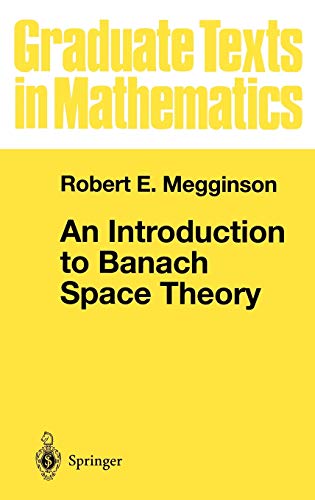
Ebook Info
- Published: 1998
- Number of pages: 618 pages
- Format: PDF
- File Size: 22.93 MB
- Authors: Robert E. Megginson
Description
Preparing students for further study of both the classical works and current research, this is an accessible text for students who have had a course in real and complex analysis and understand the basic properties of L p spaces. It is sprinkled liberally with examples, historical notes, citations, and original sources, and over 450 exercises provide practice in the use of the results developed in the text through supplementary examples and counterexamples.
User’s Reviews
Reviews from Amazon users which were colected at the time this book was published on the website:
⭐This is a text on the rudiments of Functional Analysis in the normed and Banach space setting. The case of Hilbert space is not emphasized.(Here are some examples of books on Hilbert space that I’ve found useful: Paul Halmos – Introduction to Hilbert Space and the Theory of Spectral Multiplicity, J.R. Retherford – Hilbert Space: Compact Operators and the Trace Theorem, and J. Weidmann – Linear Operators in Hilbert Spaces.)Other than that exception, this would make for a perfect textbook for use for, say, a two-semester Functional Analysis sequence for students who have had a graduate-level sequence in Real Variables (measure, integration, L^p-spaces) as from a textbook like Folland’s Real Analysis. (Professor Megginson says something to this effect in the preface.)The book consists of five (very long) chapters. I’ve studied Chapters 1 & 2, and the majority of Chapters 3 & 4, but I haven’t touched Chapter 5 (and so I cannot say anything about it). It’s EXTREMELY well-written. The exposition is sometimes a bit bloated (and sometimes too pedantic); in my opinion, the book could have been a bit shorter without loss of clarity. However, in light of its great value, I can easily overlook this. A VERY HELPFUL aspect of this book is that it’s extremely well documented. By this, I mean that it’s well-indexed, the bibliography and historical remarks are extensive; just about all of the important theorems include citations to their original sources. Also, I haven’t found any typographical errors yet!Professor Megginson doesn’t exasperate the reader by relegating important results to the exercises. The overwhelming majority of the exercises in this book simply provide examples/counterexamples (and LOTS of them) relevant to the theory presented in the corresponding sections. In the exercises, you’ll also find a few minor results. This is another aspect that makes this book ideal for self-study.Chapter 1 consists of the basics of bounded linear operators and functionals on normed and Banach spaces. There, you’ll find the Baire Category Theorem with “the big three” (Open Mapping/Closed Graph/Uniform Boundedness Theorems), as well as the Hahn-Banach Theorem, Dual spaces and Reflexivity, and the Quotient Space/Direct Sum constructions (along with some other topics). I found his approach to “the big three” to be extremely cool (for lack of a better word). Though he proves the classical Baire Category Theorem, he doesn’t use it directly to prove the big three (as almost all texts on this subject do), but he uses a “lemma” of Zabreiko (which uses a version of Baire Category); by using Zabreiko’s lemma, the proofs of the big three become easy (by anyone’s standard)!Chapter 2 consists of the weak topologies and weak compactness, although Professor Megginson takes a long route to their introduction. He first reviews the necessary ideas of topology, nets, and topological groups. Then, he gives the needed portions of the theory of (the more general) locally convex spaces (along with some digressions). The ground work culminates with Section 2.4 (Topologies Induced by Families of Functions) before the introduction of the weak and weak* topologies. As is seen in other texts, these topologies can be approached more directly, either through net convergence, or by giving a specific subbase which generates the topology; however, in my opinion, Megginson’s approach panoramically provides a view of these topologies from all angles.Chapter 3 consists of some further results about linear operators. Adjoint operators, projections, compact operators, and weakly compact operators are introduced. In this chapter, Banach algebras are briefly introduced for spectral considerations. Also, in the section on Compact Operators is a good exposition on the Fredholm-Riesz-Schauder theory.Chapter 4 consists of the relevant Basis theory. Though I enjoyed this, I more enjoyed the briefer coverage of these topics in Albiac and Kalton’s Topics in Banach Space Theory.Personally, I am an American graduate student in mathematics; I have studied at two different American math departments, both of which are well-known for Analysis. In my experience at both of these schools, a functional analysis sequence is rarely ever given; in fact, at my current department, a functional analysis sequence hasn’t been given in almost a decade! So, unfortunately for me, I’ve never had the chance to take a good functional analysis course. As I am researching topics in Measure Theory (Vector Measures) and Operator Theory (in the setting of Banach and function spaces), a good foundation in functional analysis was needed, and Professor Megginson’s book (through self-study) has been absolutely PERFECT for my needs! Of course, Functional Analysis is such a broad subject that different texts may sharply differ in their coverage. So, a different functional analysis text may better suit your needs. For instance, Rudin’s Functional Analysis text covers the rudiments in a generality that’s not as useful to me as Megginson’s coverage, but Rudin’s text covers Distributions, Fourier Transforms, and more (which would be useful for someone who wishes to study Harmonic Analysis or go into PDE’s). Another functional analysis text with an interesting set of topics (which I refer to from-time-to-time), and possibly worth mentioning, is Lawrence Baggett’s Functional Analysis; it was published with Marcel-Dekker, but is (now out-of-print and) available for free (in .pdf format) at the author’s website (just Google it).Conclusion: If you are of a similar disposition, I wouldn’t hesitate to get a copy of this beautiful book by Professor Megginson!One thing I should mention: I bought this book on Amazon, and my copy is basically a poor photocopy of the original printing (on thick laser paper). It seems that Amazon (you read me correctly) is actually printing these Springer books with print-on-demand equipment. As other reviewers have mentioned, you may find a high-quality original printing in your school’s library (as I’ve also found). So, basically, what you’ll get from Amazon is an officialized photocopy bootleg. Many other Springer texts that I’ve ordered from Amazon came the same way (and even some of them had missing pages)!Unfortunately, I fear that you’ll get the same poor quality even if you order directly from Springer. I ordered a couple of books directly from Springer a few months ago to avoid paying full price for crappy copies. Lo and behold: they were low-quality photocopies, too!
⭐The book is completely an introduction in every a aspcet about Banach Spaces. It contains a lot of exercises. There’s not better book than this one
⭐It is very clear and well organized. I find very pleasant reading it. The writing style is excelent. It helps me understand and learn the Banach spaces.
⭐Top hard cover is not tight.
⭐The printing quality totally ruined this beautifully-written book
⭐A friend recommended this book to me, because I need to understand nets better. The section on topology and nets is fantastic ! I then found the chapters on rotundity and smoothness, and their uniform versions. I also need to learn about these properties. They are explained very well indeed. Needing to understand the “basics” of Functional Analysis, I read the appendices on metric spaces and ell-p spaces, and now I am working through the first chapter, on the Baire Category Theorem, the Open Mapping Theorem, the Uniform Boundedness Principle, the Closed Graph Theorem, the Hahn-Banach theorems, and so on.The explanations are beautifully clear, yet concise. The ideas seem to flow very smoothly. Definitions and theorems which have baffled me for years are revealed to be very natural. I wish I had known of this book when it was first published nine years ago !My only, very minor, complaint is that the quality of the type in my copy seems lower than that of the type in the library’s copy. The older copy is easier on the eyes.
⭐The editorial and other reviews up to now are very good, and here I want to concentrate on some different aspects. Megginson of the University of Michigan tells the reader that he is preparing the reader for the papers of Lindenstrauss and others. Benyamini and Lindenstrauss have just published a book, via the American Mathematical Society (AMS), Geometric Nonlinear Functional Analysis (2000), which ties in with my work on logic-based probability (LBP) – see abstracts of my papers on the internet at the Institute for Logic of the University of Vienna. I have also described some aspects of functional analysis and semigroups in my other reviews at Amazon.com. Economists and mathematicians are not the only ones who can benefit from this book and the Benyamini-Lindenstrauss book. Anybody interested in speed, acceleration, volume, area, etc., will find the deepest level of analysis being currently explored by functional analysts in Banach Spaces. For the non-specialist, whom I am very interested in addressing, you could think of a Banach space as a space where the objects are speeds, accelerations, volumes, areas, etc., instead of points. One of the astonishing results is that very rare events, events which are contained in other events, boundary events, and lower dimensional events turn out to have critical importance on speeds, accelerations, volumes, areas, etc. The detective story of how this comes about requires knowing the literature on Banach Spaces, and since almost everybody has some contact with speeds, accelerations, volumes, areas, and so on, this means that the non-specialist should hire a consultant or tutor to either translate the material into approximately ordinary English or at least the level of elementary algebra and geometry or to explain the material step by step using a combination of mathematics and English ingenuity. Benyamini and Lindenstrauss, by the way, represent the rapidly oncoming Israeli school of mathematics, and it is interesting that the former British colonies or protectorates (USA, Australia, Canada, New Zealand, Israel)and Great Britain are carrying on much of the research in this area which really started with the speed-acceleration research of Sir Isaac Newton in Great Britain hundreds of years ago. As for the specialist in this area, this (Megginson) is an up to date compilation for graduate students in mathematics, but is also an excellent reference work for Banach Spaces including various integral and derivative spaces and counterexamples and the interesting topics of rotundity, smoothness, weak topology, and nets.
⭐A very recommended text for the study of functional analysis and Banach space
Keywords
Free Download An Introduction to Banach Space Theory (Graduate Texts in Mathematics, 183) 1998th Edition in PDF format
An Introduction to Banach Space Theory (Graduate Texts in Mathematics, 183) 1998th Edition PDF Free Download
Download An Introduction to Banach Space Theory (Graduate Texts in Mathematics, 183) 1998th Edition 1998 PDF Free
An Introduction to Banach Space Theory (Graduate Texts in Mathematics, 183) 1998th Edition 1998 PDF Free Download
Download An Introduction to Banach Space Theory (Graduate Texts in Mathematics, 183) 1998th Edition PDF
Free Download Ebook An Introduction to Banach Space Theory (Graduate Texts in Mathematics, 183) 1998th Edition