Ebook Info
- Published: 2006
- Number of pages:
- Format: PDF
- File Size: 8.38 MB
- Authors: Frances Kirwan
Description
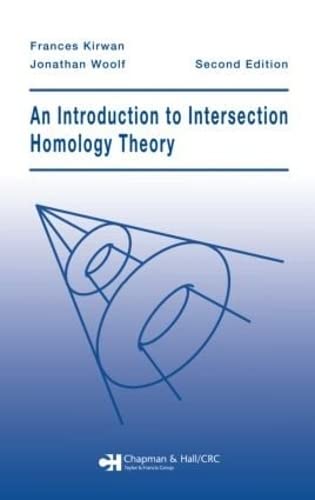
Now more that a quarter of a century old, intersection homology theory has proven to be a powerful tool in the study of the topology of singular spaces, with deep links to many other areas of mathematics, including combinatorics, differential equations, group representations, and number theory.Like its predecessor, An Introduction to Intersection Homology Theory, Second Edition introduces the power and beauty of intersection homology, explaining the main ideas and omitting, or merely sketching, the difficult proofs. It treats both the basics of the subject and a wide range of applications, providing lucid overviews of highly technical areas that make the subject accessible and prepare readers for more advanced work in the area. This second edition contains entirely new chapters introducing the theory of Witt spaces, perverse sheaves, and the combinatorial intersection cohomology of fans. Intersection homology is a large and growing subject that touches on many aspects of topology, geometry, and algebra. With its clear explanations of the main ideas, this book builds the confidence needed to tackle more specialist, technical texts and provides a framework within which to place them.
User’s Reviews
Reviews from Amazon users which were colected at the time this book was published on the website:
⭐This book is a very enjoyable survey of intersection (co)homology. It first introduces multiple (co)homology theories and states and/or proves the “de Rham” theorems for pairs of them. It then introduces “stratified spaces” and intersection (co)homology. There are lots of hands-on computations to look at, similar in flavor to the CW-complex problems from your algebraic topology class. There’s some abstract derived category stuff with a few pages on Verdier duality. It also discusses Deligne’s axiomatic characterization (within the derived category) of the intersection sheaf complex. There’s lots of other stuff in it that I haven’t read (despite the fact that it’s only 200 pages).HOWEVER, the number of typos is enormous. Most of them are obviously the fault of the publisher, not the authors (for instance, the letter ‘f’ replacing ‘…’ in a filtration). It’s really hard to read sometimes. Indices are screwed up or suppressed (which is pretty F%&*$ relevant when you’re trying to learn what a perverse sheaf is…). Maybe they fixed these in a later printing, but you’ve been warned.I actually wanted to give it 4 stars, but I felt that would reduce the impact of the typo complaint.Edit: I just noticed that my tag of “perverse sheaves” refuses to showup, even if I say “_perverse” or “-perverse” or whatever. What isthis, North Korea? There are objects in mathematics called “perversesheaves”. The name is bad for a few reasons, but that’s what they’recalled. People need to be able to search for it. Other books have this phrase in their titles. What’s the big deal? PERVERSE PERVERSE PERVERSE! You can buy pr0n on Amazon, so stop pretending.
⭐
⭐
⭐
Keywords
Free Download An Introduction to Intersection Homology Theory in PDF format
An Introduction to Intersection Homology Theory PDF Free Download
Download An Introduction to Intersection Homology Theory 2006 PDF Free
An Introduction to Intersection Homology Theory 2006 PDF Free Download
Download An Introduction to Intersection Homology Theory PDF
Free Download Ebook An Introduction to Intersection Homology Theory