

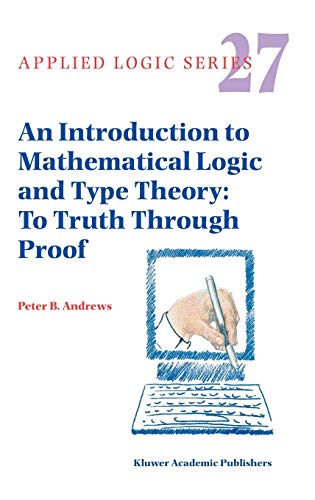
Ebook Info
- Published: 2002
- Number of pages: 408 pages
- Format: PDF
- File Size: 27.83 MB
- Authors: Peter B. Andrews
Description
In case you are considering to adopt this book for courses with over 50 students, please contact ties.nijssen@springer.com for more information. This introduction to mathematical logic starts with propositional calculus and first-order logic. Topics covered include syntax, semantics, soundness, completeness, independence, normal forms, vertical paths through negation normal formulas, compactness, Smullyan’s Unifying Principle, natural deduction, cut-elimination, semantic tableaux, Skolemization, Herbrand’s Theorem, unification, duality, interpolation, and definability. The last three chapters of the book provide an introduction to type theory (higher-order logic). It is shown how various mathematical concepts can be formalized in this very expressive formal language. This expressive notation facilitates proofs of the classical incompleteness and undecidability theorems which are very elegant and easy to understand. The discussion of semantics makes clear the important distinction between standard and nonstandard models which is so important in understanding puzzling phenomena such as the incompleteness theorems and Skolem’s Paradox about countable models of set theory.Some of the numerous exercises require giving formal proofs. A computer program called ETPS which is available from the web facilitates doing and checking such exercises.Audience: This volume will be of interest to mathematicians, computer scientists, and philosophers in universities, as well as to computer scientists in industry who wish to use higher-order logic for hardware and software specification and verification.
User’s Reviews
Reviews from Amazon users which were colected at the time this book was published on the website:
⭐I love this book. I have quite a few logic books and I have studied it for years.The question I wanted to investigate when I got this book was a very specialpurpose one: I wanted to read about what Kleene calls replacement theorems.This Andrews book has the best explained, best proved, most general replacementtheorems I have seen anywhere. I was so thrilled I went back and read a goodportion of the earlier part of the book. Andrews writes clearly and concisely.His presentation of logic is nicely ordered, economical and to the point.It is packed with a good and wide assortment of important theorems and concepts.The exercises do play an important role in extending the results of the textand are ordered in such a way that they often build naturally on their predecessors.However, I will say that the book is probably pitched at too high a mathematicallevel for a first or beginning course in logic and it gets increasingly soas the page numbers increase. For good beginner introductions to logic,I recommend The Logic Book by Bergmann, Moor, and Nelson (which is so repetitiveand wordy that beginners will have a hard time missing the point; and that isnot really a criticism — that book is not in its 5th Edition for nothing)and Ben-Ari’s Mathematical Logic For Computer Science 2nd Ed. (see my review).In any event, I find it useful to read multiple books on what is nominallythe same topic,especially for a topic that is as rich, subtle, and deep as logic– and where every author has a different take on it,and so I am very pleased to have found and be reading this Andrews book as itvery nicely extends, complements and reinforces my previous understanding of logic.
⭐The book itself for the most part is ok.Would not recommend it for beginner though since the way logic is presented through the book is very rigorous and thus unnecessarily complex is its wording.There are absolutely no solutions to any of the problems which means this book has no point of having been published since only the writer’s students may buy it and actually use it effectively.Since the author assumes many things and not all of the material presented within the book is conventional some example of usage would have cleared up the proofs and theorems but again this book is lacking this.In brief:- No solutions to a single problem and hardly any examples (if any).- Very wordy, horrible worded statements lead to misunderstandings.
⭐I took a great graduate course from Prof. Andrews, way back in the 1970’s, where his class lecture notes were titled “To Truth Through Proof”, so I assume that was a very very early draft of this book.If so, this must be a very good book, because his notes were wonderful even back then.
Keywords
Free Download An Introduction to Mathematical Logic and Type Theory: To Truth Through Proof (Applied Logic Series, 27) 2nd Edition in PDF format
An Introduction to Mathematical Logic and Type Theory: To Truth Through Proof (Applied Logic Series, 27) 2nd Edition PDF Free Download
Download An Introduction to Mathematical Logic and Type Theory: To Truth Through Proof (Applied Logic Series, 27) 2nd Edition 2002 PDF Free
An Introduction to Mathematical Logic and Type Theory: To Truth Through Proof (Applied Logic Series, 27) 2nd Edition 2002 PDF Free Download
Download An Introduction to Mathematical Logic and Type Theory: To Truth Through Proof (Applied Logic Series, 27) 2nd Edition PDF
Free Download Ebook An Introduction to Mathematical Logic and Type Theory: To Truth Through Proof (Applied Logic Series, 27) 2nd Edition