

Ebook Info
- Published: 1975
- Number of pages: 216 pages
- Format: PDF
- File Size: 8.84 MB
- Authors: R.P.M. Lehmann
Description
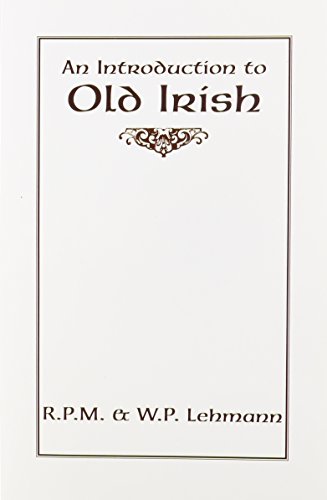
This handbook was produced with the aim of providing students with an introduction to Old Irish literature as well as to the language. One of the notable Old Irish stories is used as the basic text. Examples of poems, and of the glosses, supplement it. All are thoroughly annotated. The grammatical information provided in these annotations is summarized in grammatical sections dealing with specific constructions and forms. The first fifty of these sections are descriptive; many of the same matters are discussed in the second fifty section from a historical point of view. A final glossary includes references to all words occurring in the texts. The apparatus was accordingly designed to permit a relatively easy approach to a very difficult language.
User’s Reviews
Editorial Reviews: About the Author Ruth Preston Miller Lehmann was a professor at the University of Texas. Her works include Fled Duin na nGedn (1964). Early Irish Verse (1982), and Beowulf: An Imitative Translation (1988). Her last major publication was Blessed Bastard: A Novel of Sir Galahad (1997). Winfred P. Lehmann was an eminent linguist and professor at the University of Texas. His works include Proto-Indo-European Syntax (1974), Syntactic Typology (1981), Historical Linguistics (1992, 3rded.), Theoretical Bases of Indo-European Linguistics (1993), and Pre-Indo-European (2002).
Reviews from Amazon users which were colected at the time this book was published on the website:
⭐There is little to say which the other reviews havn’t covered but I will note a few opinions.I must respectfully disagree that this is a ‘bad’ course, especially on the note of jumping into OI texts asap in the course. Reading the literature of a language you are aspiring to learn is without doubt the greatest tool to learning the language — especially since vocabulary is obviously the main staple of any language, as well as seeing how words work together from the beginning.The main thing to note about this course however, is that it is heavy-duty study. It is not easy. OI is a complex language, and the course is in itself a daunting piece, of most value to people who are well-versed already in medieval and classical philology in general (if not even having already dabbled in Old Irish beforehand). This book is not for someone who has never studied in a similar field. I say this humbly — even for myself, in which I consider myself well-versed in such things, this was an intense book to follow. But I was able to learn from it, though I have not gotten through the entire book yet, and probably won’t until I come back to it at a later time, in which I plan on going through the ‘Sengoidelc’ course first. This latter book I have looked through yet not read myself fully yet, but even with that much knowledge, and by what many other people say, I would certainly recommend the Sengoidelc book for someone wishing to pick up Old Irish — and then pick up a handful of others, including Lehmann’s publication here, as supplementary material.For the fact of all the pieces of literature and poems easily accesable in this publication I would probably say it is a good book to have — and every piece is thoroughly annotated, and a great glossary is to be found as an appendix. These reasons alone are more than enough reason for an OI student to obtain this book. I have heard others say similar things: that the glossary appendix in itself makes this book a must-have.In conclusion, this is a good course — but, it is a difficult one. With the correct corresponding grammatical and philological knowledge, and persistence, they could certainly learn a consistent amount about OI from this book..
⭐A reader oriented approach to Old Irish. For those who want to begin reading modified segments of text from Lesson 1, this is the Introduction for you.
⭐As other reviewers note, Old Irish is not an easy language. I came to it after having studied a year of Greek, three of Latin, and two of Anglo-Saxon. But I’m not a linguist, and understanding what happens with Irish grammatically is tough to the novice. That said, this textbook helped this novice get in well enough to appreciate the course. Admittedly, the two semesters I have of Old Irish were with RPM Lehmann herself, and she added more to the course than just this book — occasional short medieval Irish poems, for instance.But I kept this book, and certainly use it when I want to refresh myself about the language. And the story used as working text is less complicated than others, but certainly not a boring one. That helped a lot.
⭐…and you have to walk before you run.I must disagree with the other reviewers. This is simply not an efficient introduction to Old Irish. For the student interested in grasping and retaining Old Irish for more than a few weeks, what have been called the virtues of Lehmann’s book are actually its chief faults.Each chapter presents a passage of actual text (the scela mucce meic datho, or Story of Mac Datho’s Pig), an analysis of the text, and then a section of grammar.There are no simple texts in Old Irish. That you begin reading an actual Old Irish text before you even begin to learn the grammar, though it certainly feels good, is not necessarily conducive to good language learning. Fairly quickly, even a diligent student of Lehmann will find him/herself lost in the labyrinth of OI grammar and vocabulary, with a half-remembered story and a mess of morphology teeming under a layer of false confidence.O.I. grammar is as hard as Indo-European grammar comes, and the pronunciation is impossible to master (since no one agrees how it was pronounced!). Lehmann tries to skirt these problems, the pronunciation by offering a kind of modified I.P.A. transliteration of the texts, which he doesn’t define beforehand and which may be harder than the Irish to interpret. As to the grammar, he defines every word in the passage in a dizzying exegesis. This becomes tedious. The 7-line text in Chapter One and its two pages of description are enough to show that too much is going on in the language to grasp without extensive study of the grammar and at least a little training in vocabulary. You simply can’t remember a text whose grammar you don’t understand.The grammatical sections that follow the text illuminate few or none of the questions that arise from the reading passage. Chapter one drops masculine and neuter o-stem nouns on the reader in a lump, along with a strong verb (berid), with no description of what’s going on. Why is the nominative of son ‘mac,’ and the genitive ‘mic?’ What else declines like ‘mac’? What words in the passage are o-stems? How do I USE these paradigms? No answers are given, not even in the glossary. Lehmann leaves the reader to guess, blindly memorize, and move on to another difficult passage of text. This process continues for 20 chapters until, at length, little about Old Irish has been communicated by the author, even less digested by the reader.I offer an alternative. No good introduction to Old Irish has yet been written. But there are three cheap and available books that together form a superior course: E.G.Quin’s “Old-Irish Workbook,” Strachan’s “Old-Irish Paradigms,” and Green’s “Old Irish Verbs and Vocabulary.” Quin’s book gives 40 lessons on grammar with progressively harder translation excersizes. It refers you throughout to Strachan’s book for full paradigms and explains them thoroughly. Finally, Green’s vocabulary answers all the lexical questions you will encounter in the course. Taken at a properly slow pace, these three books will prepare the reader to actually understand Old Irish texts without many crutches (such as Lehmann leans on everywhere). Maybe after reading these books, you might try to tackle Lehmann’s “Introduction” as a text of “The Story of Mac Datho’s Pig.” But keep your Quin, Strachan, and Green close, you will still need them!It is said that one never learns Old Irish just once. With Lehmann, you may not even get that ‘once.’ But with the alternative course, you may just save yourself a few refresher courses down the line.
⭐I can speak Modern Irish so I thought I’d have a look at where it all began. I thought it would be more approachable, the book is difficult to come to grips with-I figure its trying to teach one to speak and pronounce at the same time. It would benefit me to have a lecturer or a teacher of some sort. Teach yourself it isn’t. Still, I have learned some things about pronunciation and I will persevere.
Keywords
Free Download An Introduction to Old Irish (Introductions to Older Languages) in PDF format
An Introduction to Old Irish (Introductions to Older Languages) PDF Free Download
Download An Introduction to Old Irish (Introductions to Older Languages) 1975 PDF Free
An Introduction to Old Irish (Introductions to Older Languages) 1975 PDF Free Download
Download An Introduction to Old Irish (Introductions to Older Languages) PDF
Free Download Ebook An Introduction to Old Irish (Introductions to Older Languages)